What is SAP? A Plain-English Guide for Beginners and Experts
What is SAP?
A plain-English guide — for the curious beginner and the busy expert.
If you work at a large company, you have heard SAP mentioned in a meeting. Someone from HR told you to log your leave in SAP. Finance said an invoice is stuck in SAP. IT announced a big SAP migration for next year.
Everyone nods. No one asks what it actually means.
Let’s fix that.
The One-Line Answer
SAP is software that helps large organisations run their entire business from one place.
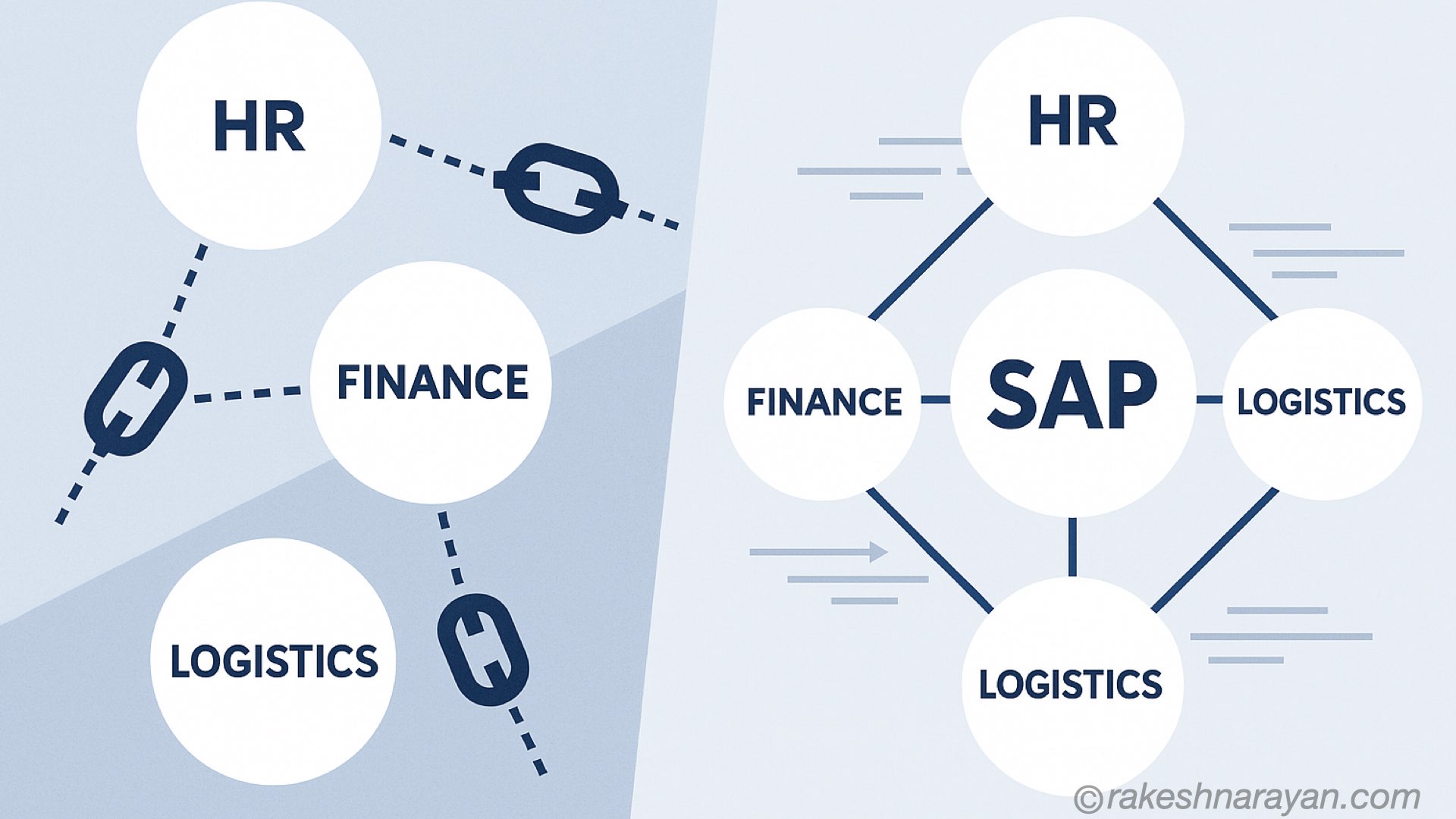
Finance. HR. Procurement. Manufacturing. Sales. Logistics. All connected. All sharing the same data. In real time.
Without something like SAP, a 10,000-person company might run 15 different systems that don’t talk to each other — spreadsheets flying around, data mismatched, decisions made on yesterday’s numbers. SAP replaces that chaos with one integrated platform.
A Little History
| Attributes | Details |
|---|---|
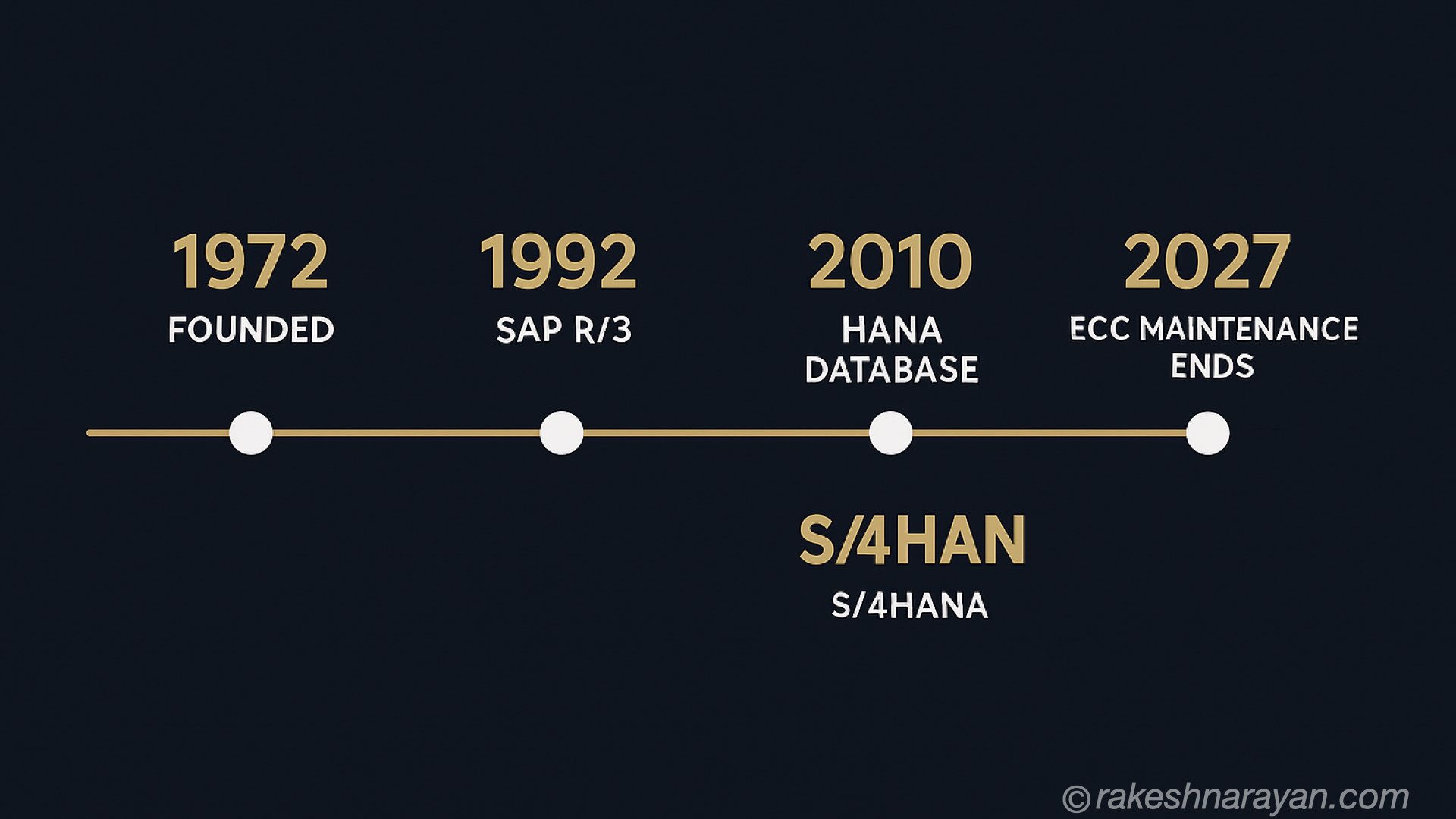
| Founded | 1972 |
| Where | Walldorf, Germany |
| By whom | Five engineers who left IBM with a better idea |
| That idea | Process business transactions in real time — not overnight batches |
| Full name | Systemanalyse und Programmentwicklung (System Analysis and Program Development) |
| Today | 400,000+ organisations in 180 countries |
What Does SAP Actually Do?
The clearest way to understand SAP is to follow a single business transaction.
Follow the Order
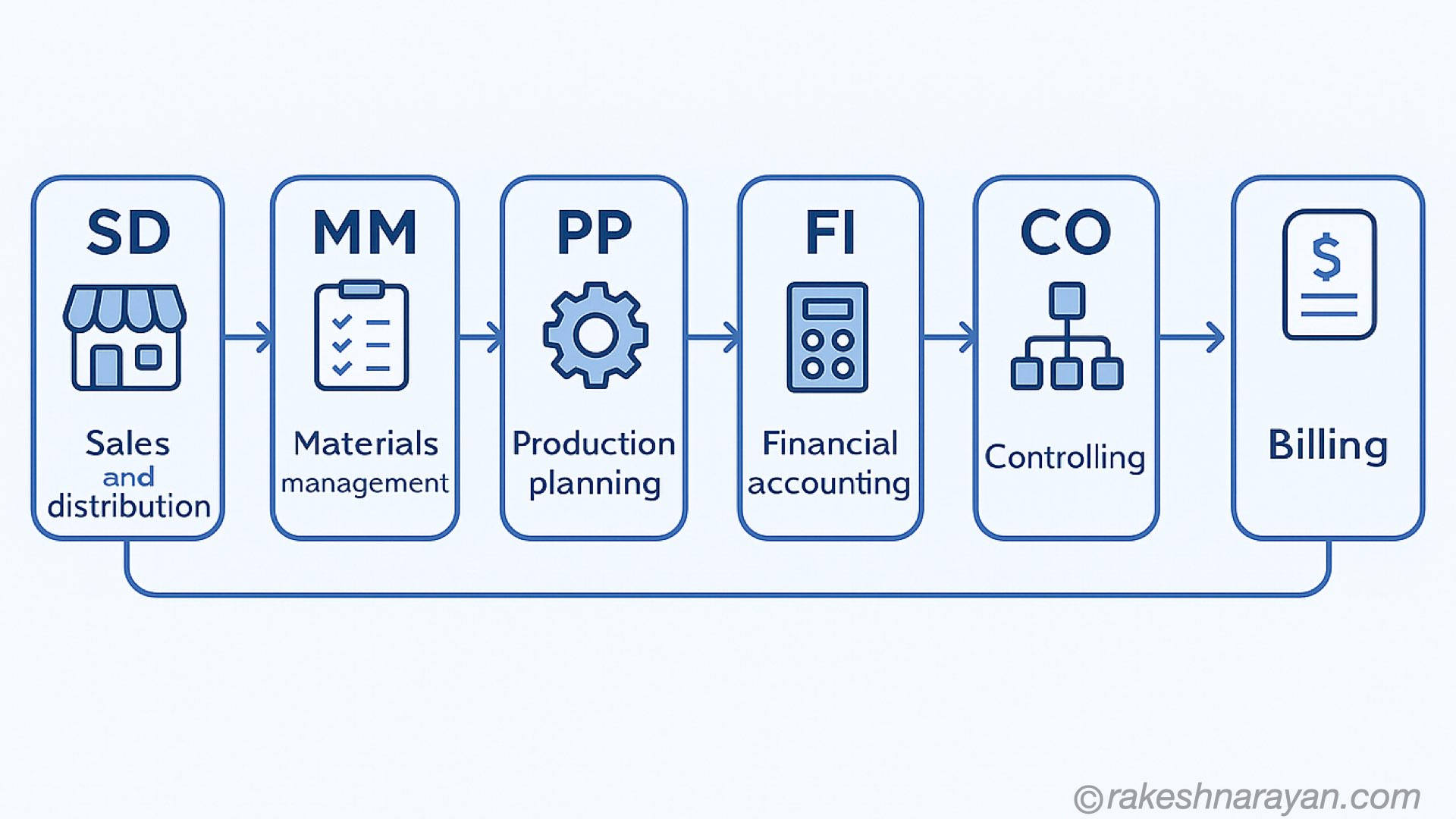
A customer orders 100 units of a product. Here is what SAP does behind the scenes:
| # | Module | Full Name | What Happens |
|---|---|---|---|
| 1 | SD | Sales & Distribution | Order captured, pricing applied, credit checked |
| 2 | MM | Materials Management | Inventory checked — stock reserved or PO raised |
| 3 | PP | Production Planning | If items need manufacturing, production order created |
| 4 | FI | Financial Accounting | Revenue recognised, accounts receivable updated |
| 5 | CO | Controlling | Costs tracked, profitability updated |
| 6 | LE | Logistics Execution | Delivery scheduled, goods shipped |
| 7 | — | Billing | Invoice generated and sent to customer |
The key point: Every step updates the same database. Finance sees the order the moment it is placed. The warehouse sees the delivery requirement without anyone sending an email. Nothing falls through the cracks.
SAP Is Not Just One Product
When someone says ‘we use SAP,’ they could mean several different things. Here is what matters:
SAP ECC — The Classic System
The on-premise SAP that most large companies have run for 20+ years. Robust. Battle-tested. Still powering thousands of organisations worldwide. The catch: SAP mainstream maintenance ends in 2027. Companies are under real pressure to migrate.
SAP S/4HANA — The New Generation
Built on SAP’s in-memory HANA database. Faster. Cleaner data model. Modern Fiori interface. Real-time analytics baked in. This is where every SAP customer is — or should be — heading.
ECC vs S/4HANA in plain English: ECC is a reliable old car that still works. S/4HANA is the electric version — same destination, smoother ride, built for what’s ahead.
SAP BTP — The Connecting Layer
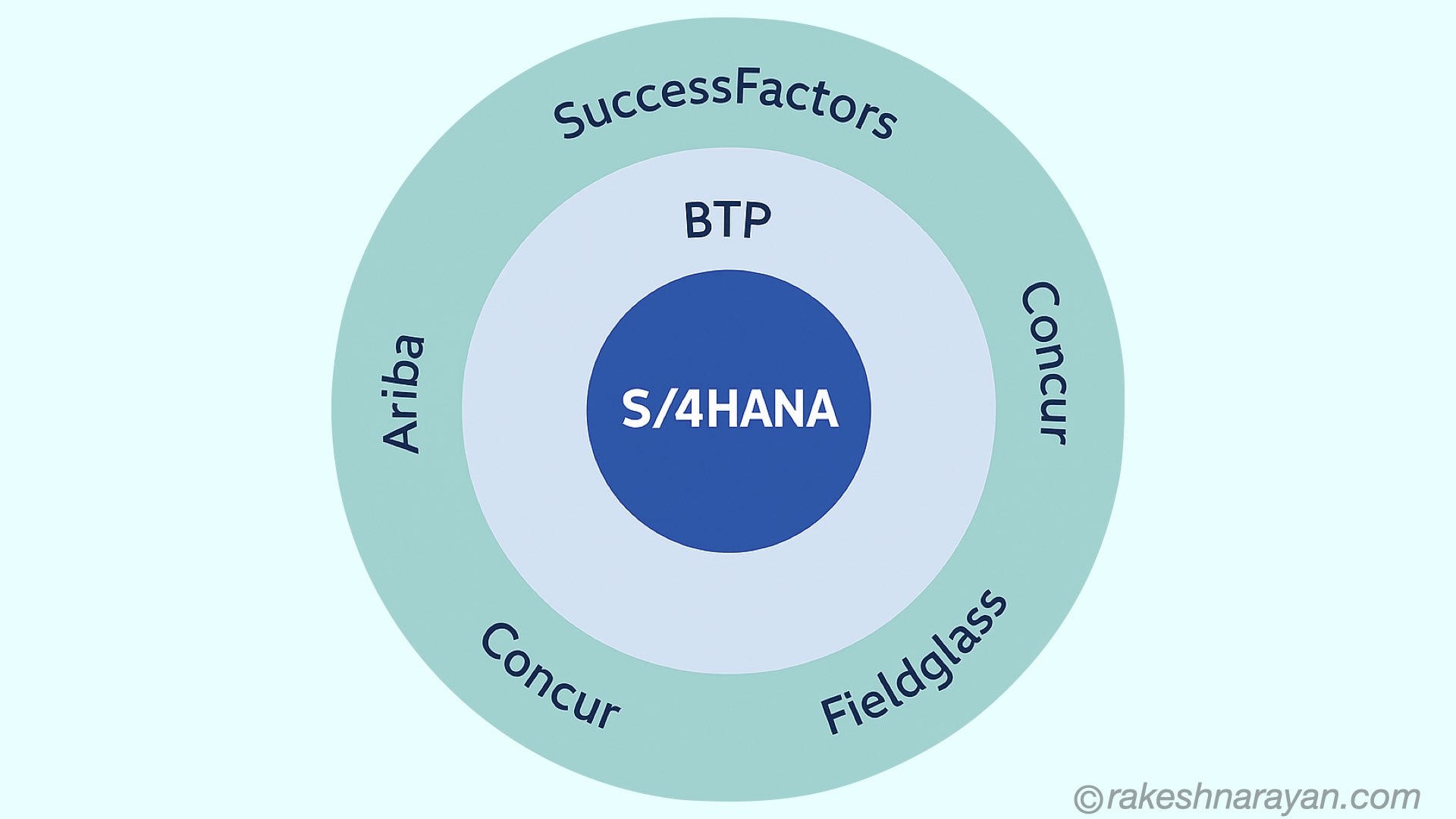
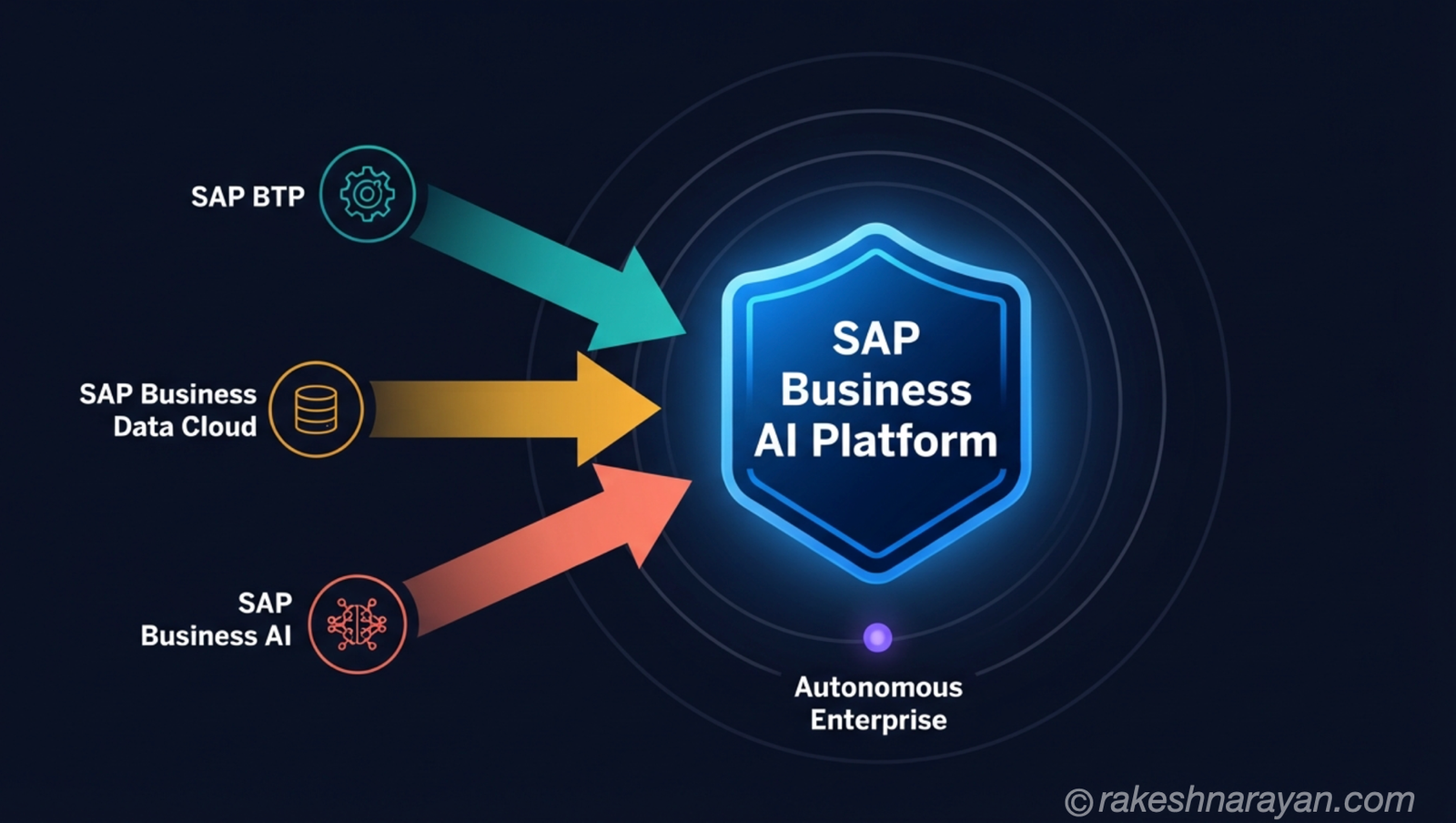
SAP BTP — Business Technology Platform. The cloud platform where you build integrations, extend SAP functionality, and plug in AI. Think of BTP as the bridge between SAP and everything else — other SAP products, third-party apps, your own custom tools.
The Cloud Applications
| Product | What It Does |
|---|---|
| SAP SuccessFactors | Cloud HR — hiring, payroll, performance, learning |
| SAP Ariba | Procurement and supplier collaboration |
| SAP Concur | Travel and expense management |
| SAP Fieldglass | External workforce and contractor management |
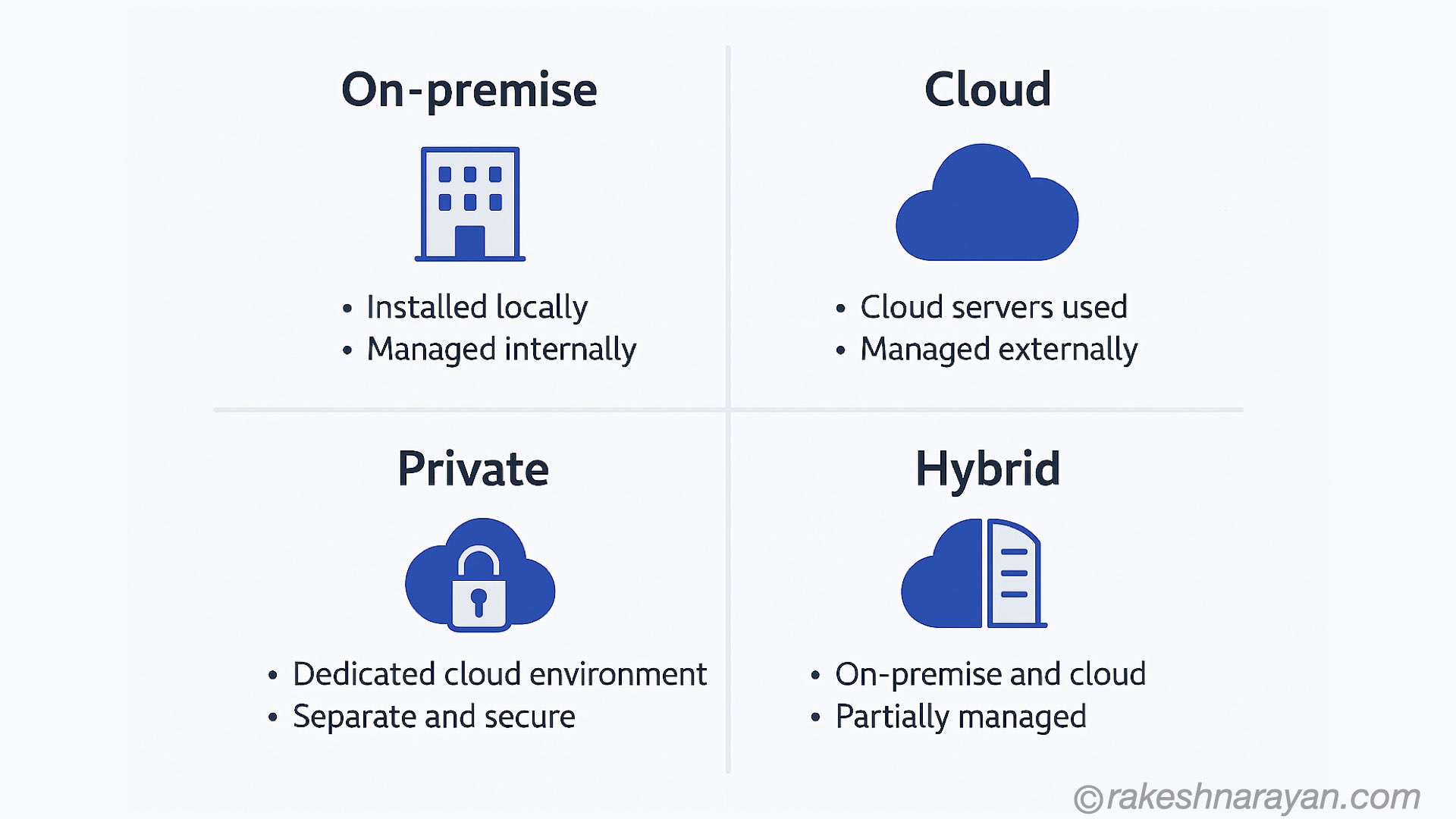
On-Premise, Cloud, or Hybrid?
This question comes up in every SAP conversation. Here is how to think about it:
| Deployment | Who Manages It | Best For |
|---|---|---|
| On-Premise | Your company | Full control; highly customised environments |
| Public Cloud | SAP | Faster setup; lower maintenance; less customisation |
| Private Cloud | Managed third party | Dedicated environment with less IT burden |
| Hybrid | Both | Most large companies today — mix of both worlds |
The industry is clearly moving to cloud. SAP’s own product roadmap reflects this — most new features land in S/4HANA Cloud first.
Who Uses SAP?
SAP is almost exclusively for medium-to-large organisations. It is powerful, but expensive to implement and run. You will find it in:
- Manufacturing & Automotive — BMW, Siemens, Bosch
- Consumer Goods & Retail — Nestlé, Unilever, IKEA
- Banking & Financial Services
- Pharma & Healthcare
- Oil, Gas & Energy
- Government & Public Sector
- Utilities & Telecoms
Smaller companies typically use lighter alternatives — Microsoft Dynamics, Oracle NetSuite, or industry-specific tools.
Why Is SAP So Complicated?
Two words: flexibility and integration.
SAP can be configured to match almost any business process in almost any industry. That is incredibly powerful — but it also means every SAP system is different. Thousands of configuration choices, years of customisations, business rules built in over decades.
And because everything is connected, a change in one place ripples everywhere. An incorrect goods receipt in MM affects inventory, which affects production planning, which flows into the financial statements.
💡 Simple analogy: SAP is like the plumbing of a building. When it works, nobody notices it. When something goes wrong, it affects every floor.
This is why SAP consultants exist. And why SAP projects tend to be large, long, and expensive.
Quick Reference — Key Terms
| Term | What It Actually Means |
|---|---|
| SAP ECC | The classic SAP — widely used, being retired in 2027 |
| SAP S/4HANA | The modern SAP — faster, cloud-ready, the future |
| SAP BTP | The integration and cloud extension platform |
| HANA | SAP’s in-memory database — the engine under S/4HANA |
| Fiori | SAP’s modern, browser-based user interface |
| Module | A functional area: FI = Finance, MM = Procurement, SD = Sales… |
| Go-Live | The moment SAP switches on in production — the finish line |
| Basis | The SAP technical team managing infrastructure and system health |
| Transport | Moving a configuration change from development to production |
| Client | A separate data environment within one SAP system |
| IMG | Implementation Guide — where all SAP configuration lives |
What Is ‘Going Live’?
You will hear this phrase constantly in SAP projects. Going live is when a company switches from their old system — or from SAP ECC — to their new SAP environment. It is the moment all those months of project work become real.
Data is migrated. Users log in for the first time. Transactions start flowing through the new system.
Done well, it feels anticlimactic. That is the goal.
From a Consultant’s Desk — 15 Years In
What I find most interesting about SAP is not the technology. It is what implementing SAP forces a company to confront about itself.
You cannot say ‘that is just how we have always done it.’ SAP demands that you define your processes clearly. Standardise where you can. Make explicit decisions about how your business actually works.
Every SAP project is really two projects running in parallel: a technology project and an organisational one. The technology is the easier part.
Done well, it transforms how a company operates. Done poorly, it is expensive and painful. The difference usually comes down to how seriously leadership takes the organisational side.
The 60-Second Summary
- SAP is enterprise software that connects all business functions into one system
- Founded in Germany in 1972; now used by 400,000+ organisations worldwide
- The classic system (ECC) is being replaced by the modern one (S/4HANA)
- BTP is the cloud platform that connects and extends SAP
- It is complex because it is flexible and deeply integrated — not poorly designed
- Every SAP implementation is unique, and each one changes the company as much as the technology
🔗 Related posts on this site
What is ERP? — the broader ERP context: what enterprise resource planning is and how SAP fits into it.
SAP S/4HANA — What It Is and How It Works — what changed from ECC, how HANA and the Universal Journal work, and the deployment options.
SAP BTP — The Platform Explained — the integration and extension platform: why every SAP customer needs to understand it.
SAP Basis Explained — The Technical Layer Under Every SAP System — the technical foundation every SAP system, on-premise or cloud, actually runs on.
SAP Modules Explained — FI, CO, MM, SD and the Rest — what SAP actually does day to day: the functional modules behind finance, procurement and sales.
This is part of an ongoing series on SAP fundamentals. Next up: SAP BTP — The Platform Explained — what it is, why it matters, and why every SAP customer needs to understand it.
Did you enjoy this article?
Let me know — it takes one click.
0 Comments
Leave a Comment
Looks like this one held your attention — I'd really appreciate a quick comment below.
Your comment has been submitted and will appear after review.