SAP Architecture Decisions — Stakeholder Sign-Off
The sponsor nodded through the whole steering committee. Custom BAdI for the exception process, they said, sounds fine. Three months later, at the next steering committee, the same sponsor asks why the team built something custom when SAP has a standard process for this. Nobody in the room reminds them they approved it themselves, because reminding a sponsor they forgot their own decision is not a career-enhancing move.
This is not the sponsor being difficult. It is the predictable result of a nod being mistaken for approval. A nod means the sponsor did not object in the room. It does not mean they understood what they were agreeing to, what it costs, or what they gave up by choosing it.
Real sign-off is different from a nod, and the difference is not about being more persuasive. It is about translating a technical decision into terms the sponsor actually owns, so that what they approve is something they could explain to someone else afterward, not something they agreed to because objecting felt awkward.
🔗 Before this post — This closes the loop with SAP Blueprinting — Fit-Gap to Design Freeze, where a decision gets frozen in a gap register, and connects to S/4HANA Architecture Decisions Every Solution Architect Needs for the kinds of decisions this post is about presenting.
Why technical sign-off and real sign-off aren’t the same thing
A sponsor who nods in a steering committee has given you technical sign-off. It gets recorded in the minutes, it lets the project move forward, and it means almost nothing if the sponsor could not restate the decision in their own words five minutes after the meeting ends.
Real sign-off means the sponsor understood the trade-off well enough to defend it later, to someone who was not in the room. That is the actual test — not whether they said yes, but whether they could explain why the answer was yes if a peer or their own boss asked them about it next quarter.
📌 Key takeaway
Most architecture decisions get presented in the language the architect thinks in — standard versus custom, configuration versus enhancement. A sponsor sitting through that presentation nods because objecting to something they do not fully follow feels riskier than agreeing to it. That is not sign-off. That is a sponsor protecting their own credibility in the room.
Translate the decision into what the sponsor actually owns
The fix is not simplifying the technical explanation. It is changing what the decision is framed in terms of. A sponsor does not own the choice between standard and custom. They own cost, risk, and how long it takes before the business sees value. Frame the decision in those three terms, and the sponsor is evaluating something that is actually theirs to evaluate.
Cost is not just the build estimate. It includes what happens to that cost every year the system is in production, because a custom object someone has to maintain for a decade costs more than its initial build price suggests. Risk is not a vague word — it is specific: what happens if this breaks, who notices first, and how hard is it to fix under pressure. Time to value is how long before the business actually benefits from this decision being made one way instead of the other.
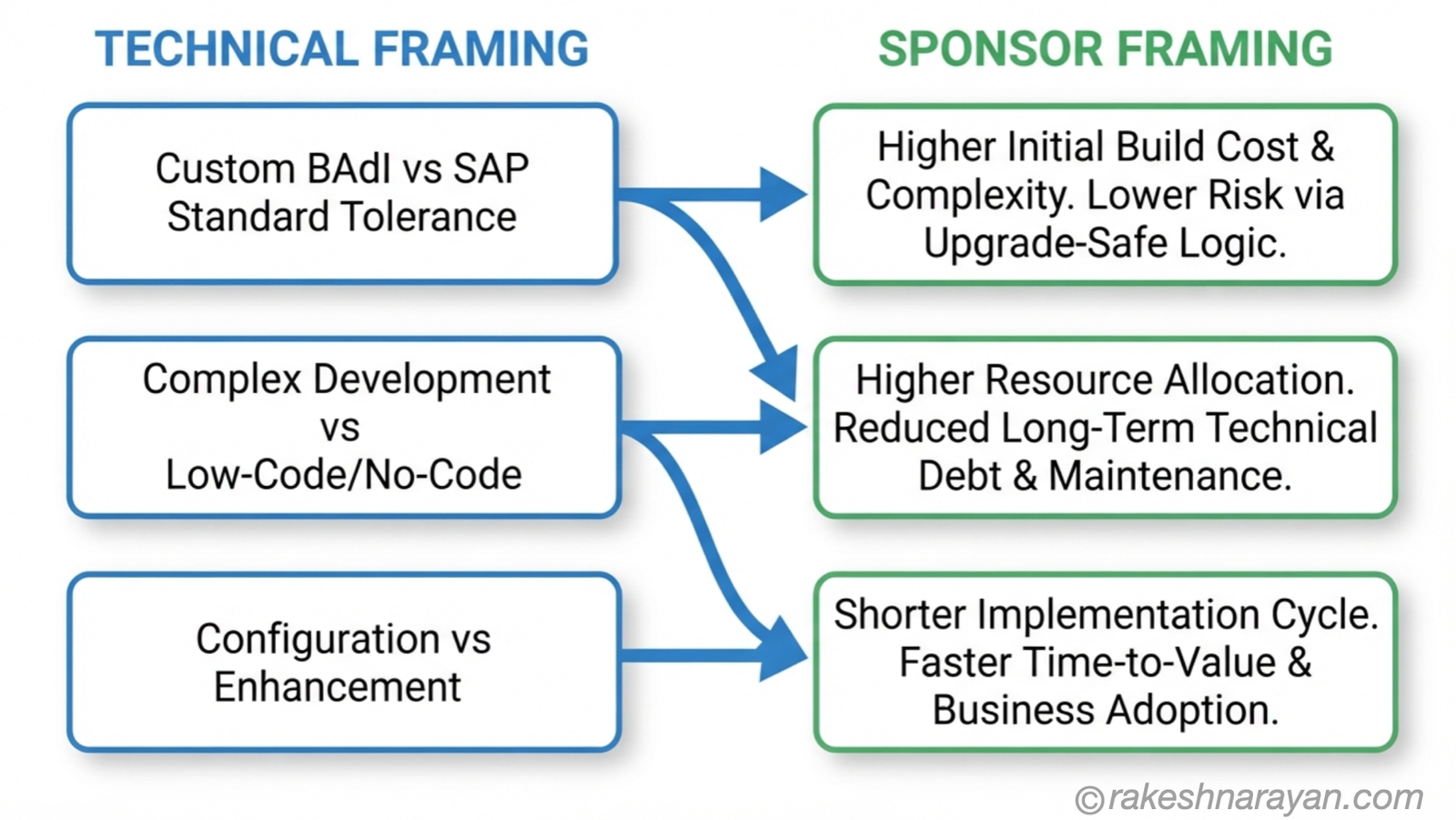
A worked example — custom BAdI vs. SAP standard
Take the same decision from the fit-gap post: a purchase order exception process, custom BAdI on one side, SAP standard tolerance settings on the other. Presented technically, the choice sounds like an implementation detail. Presented in sponsor terms, it looks different.
💡 Practical tip — Weigh maintenance cost against process gap, not code against configuration
The custom BAdI costs more to build and more to maintain every year afterward, but gives finance the exact audit trail they need without any workaround. SAP standard costs less up front and less to maintain, but finance or supply chain has to accept a slightly less granular process. Framed that way, the sponsor is weighing an ongoing maintenance cost against an ongoing process gap — a trade-off any sponsor is equipped to make.
One page, one decision
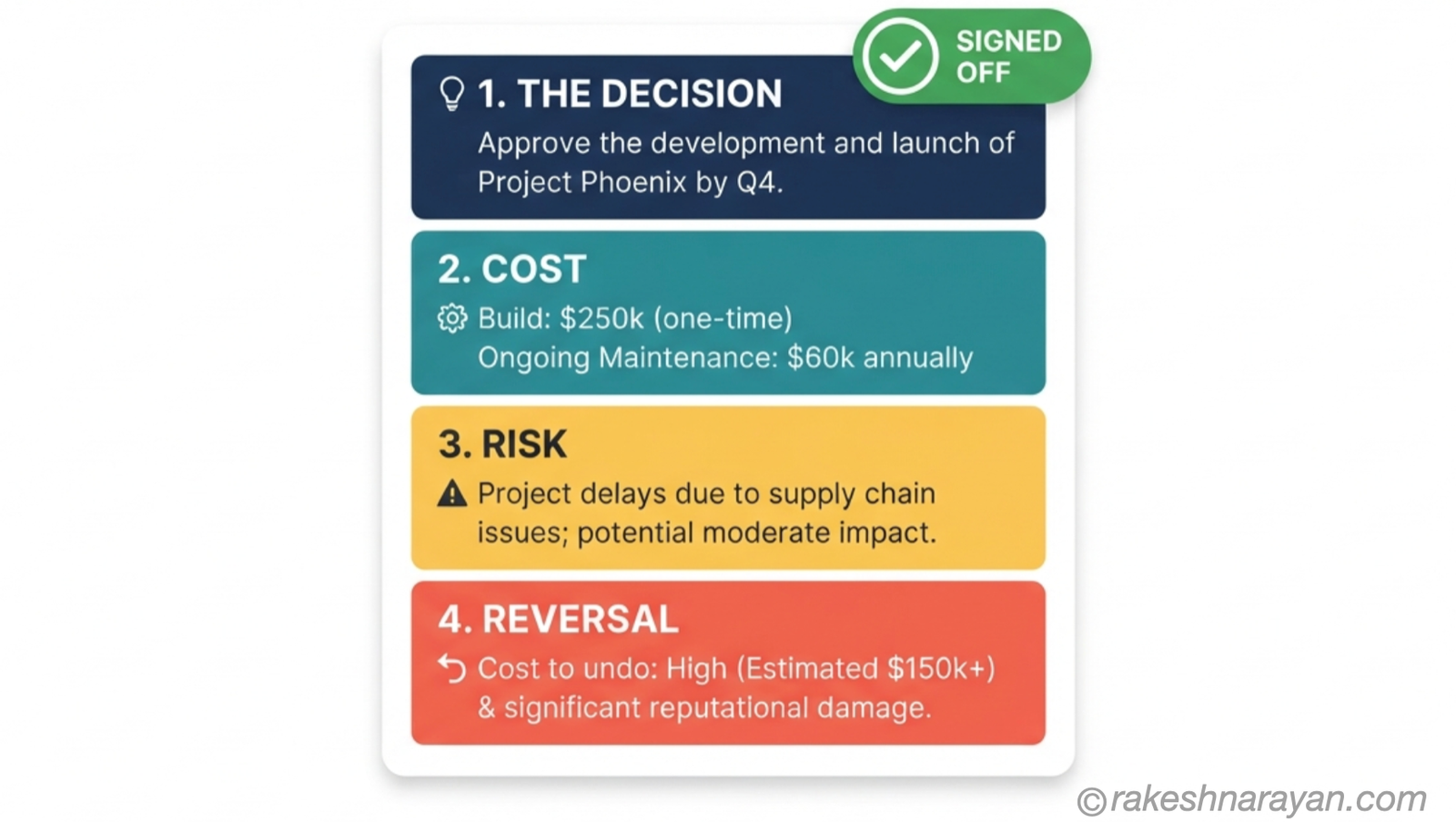
Every decision that needs sponsor sign-off should exist as one page, and that page should cover exactly one decision. A twelve-slide deck walking through the full architecture rationale gets skimmed, not read, and skimmed decisions get approved on vibe rather than understanding.
| Section | What it contains |
|---|---|
| The decision | One sentence anyone could read without context |
| Cost | Build effort and ongoing maintenance, not just the initial estimate |
| Risk | Stated plainly — what breaks, who notices, how hard it is to fix |
| Reversal | What it costs to undo this later, and how easily it can be changed |
Leave the implementation detail off the page entirely. The sponsor does not need to know how the BAdI is coded any more than they need to know how the standard tolerance table is structured. Every additional technical detail on the page is a place their attention drifts away from the decision itself.
Getting a sign-off that actually holds
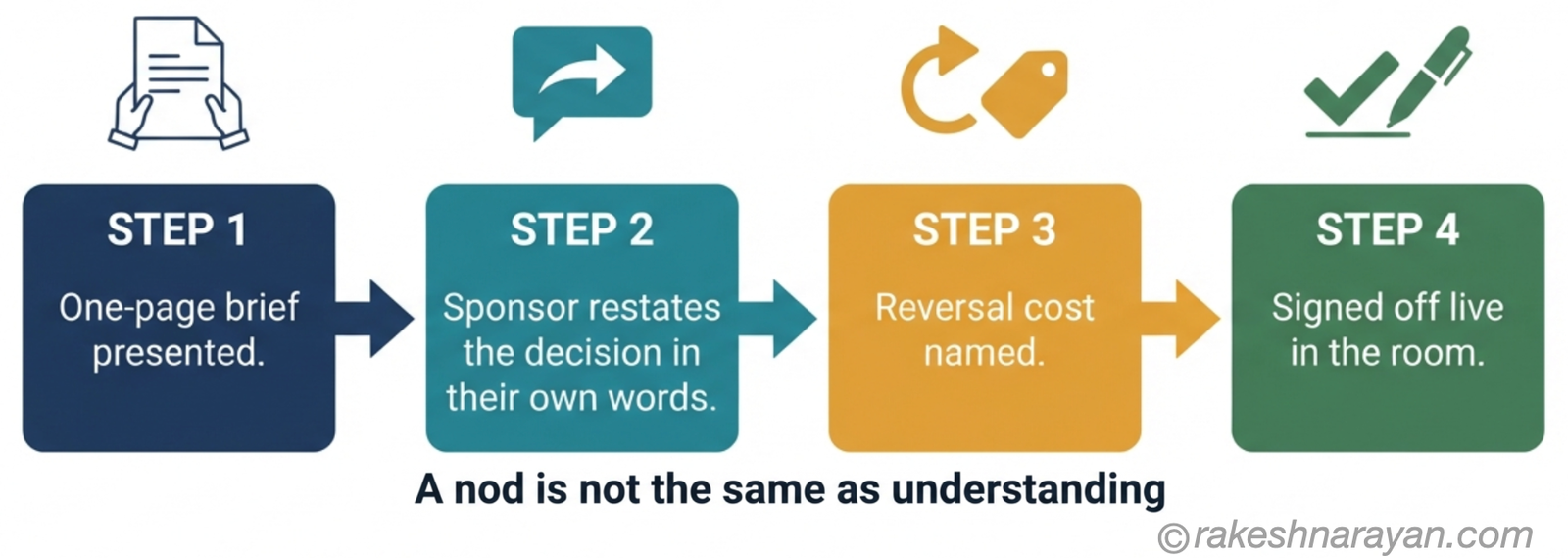
The same discipline that makes a decision log or a gap register hold up applies here. Read the decision back to the sponsor in their own terms before asking for approval, not after. Ask them to restate what they are agreeing to, in their own words, rather than asking whether they have any questions — a room with no questions is not the same as a room that understood.
⚠️ Warning — Name the reversal cost, or expect the decision to drift
Name explicitly what happens if the decision needs to be revisited later. Who has to raise it, what would justify reopening it, and what it costs to reverse. A sponsor who understands the reversal cost up front is far less likely to casually relitigate the decision three months later, because they already know what reopening it actually means.
✅ Best practice — Sign off live, not by silence on an email
Get the sign-off in the room, the same way a gap register entry gets signed in the room rather than assumed from a follow-up email. A sponsor who signs off in a live conversation, having restated the decision back to you, is a sponsor who remembers making the decision. A sponsor who received a deck by email and never replied is not.
When the sponsor pushes back
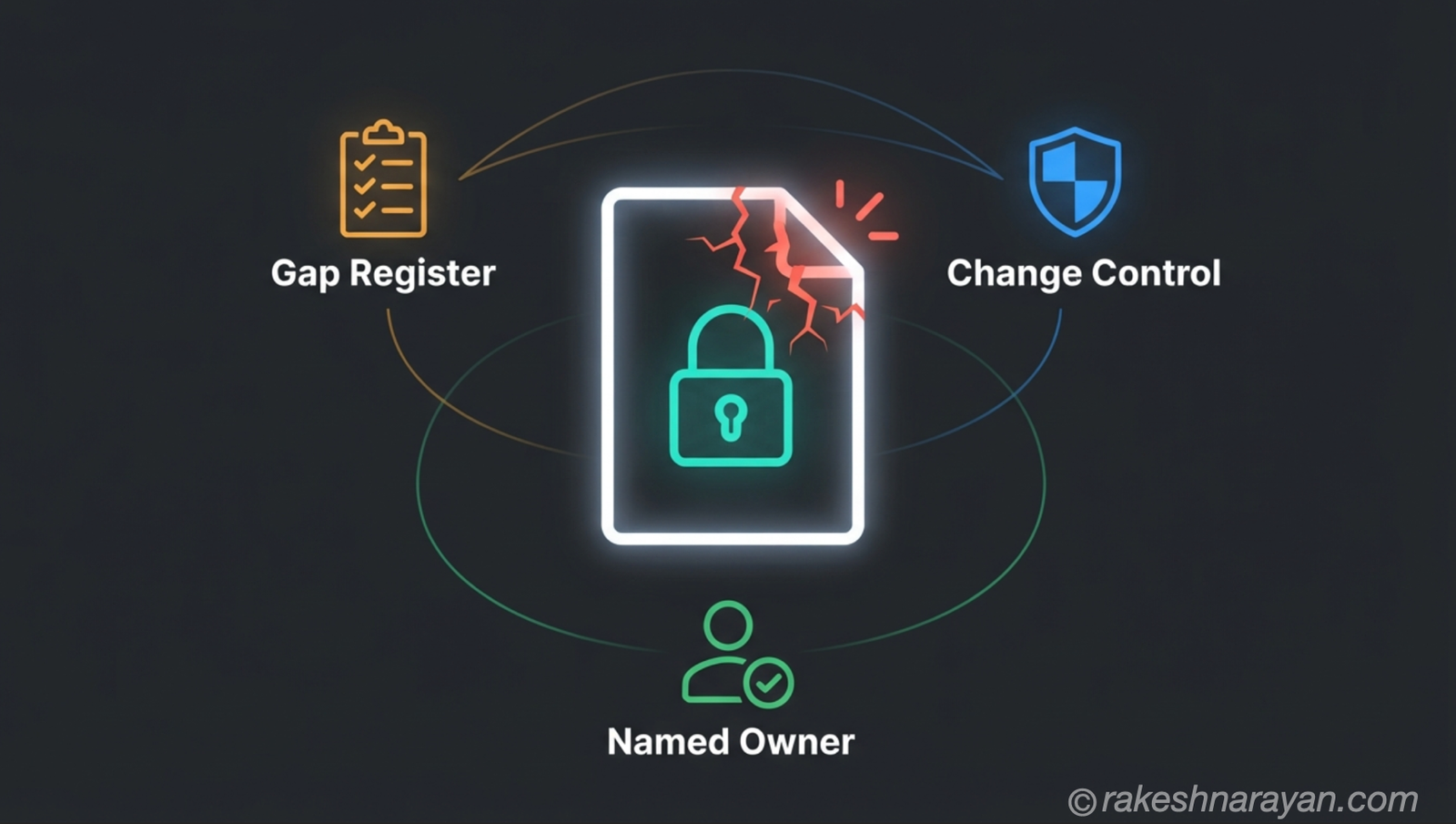
Pushback after sign-off falls into two categories, and treating them the same way is a mistake. The first is genuine new information — something has changed since the decision was made, a cost assumption turned out to be wrong, a regulatory requirement shifted. That deserves a real reopening, through the same change control discipline that protects a frozen design.
📝 Note — Most pushback is forgetting, not disagreement
The second category is the sponsor simply not remembering the trade-off they approved, because the original sign-off was a nod rather than real understanding. This is not a reason to relitigate the decision from scratch. It is a reason to walk back through the same one-page brief, in the same terms, and remind them what they weighed and why.
At a glance — decisions that hold at sign-off
| Concept | One-line summary |
|---|---|
| Technical sign-off | A nod in the room — recorded, but not proof of understanding |
| Real sign-off | The sponsor could defend the decision to someone who was not in the room |
| Sponsor terms | Cost, risk and time to value — not standard versus custom |
| One-page brief | One decision, four sections — decision, cost, risk, reversal |
| Read-back | Sponsor restates the decision before approval, not after |
| Reversal cost | Named up front so pushback later is informed, not casual |
| Pushback triage | Genuine new information gets reopened; forgetting gets re-explained |
What to take away
Sign-off is not a signature. It is a transfer of understanding from the architect to the sponsor, solid enough that the sponsor could defend the decision to someone else without you in the room.
Frame every decision in terms the sponsor actually owns — cost, risk, time to value — not in the technical terms the architect thinks in. Put it on one page, covering one decision, with the reversal cost stated plainly. Read it back before asking for approval, and get the sign-off live, not by silence on an email.
The architects whose decisions survive a steering committee are not the ones with the most persuasive slides. They are the ones who made sure the sponsor actually owned the decision, not just the meeting where it got approved.
🔗 Related posts on this site
SAP Blueprinting — Fit-Gap to Design Freeze — where the decisions this post presents for sign-off get frozen in a gap register.
SAP Fit-Gap Analysis — When Business, IT and Finance Disagree — the facilitation skill behind the trade-offs this post teaches you to present.
Running SAP Discovery Workshops That Produce Decisions — the decision-log discipline this post’s read-back practice builds on.
S/4HANA Architecture Decisions Every Solution Architect Needs — the kinds of decisions this post is about getting signed off.
Published on rakeshnarayan.com — Articles
URL: https://rakeshnarayan.com/articles/sap-architecture-decisions-stakeholder-sign-off/
Did you enjoy this article?
Let me know — it takes one click.
0 Comments
Leave a Comment
Looks like this one held your attention — I'd really appreciate a quick comment below.
Your comment has been submitted and will appear after review.