SAP S/4HANA vs ECC — The Real Difference
If you work anywhere near SAP, you have been hearing about S/4HANA for years. Every SAP event, every roadmap presentation, every customer conversation has it somewhere on the agenda.
But a lot of the comparison material out there reads like a product brochure. Faster. Simpler. AI-ready. Cloud-native. None of that tells you what actually changed and why it matters for the work you do every day.
I have spent 15 years working with SAP systems — ECC for most of that, S/4HANA for a significant part. This post explains the real differences — the ones that change how you design, configure and use the system.
🔗 New to SAP? Start here first
This post assumes you have a basic understanding of what SAP is. If you are new to SAP, read What is SAP? and What is ERP? first — they give you the foundation this post builds on.
First — what is ECC?
SAP ECC stands for ERP Central Component. It is the on-premise SAP ERP system that most large organisations have been running for the past two to three decades. It sits on top of a traditional relational database — Oracle, SQL Server, IBM DB2 or SAP’s own MaxDB — and uses a classic SAP GUI or, in later versions, Fiori on top.
SAP announced in 2020 that mainstream maintenance for ECC ends in 2027, with extended maintenance available until 2030. After that, you are on your own. This is the commercial driver behind the wave of S/4HANA migrations happening right now.
📌 The 2027/2030 deadline
SAP mainstream maintenance for ECC ends 31 December 2027. Extended maintenance runs to 2030, but at an additional cost premium. After 2030, there are no more SAP-issued patches, legal change packages or support fixes. This is the single biggest reason most SAP customers are planning their S/4HANA move now.
The five real differences
1. The database — from any database to HANA only
ECC can run on several databases. S/4HANA runs exclusively on SAP HANA — SAP’s in-memory database.
HANA stores data in memory (RAM) rather than on disk. Queries that took minutes on traditional databases take seconds or less on HANA. This is not marketing — it is a genuine architectural shift that changes what is possible in reporting, real-time analytics and period-end processing.
| SAP ECC | SAP S/4HANA | |
|---|---|---|
| Database | Oracle, SQL Server, IBM DB2, MaxDB, HANA (later versions) | SAP HANA only — no exceptions |
| Data storage | Row-based (traditional relational) | Column-based in-memory — optimised for analytics |
| Aggregates and indexes | Maintained separately — required for performance | Eliminated — HANA calculates in real time |
| Period-end performance | Can be slow — batch jobs run overnight | Near real-time — significant reduction in closing times |
2. The data model — simplified, dramatically
This is the most significant change and the one most people underestimate.
In ECC, financial data was spread across dozens of tables — FI, CO, Asset Accounting, Profit Centre Accounting, Material Ledger each had their own tables that had to be reconciled. BSEG, BKPF, COEP, FAGLFLEXA — the list goes on.
In S/4HANA, all of this is consolidated into a single table called ACDOCA — the Universal Journal. Every financial document posts to one place. Reconciliation between FI and CO is no longer needed because they share the same line items.
| Area | ECC approach | S/4HANA approach |
|---|---|---|
| Financial posting | Multiple tables — BSEG, BKPF, COEP, FAGLFLEXA and more | Single table — ACDOCA (Universal Journal) |
| FI-CO reconciliation | Required — periodic reconciliation between modules | Not needed — FI and CO post to same line items |
| Material inventory | MARA, MARC, MARD — multiple tables | Simplified material master with fewer tables |
| Business Partner | Separate Customer (KNA1) and Vendor (LFA1) master data | Single Business Partner object replaces both |
| Custom fields | Extension tables, user exits | In-app extensibility — no modification |
💡 Why the data model matters
A simpler data model means faster reporting, less complex custom code, fewer reconciliation jobs, and significantly easier upgrades. It also means migration work — existing custom reports and interfaces built on ECC table structures need to be adapted for S/4HANA.
3. The user interface — Fiori is now the default
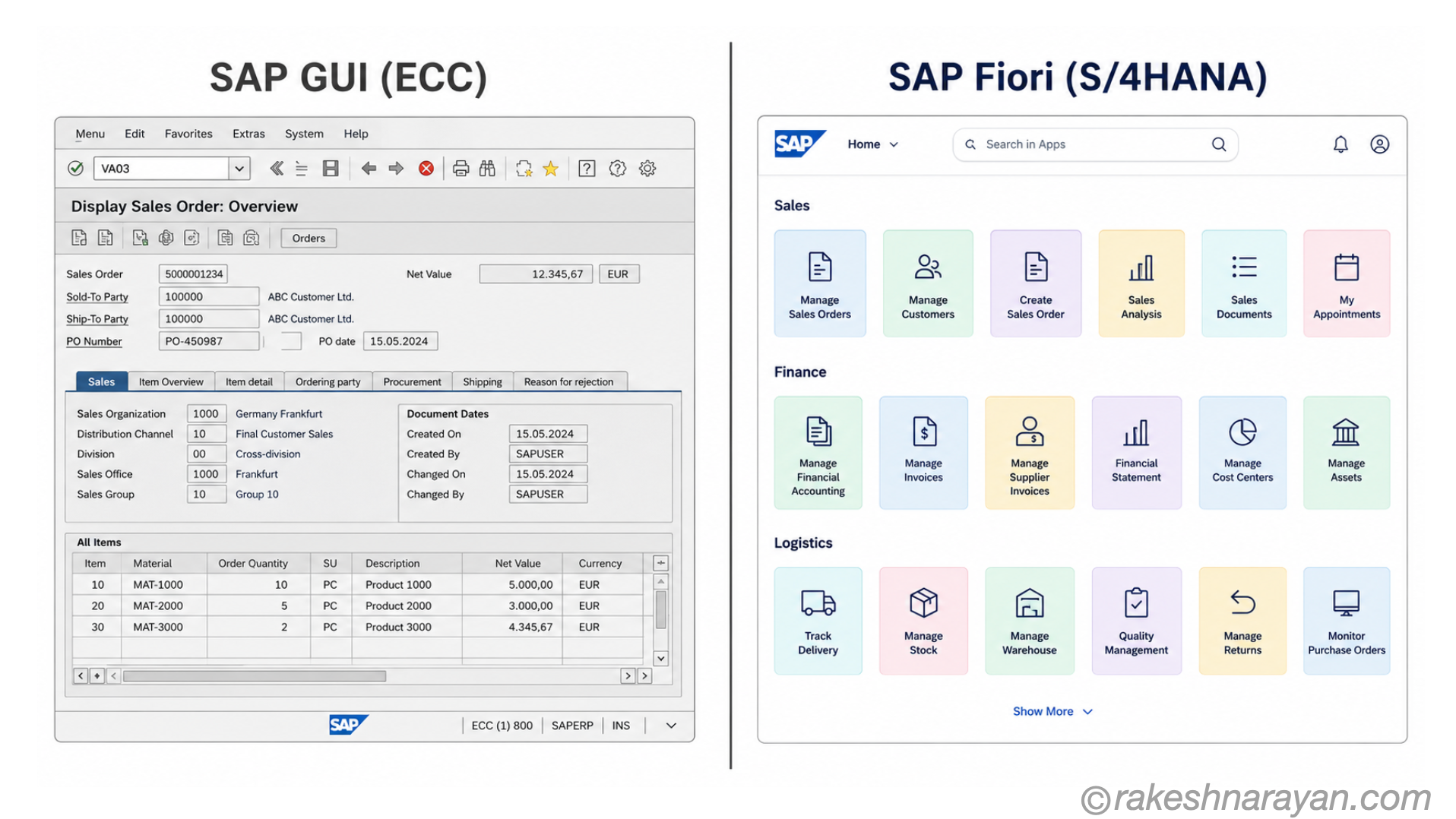
ECC was designed for SAP GUI — the transaction-code driven interface that SAP consultants know by heart. T-codes like ME21N, FB60, VA01 are the language of ECC. The interface was designed for power users doing high-volume data entry.
S/4HANA is designed for Fiori first. SAP Fiori is a modern, role-based, browser-native UX that works on desktop, tablet and mobile. The goal is to show a user only what they need for their role — not the full complexity of the ERP.
| SAP ECC | SAP S/4HANA | |
|---|---|---|
| Primary interface | SAP GUI (SAPGUI) — installed desktop application | SAP Fiori — browser-based, responsive |
| Navigation model | Transaction codes (T-codes) | Role-based launchpad with apps |
| Mobile support | Limited — not designed for mobile | Native — works on any device |
| User experience | Functional, dense, designed for expert users | Simplified, role-based, designed for all users |
| SAP GUI in S/4HANA | Still available — many technical T-codes remain | Present but not the primary experience |
4. Embedded analytics — reporting built in, not bolted on
In ECC, reporting was largely separate from transactional work. You ran a transaction, then opened a separate report or went to BW (SAP Business Warehouse) to see the data. The two worlds — operational and analytical — were distinct.
In S/4HANA, analytics are embedded directly into the application. Because HANA runs queries in real time on live transactional data, you can see KPIs, overdue items, financial summaries and operational dashboards without leaving the transaction or waiting for a data load.
| SAP ECC | SAP S/4HANA | |
|---|---|---|
| Analytics approach | Separate BW or reports — data extracted and loaded | Embedded — live analytics on transactional data |
| Real-time reporting | Not practical — reports run on extracted data | Yes — same second visibility on posted documents |
| BW still needed? | Yes — central analytical platform | For complex historical reporting yes, but less dependency |
| Fiori analytical apps | Limited | Core part of the product — KPI tiles, analytical list pages |
5. Cloud deployment — a genuine option, not an afterthought
ECC was designed for on-premise. Running it in the cloud is possible but it is essentially lifting a traditional system onto cloud infrastructure — you still manage everything.
S/4HANA was designed with cloud in mind and comes in three deployment models:
| Deployment | What it means | Cloud model |
|---|---|---|
| S/4HANA On-Premise | Customer owns and manages everything — full customisation | On-Premise |
| S/4HANA Private Cloud | SAP or partner manages infrastructure — customer manages application | Managed IaaS / PaaS |
| S/4HANA Public Cloud | SAP manages everything — customer configures via best-practice processes only | SaaS |
💡 Public Cloud = less customisation
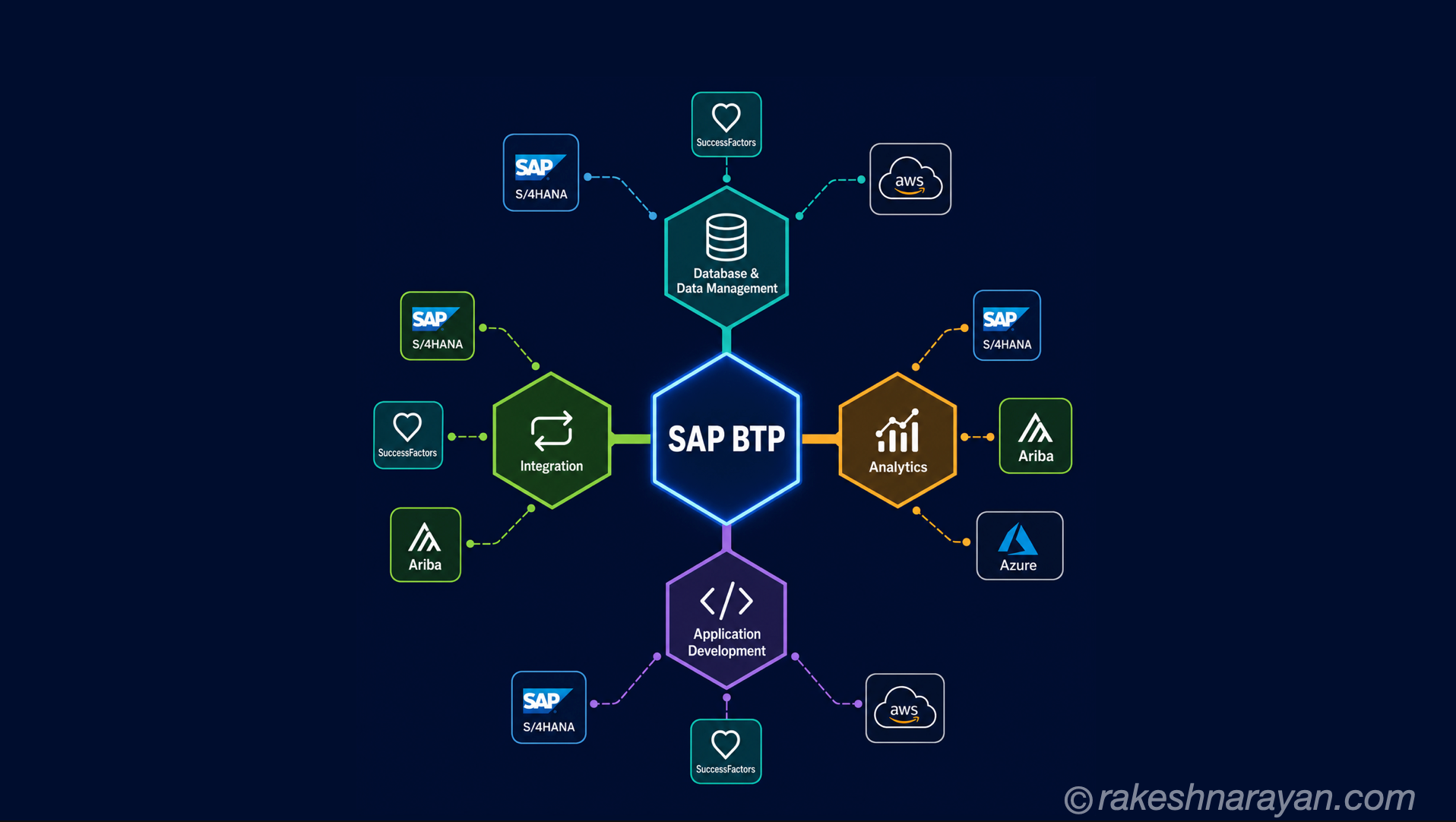
S/4HANA Public Cloud follows a ‘clean core’ principle — SAP manages the system and upgrades it regularly. Custom code is not allowed at the core level. Extensions go through SAP BTP. This is a significant mindset shift for organisations used to deeply customised ECC landscapes.
What did not change
It is worth being honest about what stayed the same — because a lot did.
- The business process logic — order-to-cash, procure-to-pay, record-to-report — is fundamentally the same
- The module structure — SD, MM, FI, CO, PP, HR — is still there, just restructured
- SAP Basis and transport management concepts carry over
- ABAP is still the primary development language — though Cloud ABAP has restrictions
- The configuration approach — IMG, table entries, condition techniques — is largely familiar
Experienced ECC consultants do not start from zero. The knowledge transfers — but the technical landscape around it has changed significantly.
The migration reality
Moving from ECC to S/4HANA is not an upgrade in the traditional sense. It is a transformation project. The key decisions every organisation faces:
| Decision | Options | What it drives |
|---|---|---|
| Conversion approach | Brownfield (convert existing system), Greenfield (new implementation), Selective Data Transition | How much of the existing config and data carries forward |
| Deployment model | On-Premise, Private Cloud, Public Cloud | Customisation freedom vs operational overhead |
| Custom code | Assess, adapt or retire | Typically 20-40% of custom code needs changes due to data model and API changes |
| Timeline | Most migrations take 18 months to 3+ years | Depends on landscape complexity, data volume and organisational readiness |
📌 The clean core imperative
SAP’s strong recommendation for S/4HANA is to keep the core clean — meaning no modifications to standard SAP objects. Extensions, custom logic and integrations should sit on SAP BTP, not inside the core system. This enables SAP to upgrade the core regularly without breaking custom code. It is a fundamental change in how SAP systems are maintained.
Side by side — the full comparison
| Topic | SAP ECC | SAP S/4HANA |
|---|---|---|
| Database | Any supported RDBMS | SAP HANA only |
| Data model | Distributed across many tables | Simplified — ACDOCA Universal Journal at the centre |
| User interface | SAP GUI primary | SAP Fiori primary — GUI still available |
| Analytics | Separate BW or reports | Embedded real-time analytics |
| Deployment | On-premise only | On-premise, Private Cloud or Public Cloud |
| Maintenance end | 2027 (mainstream), 2030 (extended) | Active — long-term investment by SAP |
| Extensibility | Modifications and user exits | Clean core — extensions via BTP |
| Master data | Separate Customer and Vendor objects | Unified Business Partner |
| AI readiness | Limited — requires additional platforms | AI features built in via SAP AI Core and Joule |
| Upgrade cycle | Major upgrades every few years | Continuous updates (especially Public Cloud) |
What to take away
S/4HANA is not ECC with a better interface. The database is different, the data model is fundamentally simplified, the UX is redesigned from the ground up, and the extensibility model has changed completely.
That said, it is still SAP. The business processes, the configuration philosophy and the consulting skills that matter in ECC are still relevant in S/4HANA. What changes is the technical landscape around them.
If you are currently on ECC, the question is not whether to move — it is when and how. The 2027 maintenance deadline makes that decision unavoidable for most organisations.
🔗 Related posts on this site
What is SAP? — the foundation for understanding the SAP product landscape.
What is ERP? — what ERP systems do and why they exist.
The Cloud Service Model — IaaS, PaaS and SaaS — understanding where S/4HANA Public Cloud (SaaS) and Private Cloud fit in the cloud stack.
Published on rakeshnarayan.com — Articles