AI vs ML vs Deep Learning — What Is the Actual Difference?
These three terms are everywhere. People use them interchangeably in meetings, in job descriptions, in product pitches. Most of the time, nobody challenges it because nobody is quite sure of the difference.
The confusion is understandable — the terms are genuinely related. But they are not the same thing. Each one is a subset of the previous. Understanding the nesting is what makes everything else in AI make sense.
🔗 Foundation post
This post is the entry point to the AI section on this site. Once you have this mental model, the other AI posts follow naturally — start with What is a Large Language Model? next, which covers LLMs in detail. The concepts of ML training and neural networks introduced here underpin everything there.
The one-sentence version of each
Before going deeper, here are the simplest accurate definitions:
| Term | One-sentence definition |
|---|---|
| Artificial Intelligence | The broad field of computer science concerned with building systems that can perform tasks typically requiring human intelligence — reasoning, learning, problem-solving, perception. |
| Machine Learning | A subset of AI. Systems that learn patterns from data and improve their performance through experience — without being explicitly programmed for each task. |
| Deep Learning | A subset of Machine Learning. Systems that use artificial neural networks with many layers to learn from very large amounts of data — particularly effective for unstructured data like images, audio and text. |
💡 The nesting in one sentence
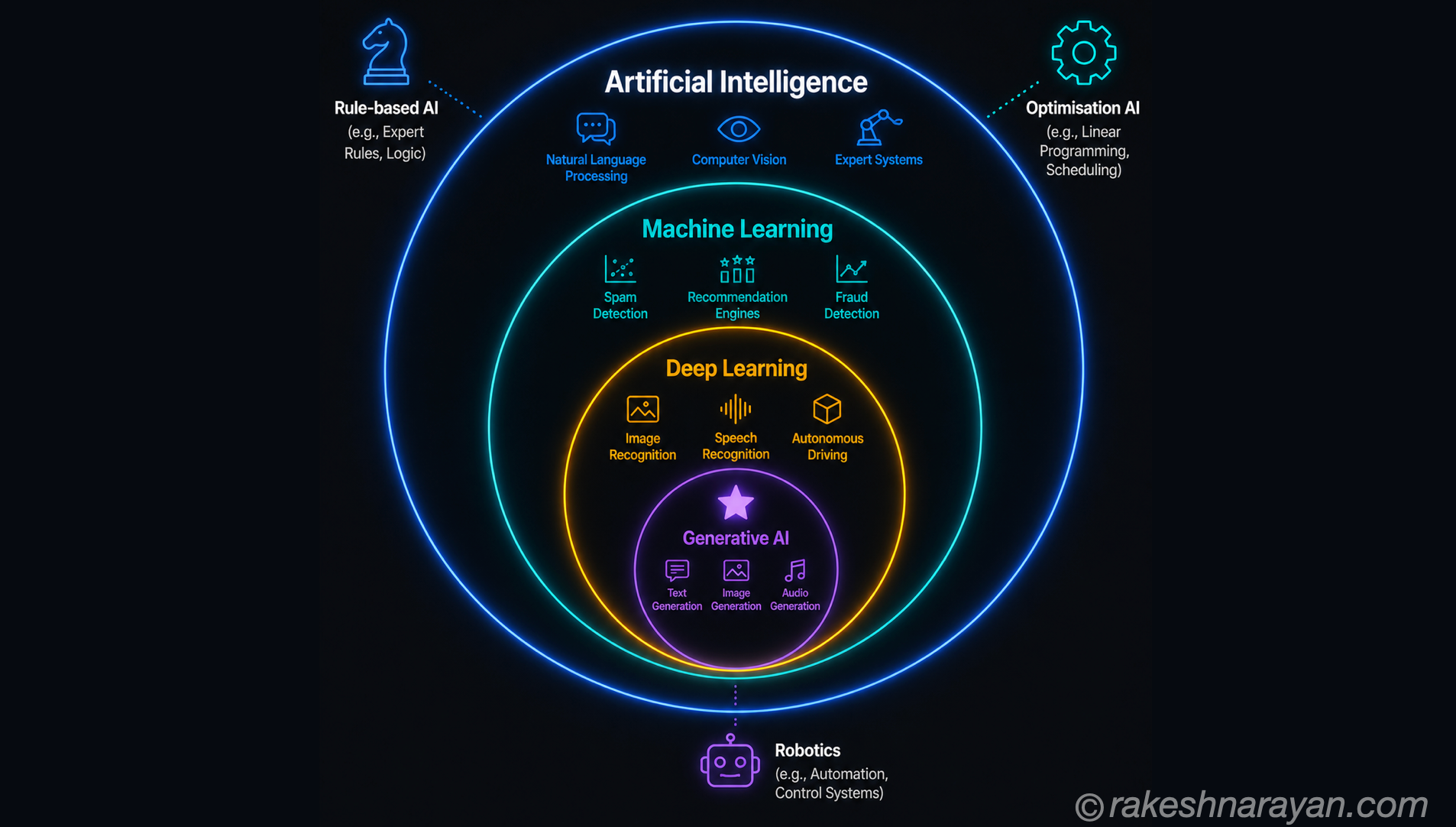
Every deep learning system is a machine learning system. Every machine learning system is an AI system. But not every AI system uses machine learning, and not every machine learning system uses deep learning.
Artificial Intelligence — the broadest category
AI is not a technology. It is a field — the pursuit of machines that can do things that would normally require human intelligence. That is a deliberately wide definition and it covers an enormous range of approaches.
Before machine learning became dominant, most AI was rule-based. An expert system for medical diagnosis had thousands of if-then rules written by doctors. It worked — within narrow limits. Add a condition the rules did not cover and it failed. It was not learning. It was following instructions.
| Type of AI | How it works | Examples | Still in use? |
|---|---|---|---|
| Rule-based AI | Explicit if-then rules written by humans | Medical expert systems, early chess programs, traditional spam filters | Yes — many enterprise systems still use rules for clear-cut decisions |
| Search and optimisation | Explores possible solutions to find the best outcome | Pathfinding, scheduling, logistics optimisation | Yes — very widely used |
| Machine Learning | Learns patterns from data | Recommendation engines, fraud detection, image classifiers | Yes — dominant approach for most modern AI |
| Deep Learning | Multi-layer neural networks learning from large datasets | Voice recognition, image generation, large language models | Yes — powers most AI you use today |
Machine Learning — the approach that changed everything
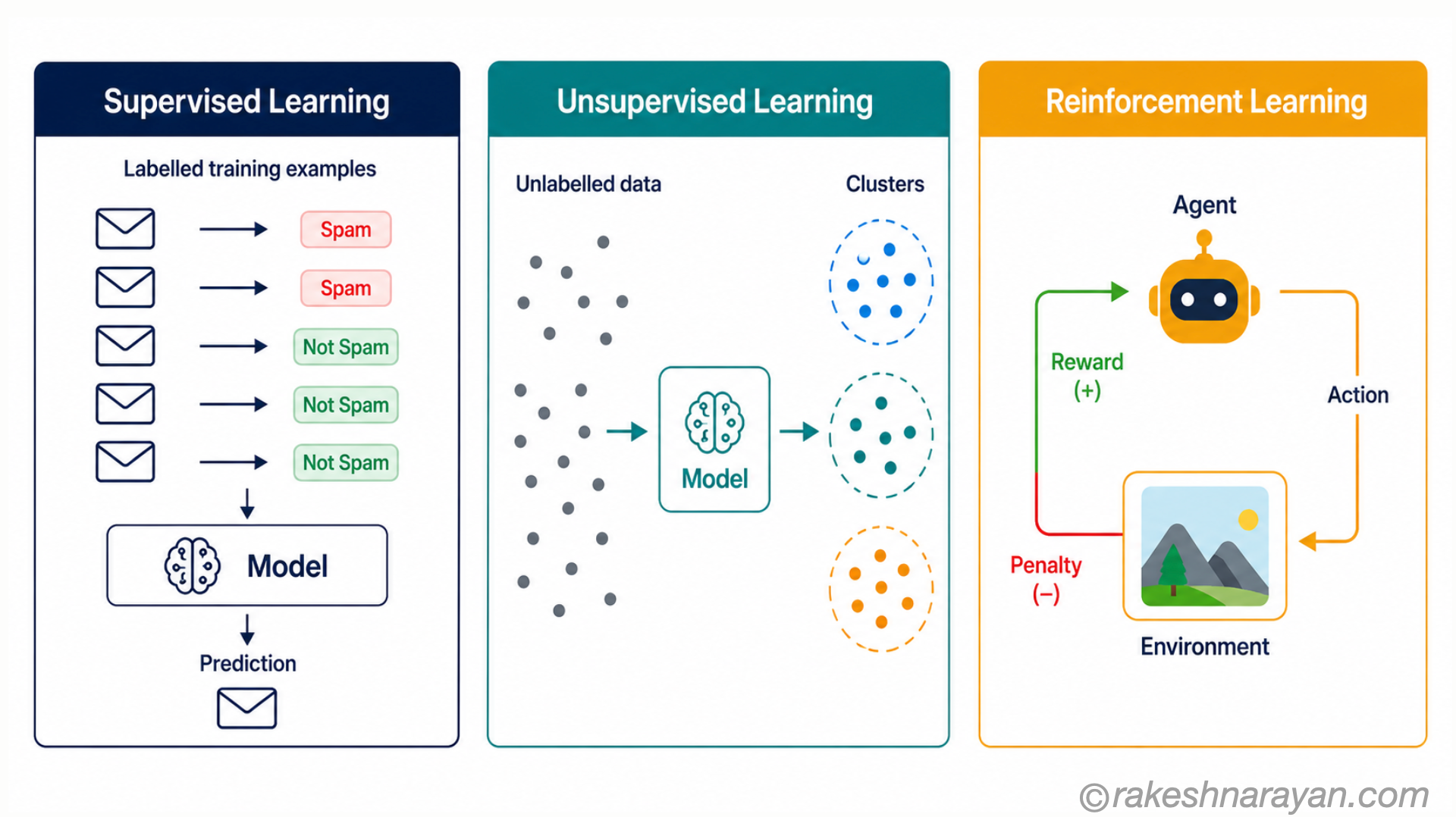
Machine learning is the shift from writing rules to learning from examples. Instead of programming a spam filter with a list of banned words, you show the model thousands of emails labelled spam or not spam. It learns the patterns.
This sounds simple. The implication is significant: you no longer need to anticipate every case. The model finds patterns in data that humans might never have articulated as rules.
The three types of learning
| Learning type | How it works | Real example |
|---|---|---|
| Supervised learning | Model trained on labelled data — input paired with correct output. Learns to map inputs to outputs. | Email spam detection (input: email, label: spam/not spam), house price prediction |
| Unsupervised learning | Model trained on unlabelled data. Finds patterns, clusters or structure without being told what to look for. | Customer segmentation, anomaly detection in financial transactions |
| Reinforcement learning | Model learns by trial and error — receives rewards for good actions, penalties for bad ones. | Game playing (AlphaGo), robotics, training LLMs via RLHF |
Deep Learning — when neural networks go deep
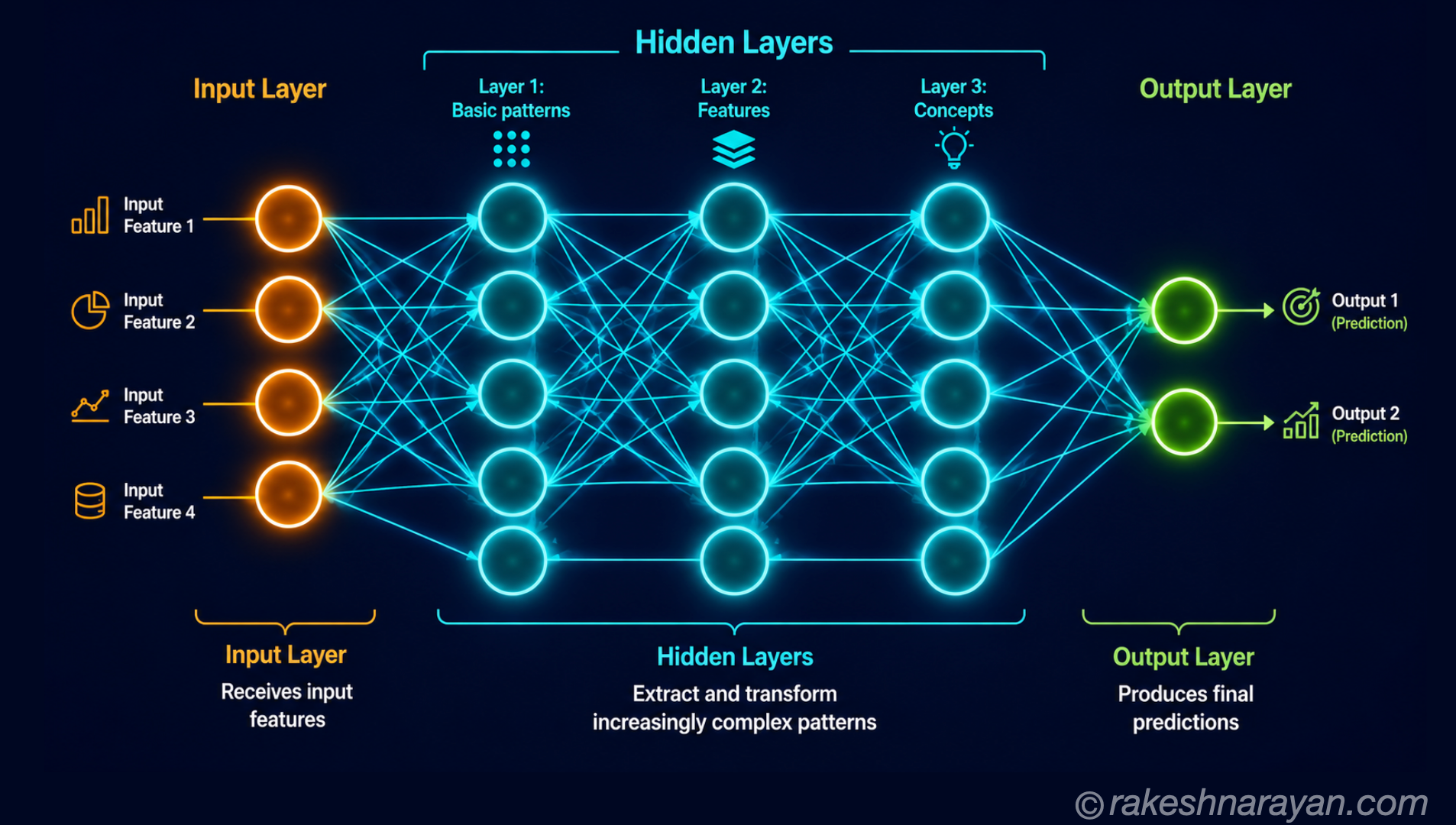
Deep learning is machine learning using artificial neural networks with many layers — hence ‘deep’. Each layer learns increasingly abstract representations of the data. The first layer of an image recognition network might learn edges. The next learns shapes. The next learns objects.
What made deep learning practical was two things converging in the 2010s: very large datasets (the internet) and very powerful GPUs. Without both, training a deep neural network was too slow and too expensive to be useful.
| What deep learning does well | Why |
|---|---|
| Image and video recognition | Learns spatial features across layers — edges, textures, objects, faces |
| Speech recognition and synthesis | Learns temporal patterns in audio — phonemes, words, prosody |
| Natural language processing | Learns semantic and syntactic patterns in text at scale |
| Generative tasks | Learns the distribution of data well enough to generate new examples — images, text, audio |
Where generative AI sits
Generative AI — ChatGPT, Claude, image generators — sits inside deep learning. It is a specific application of deep neural networks trained to generate new content rather than classify existing content.
Large language models are deep learning models. Diffusion models (which generate images) are deep learning models. The reason generative AI feels different is scale and capability — not a fundamentally different type of AI.
| Generative AI model type | What it generates | Examples |
|---|---|---|
| Large Language Model (LLM) | Text — responses, code, summaries, translations | GPT-4o, Claude, Gemini, Llama, SAP Joule |
| Diffusion model | Images and video from text descriptions | DALL-E, Midjourney, Stable Diffusion, Adobe Firefly |
| Audio model | Speech, music, sound effects | ElevenLabs, Suno, Google NotebookLM audio |
| Multimodal model | Combinations — text, image, audio in one model | GPT-4o, Claude 3.5, Gemini 1.5 Pro |
The practical distinctions — when does the label matter?
For everyday use, the distinctions rarely matter. You use the tool that does the job. But three situations exist where knowing the difference is genuinely useful:
- Evaluating AI products — ‘AI-powered’ could mean a simple rule engine. Knowing what type of AI is actually being used helps you assess capabilities and limitations honestly.
- Diagnosing failures — a rule-based system fails because a rule is missing or wrong. An ML system fails because the training data was biased. A deep learning system fails because the model has not seen this type of input before. The fix is different in each case.
- Making build vs buy decisions — a simple classification problem might need only basic ML, not a full LLM. Using a large model for a problem a decision tree handles is expensive and slower.
At a glance — the differences
| Concept | One-line summary |
|---|---|
| Artificial Intelligence | The broad field — any technique that makes machines perform tasks requiring human intelligence |
| Machine Learning | A subset of AI — systems that learn patterns from data without being explicitly programmed for each case |
| Supervised learning | Training on labelled data — learning the mapping from input to known output |
| Unsupervised learning | Training on unlabelled data — finding patterns and structure without predefined answers |
| Reinforcement learning | Learning through trial and error — reward for good outcomes, penalty for bad |
| Deep Learning | A subset of ML — multi-layer neural networks learning from large datasets |
| Neural Network | The architecture deep learning uses — layers of connected nodes inspired by the brain |
| Generative AI | A deep learning application — models trained to generate new content, not just classify existing content |
| LLM | A type of generative AI model — trained on text to predict and generate language |
What to take away
AI is the field. Machine learning is the dominant approach within it. Deep learning is the technique within machine learning that powers almost everything you interact with today — from voice assistants to image recognition to the large language models behind ChatGPT, Claude and SAP Joule.
The nesting matters because each level has different strengths, different failure modes and different computational requirements. A machine learning model trained on structured data is not the same thing as a deep learning model trained on billions of words — even though both get called AI.
Once the nesting clicks, the rest of the AI landscape becomes much easier to navigate.
🔗 Related posts on this site
What is a Large Language Model (LLM)? — deep learning in action: how LLMs are trained and what they actually do.
AI Hallucinations — Why They Happen — a direct consequence of how deep learning models work — they predict, they do not verify.
RAG — Retrieval Augmented Generation — how to ground deep learning models in real, current knowledge.
How Generative AI Works — the mechanics behind generative AI: tokens, embeddings and the transformer.
Published on rakeshnarayan.com — Articles
URL: https://rakeshnarayan.com/articles/ai-vs-ml-vs-deep-learning/
Did you enjoy this article?
Let me know — it takes one click.
0 Comments
Leave a Comment
Looks like this one held your attention — I'd really appreciate a quick comment below.
Your comment has been submitted and will appear after review.