Open Source vs Closed Source AI Models — The Real Trade-offs
Two years ago, this was a simple conversation. If you needed the best model, you used OpenAI or Anthropic, paid per token, and got on with it. Open source models were a reasonable option for experimentation, fine-tuning, or keeping costs down — but not something you relied on for serious production work. That assumption is now outdated.
Models like Llama 4, DeepSeek-V3, and Qwen have closed the capability gap dramatically. For a large portion of real workloads, you can no longer justify choosing closed source on quality grounds alone. The decision has shifted from which model is better to which trade-offs match your situation.
This post maps those trade-offs honestly — without a vendor bias in either direction. Because the real answer, in almost every enterprise I have seen, is not open or closed. It is knowing when each one is the right tool.
🔗 Foundation for this post
This post assumes you know what an LLM is and broadly how AI models work. If you are newer to the topic, start with What is a Large Language Model? — it covers how models are trained and what they actually do. AI in the Enterprise — A Practical Map shows where open and closed models are being deployed in real organisations in 2026. The trade-offs in this post connect directly to the deployment decisions covered there.
What “open” and “closed” actually mean
These terms get used loosely. Before comparing anything, the definitions matter.
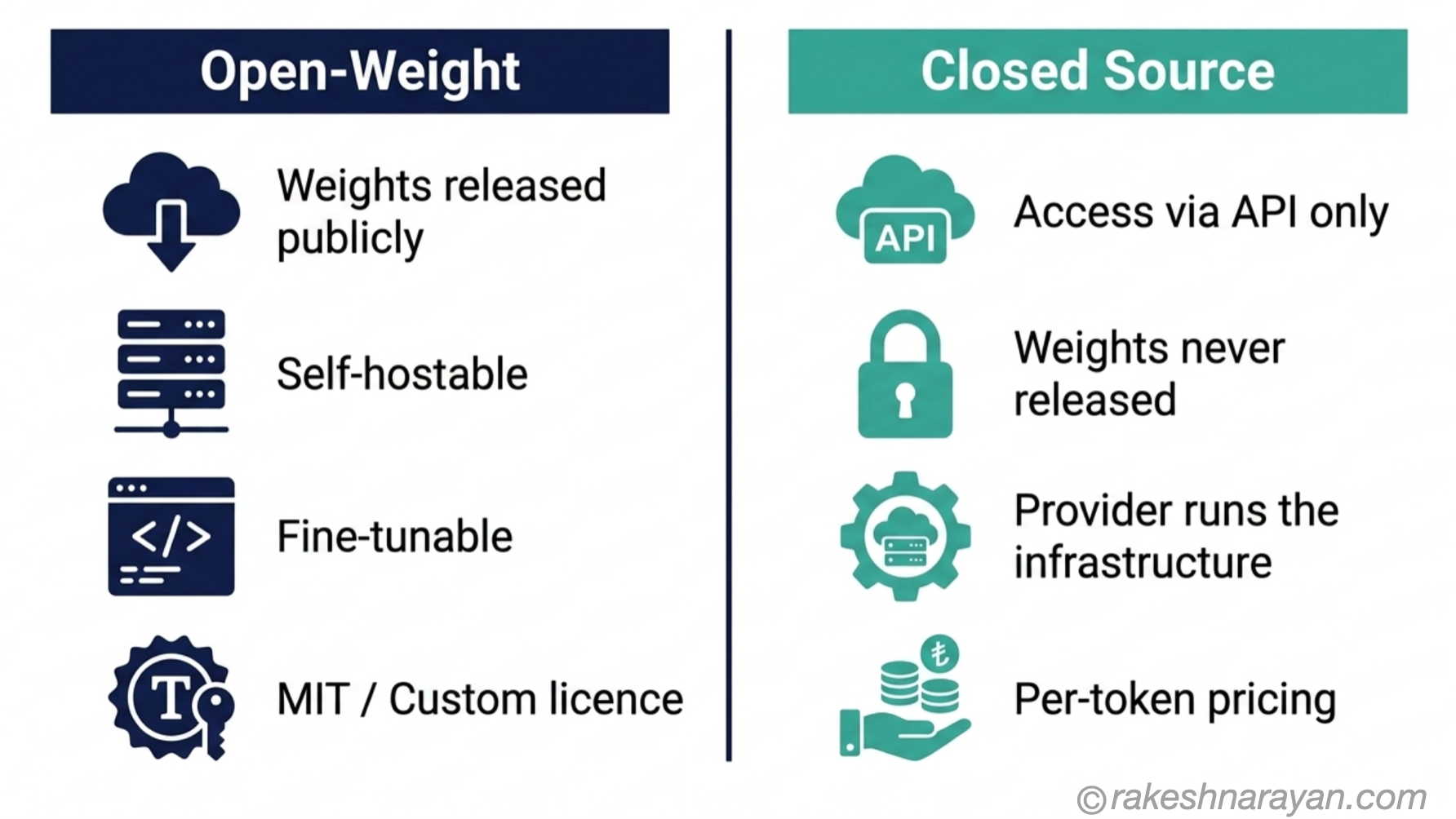
A closed source model is accessed through an API. The weights — the billions of numerical parameters that define the model’s behaviour — are never released publicly. You send a request, the provider runs the model on their infrastructure, and you get a response. You cannot inspect the model, host it yourself, or modify it. GPT, Claude, and Gemini all work this way.
An open source model — more accurately called open-weight — releases the model weights publicly. You can download them, run them on your own hardware, fine-tune them, and in most cases deploy them commercially. Llama 4 (Meta), DeepSeek-V3 (MIT licence), and Mistral are the most prominent examples as of mid-2026.
📝 Open-weight is not the same as fully open source
Traditional open source software releases the source code under a licence like Apache 2.0 or MIT — freely modifiable, redistributable, no restrictions. Open-weight AI releases the trained model parameters, but the training data and full training code are usually not released. Llama 4 uses a custom Meta licence that permits commercial use but includes restrictions — including a requirement for attribution and a carve-out for companies above 700 million monthly active users. DeepSeek-V3 is released under the MIT licence, which is about as permissive as it gets. Always read the licence before deploying in production.
The capability gap — what changed
In 2023, the capability gap was real. GPT-4 was visibly better than anything open source on complex reasoning, code generation, and nuanced instruction following. The compromise was explicit.
That changed in 2024 and accelerated sharply in 2025 and 2026. Three things happened at once. Meta released Llama 4 with a mixture-of-experts architecture — Maverick outperformed GPT-4o on key benchmarks at launch.
DeepSeek demonstrated that frontier-level reasoning could be trained at a fraction of the cost that US labs had assumed was necessary. Then the Chinese AI labs — Alibaba’s Qwen, Zhipu’s GLM — proved that permissive licences and world-class performance are not mutually exclusive.
The gap has not closed completely. For the absolute frontier — complex multi-step reasoning, advanced coding agents, the hardest 10% of tasks — closed source models like Claude Opus 4 and OpenAI’s frontier models still hold an edge. But for the broad middle of enterprise workloads, open-weight models are no longer a compromise.
📌 The practical implication
If your workload is document summarisation, classification, content generation, standard code completion, or RAG-grounded Q&A, a well-chosen open-weight model will handle it in 2026. The performance argument for closed source now needs to be made specifically, not assumed.
Where closed source still wins
Being honest here matters. Open source has caught up dramatically — but there are still clear situations where closed source is the better choice.
| Situation | Why closed source is stronger |
|---|---|
| Frontier reasoning and agentic tasks | The top closed models still hold the edge on complex multi-step tasks — legal analysis, advanced coding agents, autonomous decision chains. The gap is narrower, but it is real. |
| Zero infrastructure overhead | API access means no servers to maintain, no GPU provisioning, no inference framework to manage. For small teams or early-stage products, this is a genuine advantage. |
| Built-in safety and guardrails | Closed models from Anthropic, OpenAI and Google have extensive safety fine-tuning and content filtering built in and continuously maintained. Replicating this with an open-weight model requires significant investment. |
| Fastest access to new capability | The latest reasoning advances and multimodal features appear in closed APIs first. If frontier performance matters, closed source stays closer to the cutting edge. |
| Enterprise support and SLAs | Paid closed source tiers come with SLAs, uptime guarantees and support agreements. Running your own open-weight infrastructure means you own the reliability problem. |
Where open source wins
This is where the story has changed most. Several of these were theoretical advantages in 2023. They are real, practical advantages in 2026.
| Situation | Why open source is stronger |
|---|---|
| Data sovereignty | Your data never leaves your infrastructure. For healthcare, finance, legal, or any regulated industry handling sensitive data, this is not optional — it is a hard requirement. Running Llama 4 or DeepSeek-V3 on-premise means no data crosses a third-party boundary. |
| Cost at scale | Above roughly 5–10 million tokens per month, self-hosting an open-weight model is significantly cheaper than paying per token. The model is free. You are paying for compute, not per request. |
| Full fine-tuning control | You can fine-tune on your own domain data — industry terminology, internal processes, house style — in ways that closed API fine-tuning does not fully support. The result is a model that genuinely understands your context. |
| No vendor lock-in | Closed API models can be deprecated, repriced, or changed at any time. Your production system depends on decisions you do not control. Open weights, once downloaded, cannot be taken away. |
| Customisation of behaviour | Want to remove certain refusals, adjust safety thresholds for a specific professional context, or modify how the model handles your domain? With open weights, you can. With a closed API, you cannot. |
| Regulatory and audit requirements | Some industries and geographies require the ability to audit the AI system in full. That is not possible with a closed model. It is possible with open weights. |
⚠️ Data sovereignty is not just a preference in 2026
The EU AI Act, GDPR enforcement, and sector-specific regulations in finance and healthcare mean that sending sensitive data to a third-party closed API is a compliance decision, not just a technical one. Know your data classification before you choose your model.
The four decisions that determine which to use
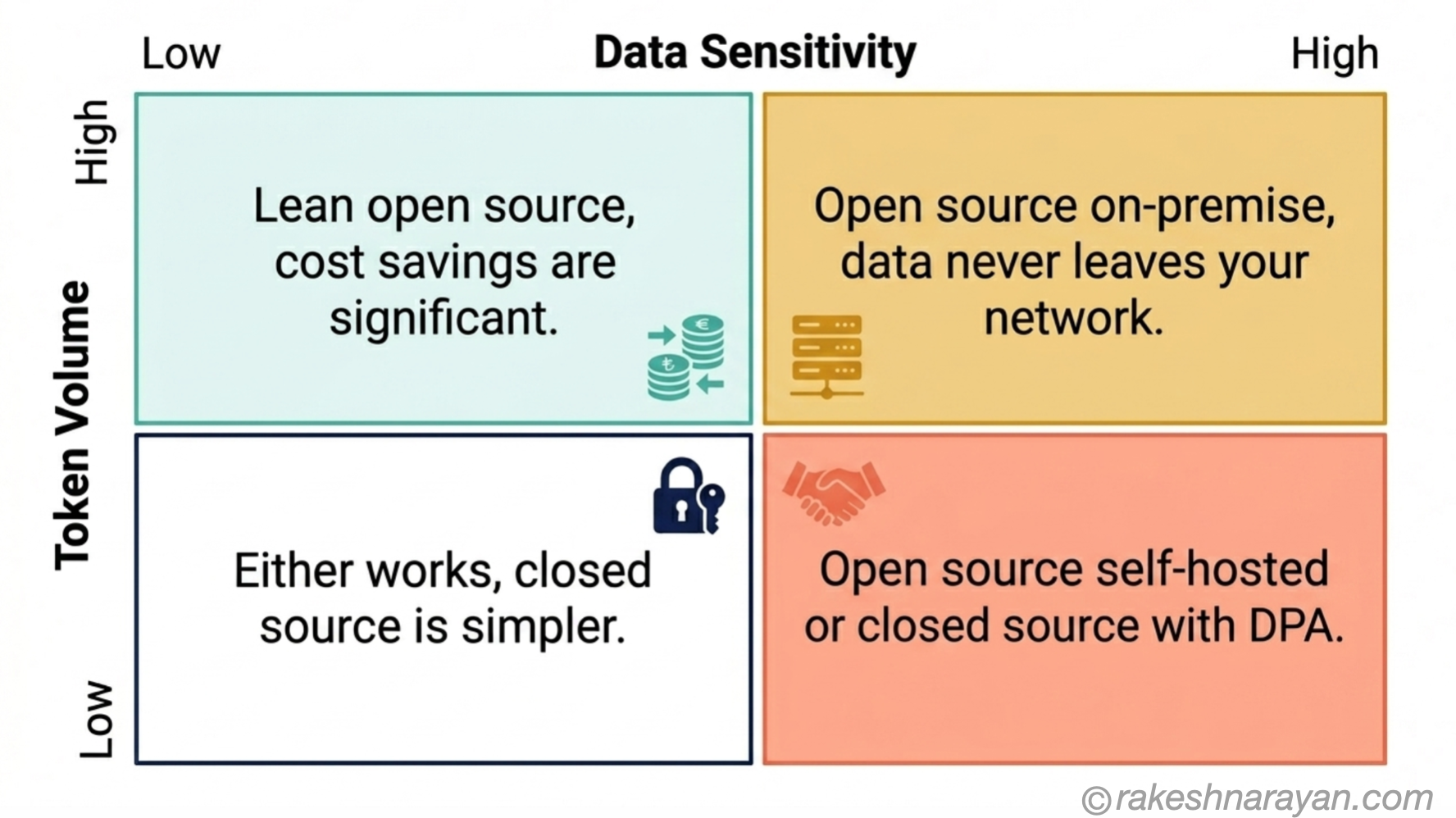
Every situation is different, but four questions cover most of the decision space. Work through these in order — the answer to each one narrows the field.
1. How sensitive is the data?
If you are processing personal data, confidential client information, patient records, financial documents, or anything subject to GDPR, HIPAA, or sector-specific regulation — start with open source, self-hosted. Closing this question first rules out closed API in many enterprise contexts.
2. What is your monthly token volume?
Below around 5 million tokens per month, the engineering cost of self-hosting an open-weight model often exceeds the savings from not paying per token. Above that threshold, the economics shift clearly in favour of open source. At very high volumes — tens of millions of tokens per month — the cost difference becomes substantial.
3. Do you need frontier capability?
Be specific here. ‘We need the best model’ is not a requirement — it is an assumption. Define the task. If it is complex multi-step reasoning, autonomous agent behaviour, or tasks where you have benchmarked and found a clear gap — closed source may be worth it. For most document processing, Q&A, classification, and generation tasks, a top open-weight model will perform comparably.
4. Does your team have the capability to self-host?
Running an open-weight model in production is not a download-and-go operation. You need ML engineering capacity for inference infrastructure, quantisation decisions, model updates, and monitoring. Without that, the operational burden of self-hosting can exceed the cost of closed source APIs. This is the honest reason many teams end up on closed APIs — not capability, but operational overhead.
✅ Best practice
Answer these four questions in order before any model selection conversation. The answers often change the framing entirely — what looks like a ‘closed source vs open source’ debate turns out to be a question about data classification and team capability.
The hybrid pattern most teams end up with
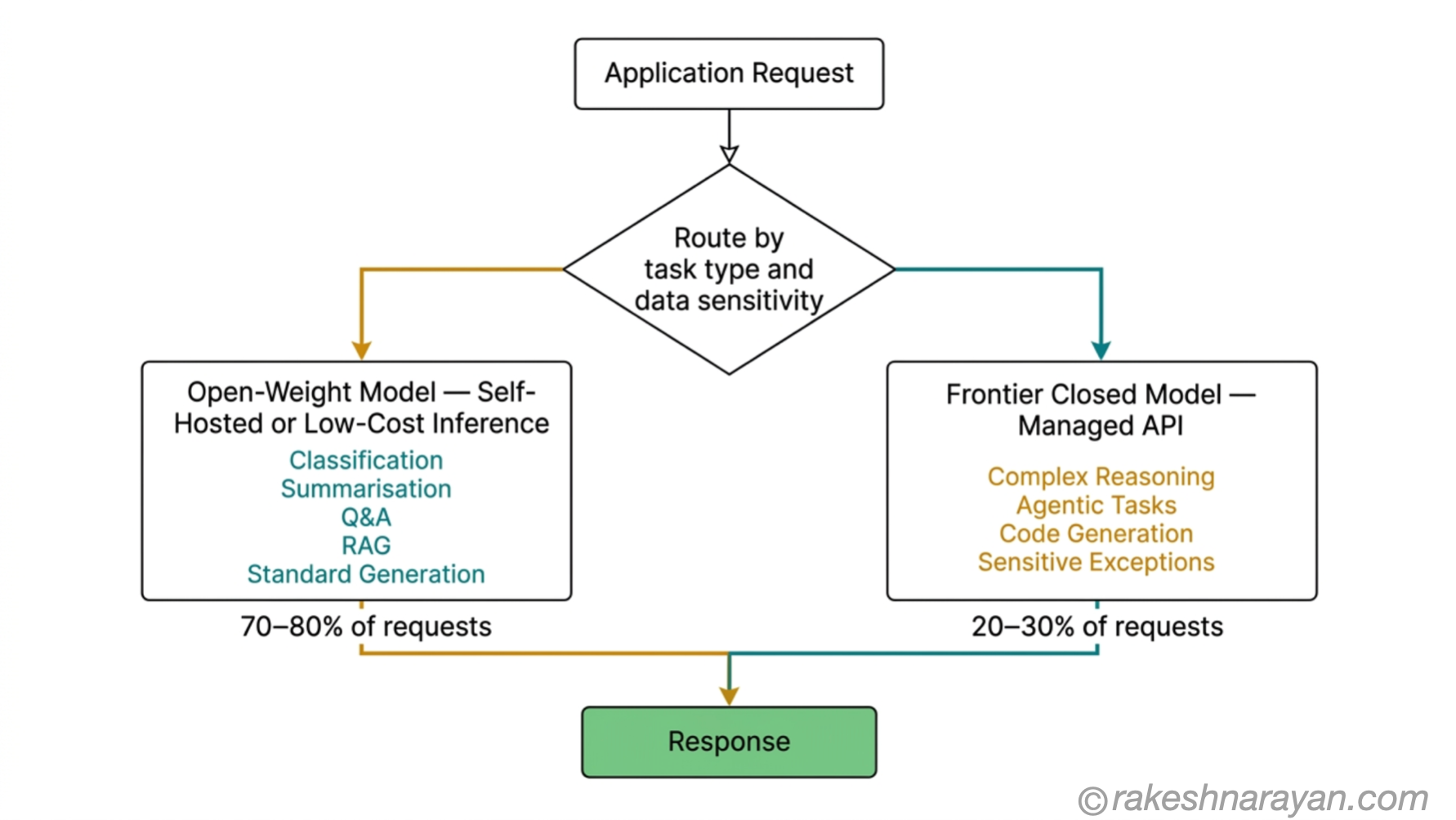
Here is what I see in practice in 2026. Most teams that have thought carefully about this do not make a single choice. They route.
The pattern is roughly: a fast, cheap open-weight model (7B–14B parameters, self-hosted or via a low-cost inference provider) handles 70–80% of requests. A frontier closed model handles the 20–30% that require maximum capability. The routing logic is built into the application layer — classify the task, route it to the right tier.
This approach can cut per-token costs by 60–80% compared to sending everything to a frontier model, while maintaining quality where it matters. SAP AI Core on BTP supports this pattern — you can deploy open-weight models alongside managed model access, and route based on task type and data classification.
💡 Practical tip
Start with a closed source API to validate your use case quickly. Once you have confirmed value and understand your token volume, benchmark an open-weight alternative on your specific workload. If quality holds, migrate. This sequence avoids premature infrastructure investment while leaving the door open for cost optimisation once the use case is proven.
At a glance — open source vs closed source
| Concept | One-line summary |
|---|---|
| Open-weight model | Model weights are publicly released — you download, host, and run them on your own infrastructure |
| Closed source model | Model accessed through an API only — weights are proprietary, provider handles all infrastructure |
| Capability gap (2026) | The gap has closed for most workloads; the frontier remains with closed source for the hardest tasks |
| Data sovereignty | Open-weight self-hosted means data never leaves your infrastructure — critical for regulated industries |
| Cost at scale | Above ~5–10M tokens/month, self-hosting open models is significantly cheaper than per-token API pricing |
| Fine-tuning | Open-weight models can be fully fine-tuned on your own data; closed APIs offer limited fine-tuning options |
| Vendor lock-in | Downloaded weights cannot be deprecated or repriced; closed APIs can change at any time |
| Operational overhead | Self-hosting requires ML engineering capacity; closed APIs require none beyond integration |
| Hybrid routing | Use open models for volume workloads, closed frontier models for the hardest 20% — the common production pattern |
| Llama 4 licence | Commercial use permitted; restrictions apply above 700M MAU — always read the current licence at ai.meta.com/llama |
| DeepSeek-V3 licence | MIT licence — the most permissive available; full commercial use, modification, and redistribution allowed |
What to take away
The open source versus closed source debate in AI is not really a debate about quality anymore. For most enterprise workloads in 2026, both tiers can do the job. The real question is about architecture — data residency, operational model, cost structure, and how much flexibility your organisation needs over time.
The teams getting this right are not picking a side. They are mapping their workloads, classifying their data, and routing intelligently. Closed source for fast time-to-value and frontier tasks. Open source for scale, sensitivity, and control. Neither as a religion — both as tools.
One thing has changed that is easy to miss: vendor lock-in risk is now asymmetric. If you build entirely on a closed API, you are dependent on pricing and availability decisions made by a company whose interests are not aligned with yours. Open weights, once downloaded, are yours permanently. That is not an ideological point — it is an architectural one worth taking seriously.
🔗 Related posts on this site
Fine-Tuning vs Prompt Engineering vs RAG — once you have chosen your model, this post explains the three approaches for making it work for your use case.
AI in the Enterprise — A Practical Map — where open and closed models are being deployed in real organisations and how the architecture decisions play out.
Ethics and Responsible AI — transparency, auditability, and bias are directly affected by whether your model weights are open or closed.
What is a Large Language Model? — if any part of this post assumed more context than you had, start here.
AI Data Sovereignty — The Three Concepts That Matter — data sovereignty is one of the strongest arguments for open-weight self-hosting; this post explains the regulatory and legal dimensions in full.
How to Choose the Right AI Model — A Decision Framework — open vs. closed is one axis of a bigger decision; this post covers the full task/risk/context/cost framework.
Published on rakeshnarayan.com — Articles
URL: https://rakeshnarayan.com/articles/open-source-vs-closed-source-ai-models-the-real-trade-offs/

Did you enjoy this article?
Let me know — it takes one click.
0 Comments
Leave a Comment
Looks like this one held your attention — I'd really appreciate a quick comment below.
Your comment has been submitted and will appear after review.