SAP Integration Suite — What It Is and How It Works
Ask an SAP project team what they use for integration and you will hear a mix of answers. PI. PO. CPI. Cloud Integration. Integration Suite. Sometimes all of them in the same breath, sometimes used interchangeably.
They are not the same thing. And the confusion matters — because SAP Integration Suite is now the strategic integration platform for every S/4HANA-centric organisation, and PI/PO mainstream maintenance ends December 2027. If you are in a project touching integration right now, this is the product you need to understand.
This post explains what Integration Suite actually is, what its capabilities do, and how they fit together — without the marketing layer.
🔗 Related context
If you are new to BTP, start with SAP BTP — The Platform Explained first — it covers what BTP is and how its services relate. The SAP Integration Patterns — The Decisions That Matter post covers when to use synchronous versus event-driven patterns — the strategic layer that sits above the tool.
What SAP Integration Suite actually is
SAP Integration Suite is SAP’s integration platform as a service (iPaaS), running on SAP Business Technology Platform. It is not middleware in the traditional sense — it is a cloud-native suite of integration capabilities delivered as a managed service, with no server infrastructure for you to maintain.
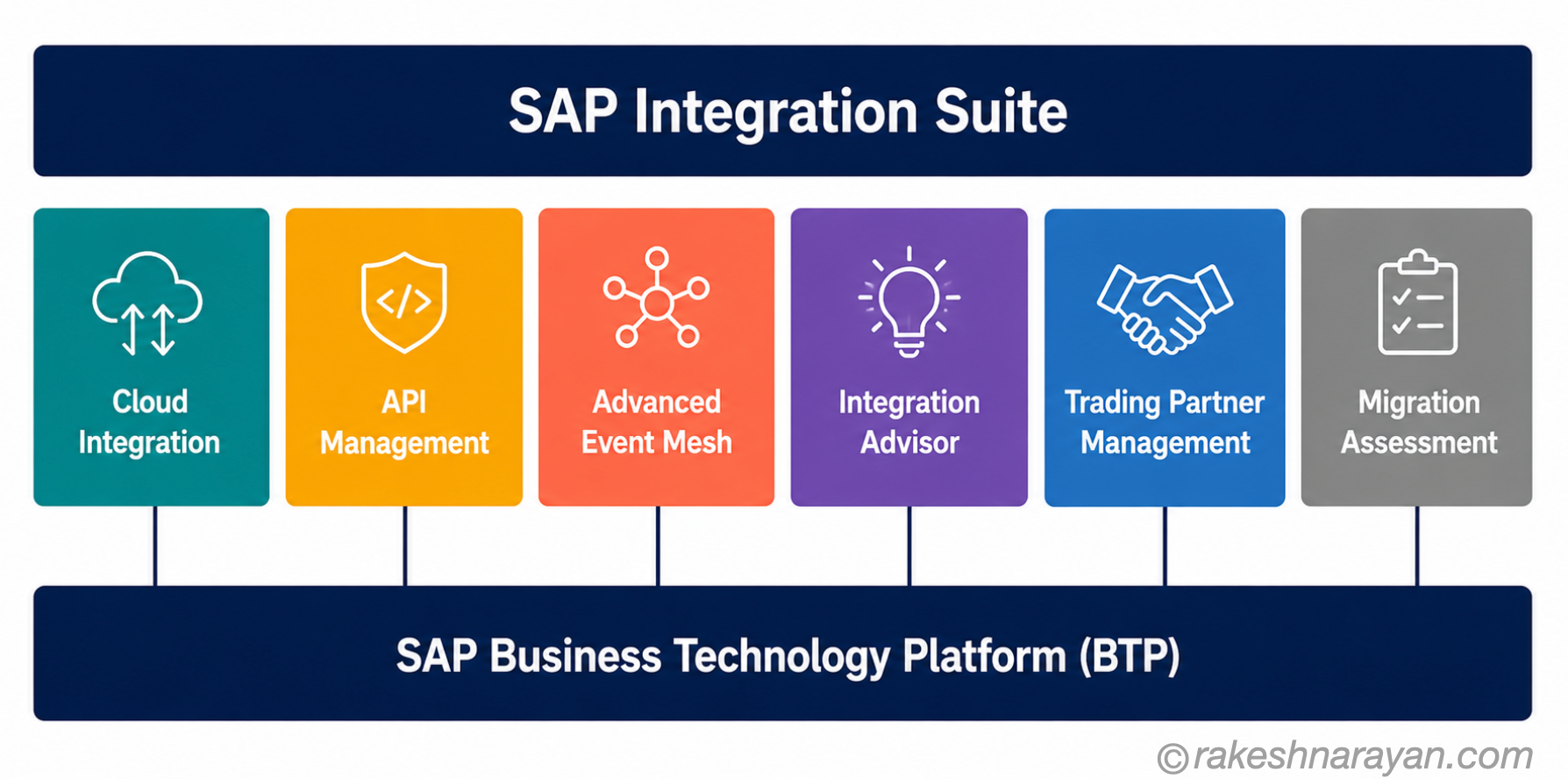
The important history: SAP used to sell these capabilities as separate products. SAP Cloud Platform Integration (CPI) handled process integration. SAP API Management was its own product. SAP Event Mesh was separate. Integration Advisor was separate. In 2020, SAP consolidated them under the Integration Suite umbrella — one licence, one platform, one place to build and monitor everything.
That consolidation is the single most useful thing to understand about the product. Integration Suite is not a new technology. It is the rationalisation of several tools that used to require separate contracts, separate UIs and separate teams.
📌 The one-sentence version
SAP Integration Suite is the cloud-native replacement for SAP PI/PO and the strategic integration layer for every SAP S/4HANA implementation — bringing process integration, API management, event-driven messaging and B2B connectivity into one managed platform on BTP.
The core capabilities — what each one does
Integration Suite has several capabilities. Four of them do the majority of the work in most implementations. The others matter in specific scenarios. Here is the honest breakdown.
| Capability | What it does | When you use it |
|---|---|---|
| Cloud Integration | Design, deploy and monitor integration flows (iFlows) that move and transform data between systems — cloud to cloud, cloud to on-premise, or on-premise to on-premise via the Cloud Connector. | Your main workhorse. Every A2A and B2B process integration scenario — replacing what PI/PO did. |
| API Management | Create, govern, secure and publish APIs. Apply rate limiting, authentication policies and access controls. Expose APIs to internal teams or external developers via a developer portal. | When you need to manage how systems and partners consume your APIs — not just build them. |
| Advanced Event Mesh | Distributed, event-driven messaging. Publish and subscribe to business events in real time across SAP and non-SAP systems. Supports asynchronous, loosely coupled integration patterns. | When you need real-time event distribution — stock level changes, order status updates, any scenario where polling is too slow or too expensive. |
| Integration Advisor | AI-assisted B2B and EDI mapping. Uses a shared knowledge base and machine learning to propose mappings between industry standard message formats (EDIFACT, ANSI X12, IDoc). | B2B integration with trading partners using EDI standards. Cuts mapping development time significantly. |
| Trading Partner Management | Manage B2B partner onboarding, agreements and message exchange. Handles the business configuration side of B2B — who you exchange documents with and under what terms. | When you have multiple external trading partners exchanging documents — buyers, suppliers, logistics providers. |
| Migration Assessment | Analyses your existing SAP PI/PO landscape and assesses which interfaces can be migrated to Integration Suite and estimates effort. | PI/PO migration projects. Run this first before any migration planning conversation. |
| Open Connectors | Pre-built connectors for third-party SaaS applications via a unified REST layer. Historically used for non-SAP cloud apps. | Still available, but newer third-party adapters are now delivered directly within Cloud Integration — check current availability for your specific target system. |
| Integration Assessment | A structured methodology tool for integration architects to assess integration requirements, choose the right patterns and manage the integration lifecycle. | Large-scale integration strategy projects — helps teams move from ad-hoc decisions to a governed approach. |
💡 Practical tip — iFlows explained
An iFlow (integration flow) is the unit of work in Cloud Integration. It is a graphical design artifact — a flow diagram showing how a message enters, gets processed and routed, gets transformed, and exits to the target system. If you have used mapping objects and communication channels in PI/PO, iFlows are the equivalent. Each interface you build in Integration Suite is an iFlow.
How the capabilities work together
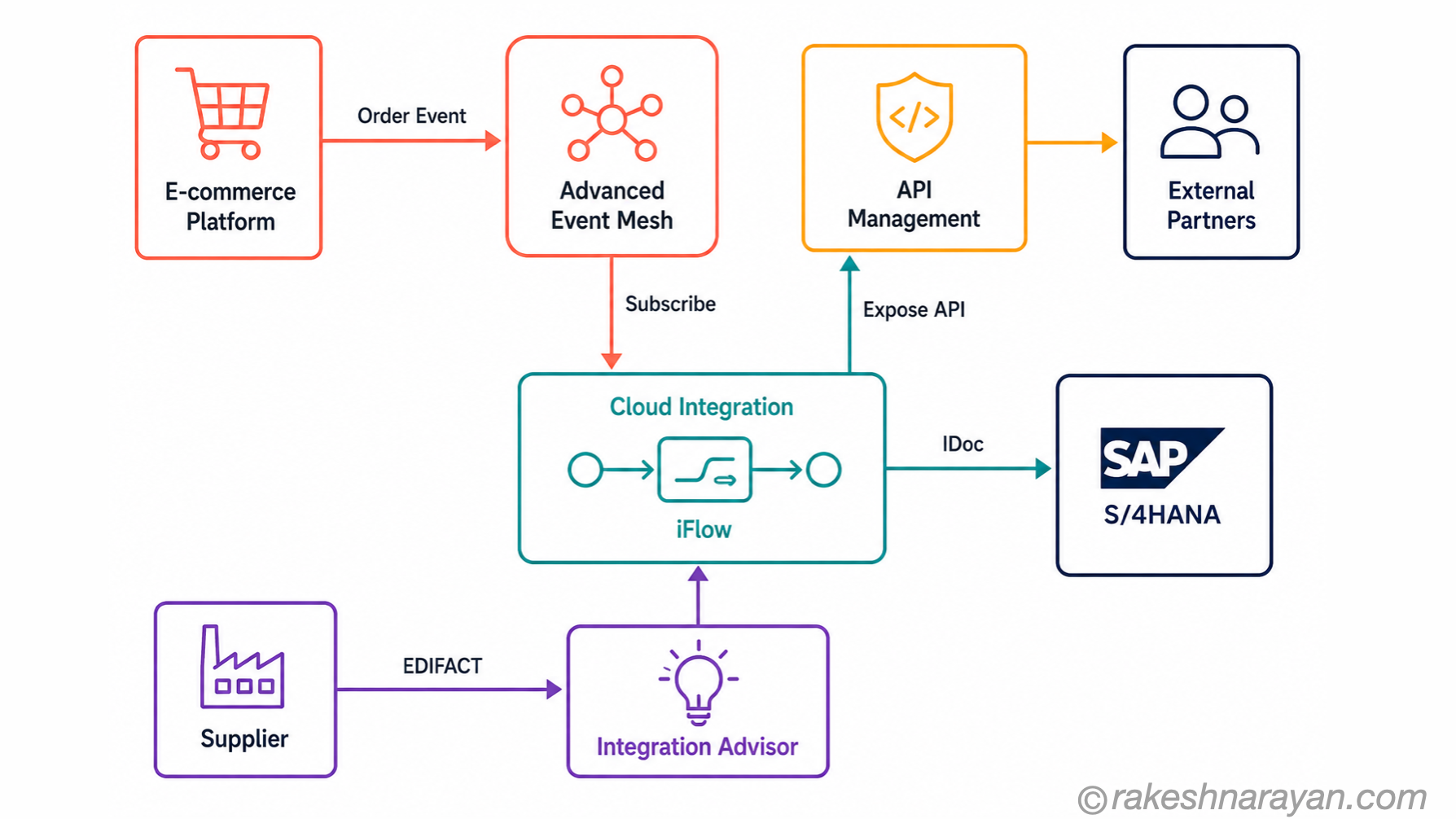
The capabilities are not alternatives — they are complements. Most real integration landscapes use at least three of them simultaneously. Here is a concrete example.
A customer places an order in an e-commerce platform. The order event is published to Advanced Event Mesh. An iFlow in Cloud Integration subscribes to that event, transforms the payload into SAP IDoc format, and posts it to S/4HANA. The same order status API is exposed externally via API Management, with rate limiting applied so the e-commerce platform cannot flood the system. Meanwhile, a supplier confirmation arrives as an EDIFACT message — Integration Advisor handles the mapping, and Trading Partner Management manages the supplier agreement that governs the exchange.
That is one end-to-end scenario using five capabilities. None of them duplicates another. Each does one thing and does it well.
⚠️ Common misconception
API Management and Cloud Integration are not the same thing. Cloud Integration moves and transforms data between systems. API Management governs how APIs are exposed and consumed — it adds the security, monitoring and lifecycle layer on top. You often use both together: Cloud Integration builds the interface, API Management exposes it safely.
Where Integration Suite sits — the BTP relationship
Integration Suite is a service on SAP Business Technology Platform. It is not a separate product you buy independently of BTP — you subscribe to it through your BTP global account, activate the capabilities you need, and run everything on BTP’s infrastructure.
This matters for two reasons. First, it means Integration Suite inherits BTP’s multi-cloud reach — it runs on AWS, Azure and Google Cloud, in over 40 data centers globally as of 2026, so you can choose your region for data sovereignty requirements. Second, it connects naturally to other BTP services — SAP AI Core, SAP HANA Cloud, SAP Build Process Automation — because they all sit on the same platform.
📝 Note
SAP Business Accelerator Hub is where you find prebuilt integration content — over 3,400 prebuilt integrations maintained by SAP and partners. These are not add-ons you pay extra for. If you are building an integration between S/4HANA and SuccessFactors, SAP almost certainly has a prebuilt package for it. Check here before building from scratch: https://api.sap.com
The PI/PO question — what this means for existing landscapes
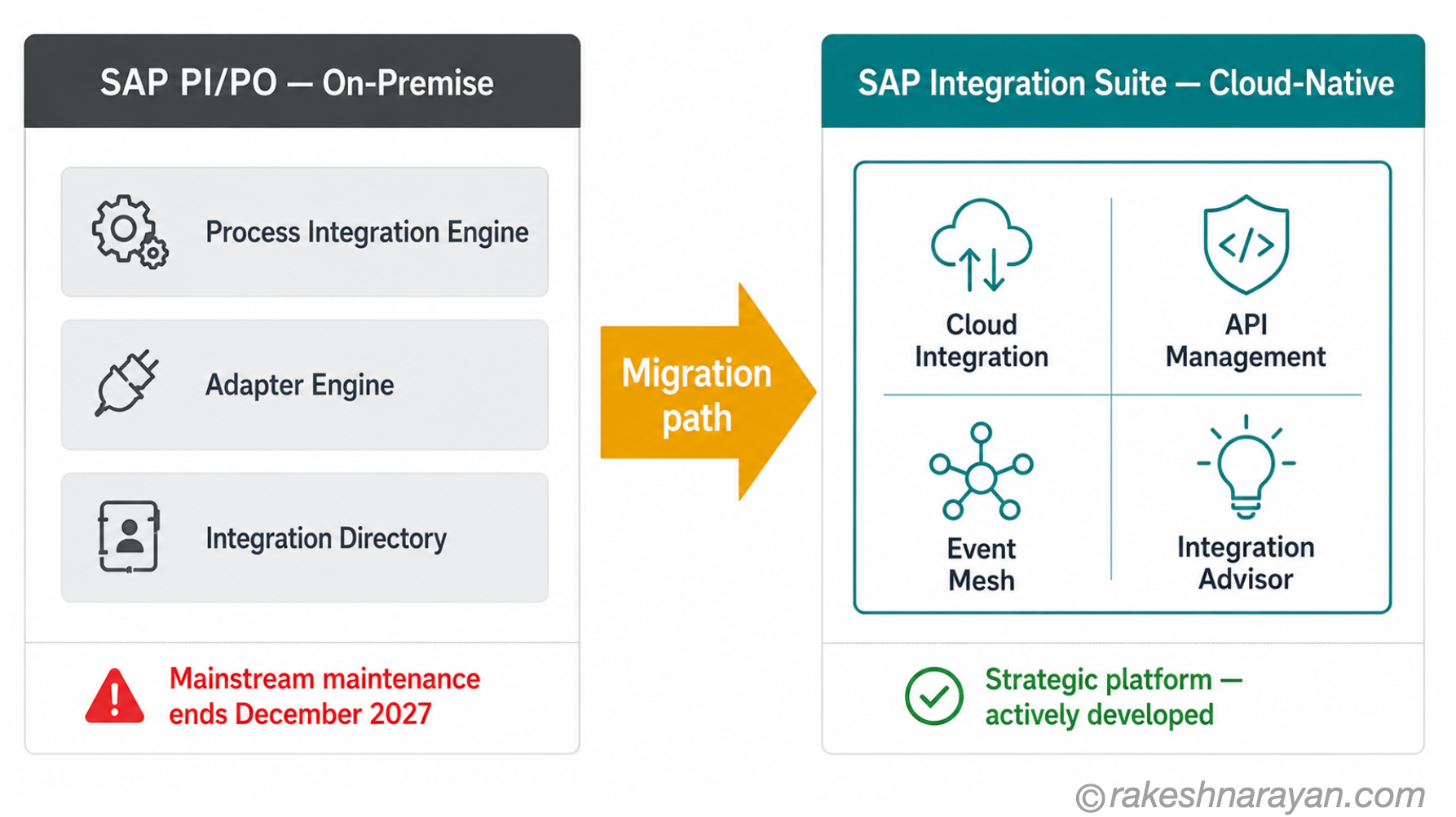
SAP PI (Process Integration) and SAP PO (Process Orchestration) mainstream maintenance ends December 2027, with extended maintenance available until 2030 at additional cost. After that, SAP provides no further security updates or support.
Integration Suite is SAP’s designated migration target. Cloud Integration handles the same A2A and B2B process integration scenarios that PI/PO did. Existing PI/PO objects — IDocs, RFCs, ABAP Proxies, message mappings — have migration paths. SAP provides Migration Assessment (the capability described above) and tooling to automate parts of the migration.
Three things are genuinely different from PI/PO and worth understanding before you migrate:
| What changes | PI/PO approach | Integration Suite approach |
|---|---|---|
| Design paradigm | Graphical ID and mapping objects, separate communication channels | iFlows — a single graphical artifact combines routing, mapping and channel configuration |
| Deployment model | On-premise NetWeaver stack you manage | Cloud-native managed service — SAP handles infrastructure, upgrades, scaling |
| Monitoring | Transaction SXI_MONITOR, RWB — separate tools | Unified monitoring dashboard in the Integration Suite UI — one place for all capabilities |
✅ Best practice
Run Migration Assessment before any PI/PO migration scoping conversation. It will classify your existing interfaces by migration complexity — straightforward, needs rework, or not migratable. That classification drives your timeline and cost estimate more accurately than any rule of thumb.
At a glance — SAP Integration Suite
| Concept | One-line summary |
|---|---|
| SAP Integration Suite | SAP’s cloud-native iPaaS on BTP — the strategic integration platform for S/4HANA-centric organisations |
| Cloud Integration | The core engine — design and run iFlows that move and transform data between systems |
| iFlow | The unit of work in Cloud Integration — a graphical integration flow combining routing, mapping and channel config |
| API Management | Govern, secure and publish APIs — adds rate limiting, authentication and a developer portal on top of your interfaces |
| Advanced Event Mesh | Real-time event distribution — publish/subscribe messaging for asynchronous, loosely coupled integration |
| Integration Advisor | AI-assisted B2B/EDI mapping — proposes mappings between industry standards using a shared knowledge base |
| Trading Partner Management | Business configuration for B2B — manage partner agreements and document exchange settings |
| Migration Assessment | Analyses your PI/PO landscape and classifies interfaces by migration complexity — run this first |
| SAP Business Accelerator Hub | Over 3,400 prebuilt integrations from SAP and partners — check here before building from scratch |
| PI/PO end of mainstream maintenance | December 2027 — organisations on PI/PO should be actively planning migration now |
| Gartner Magic Quadrant | SAP named a Leader in iPaaS for the sixth consecutive year in 2026 |
What to take away
Integration Suite is not just PI/PO in the cloud. That framing is technically accurate but strategically wrong. PI/PO was a middleware box — one tool for one integration pattern. Integration Suite is a set of composable capabilities you pick based on what the integration problem actually requires. Event-driven? Advanced Event Mesh. API exposure? API Management. B2B EDI? Integration Advisor. Process integration? Cloud Integration.
The organisations getting the most out of Integration Suite are not those who migrated PI/PO interfaces one-for-one. They are the ones who used the migration as an opportunity to redesign — replacing batch IDocs with event-driven flows, exposing data via governed APIs instead of point-to-point connections, and centralising monitoring in one place for the first time.
If your organisation is still on PI/PO, the 2027 deadline is real. But the migration is not just a maintenance exercise. Done well, it is the cleanest opportunity you will get to modernise how SAP connects to everything else.
🔗 Related posts on this site
SAP Integration Patterns — The Decisions That Matter — the strategic layer above Integration Suite: when to use synchronous, asynchronous, event-driven or batch patterns.
SAP BTP — The Platform Explained — Integration Suite runs on BTP; this post explains what BTP is and how its services fit together.
OData Protocol in SAP — V2, V4 and How It Works — OData is the API standard behind most SAP service exposures; understanding it helps when configuring API Management.
Event-Driven Architecture — The Concept Behind Modern Integration — the architectural pattern that Advanced Event Mesh implements — essential reading before designing event-driven iFlows.
SAP Integration Suite MCP Gateway — AI Agents to SAP APIs — how the APIs and iFlows you build here become governed tools for AI agents.
Published on rakeshnarayan.com — Articles
URL: https://rakeshnarayan.com/articles/sap-integration-suite-what-it-is-and-how-it-works/
Did you enjoy this article?
Let me know — it takes one click.
0 Comments
Leave a Comment
Looks like this one held your attention — I'd really appreciate a quick comment below.
Your comment has been submitted and will appear after review.