AI in SAP: How Joule and Business AI Actually Work
🔗 Read These First
What is a Large Language Model (LLM)? — understanding how LLMs work gives important context for how Joule and SAP’s generative AI capabilities are built.
AI Agents — What They Are and How They Work — Joule is increasingly agent-based. This post explains the agent concept.
Every major enterprise software vendor has announced AI capabilities in the last two years. SAP is no different. The difference is that SAP’s AI story is harder to follow — because the company has been embedding AI across a product suite that spans ERP, HR, procurement, analytics, and a cloud platform, and it is doing so at a pace that makes any snapshot quickly out of date.
This post cuts through that. It explains how SAP has structured its AI approach, what Joule actually is and is not, where AI sits in S/4HANA and BTP, and what has changed as SAP’s AI capabilities have shifted from assistant to agent. The goal is a stable mental model — not a feature list, which will be obsolete by the time you read it.
SAP Business AI — the Framework
SAP calls its overall AI approach SAP Business AI. The framing is deliberate: not generic AI applied to enterprise software, but AI that is grounded in business context, trained on or adapted to SAP-specific data, and designed to be relevant, reliable, and responsible.
SAP Business AI has three properties it emphasises across all its AI capabilities:
| Property | What It Means | Why It Matters |
|---|---|---|
| Relevant | AI that understands business context — SAP data models, business processes, industry semantics. | Generic LLMs often produce plausible but wrong answers for domain-specific questions. Business context reduces this. |
| Reliable | Traceable, auditable outputs with human oversight. AI that explains its reasoning. | Enterprise decisions need accountability. An AI that cannot explain why it recommended something is a liability. |
| Responsible | GDPR compliance, data residency options, transparency in AI usage. | Enterprise customers need to know where their data goes. SAP offers regional hosting and data isolation options. |
Joule — What It Actually Is
Joule is SAP’s AI copilot — a conversational assistant embedded across SAP products. It was introduced in 2023 and has expanded rapidly. As of 2026, Joule is available in S/4HANA Cloud Public and Private Edition, SuccessFactors, Ariba, Concur, and SAP BTP.
The technical underpinning: Joule is not a single model. It is a layer built on top of large language models — including models from SAP’s partners (Microsoft, Google, Anthropic, and others) — combined with SAP’s Knowledge Graph. The Knowledge Graph is a semantic representation of S/4HANA’s data structures, APIs, and business object relationships. It is what allows Joule to understand SAP-specific context that a generic LLM would not know.
| What Joule Can Do | What Joule Is Not (Yet) Fully |
|---|---|
| Answer questions about business data in natural language | A replacement for SAP Fiori apps for complex transactions |
| Execute standard transactions triggered by natural language | A general-purpose coding assistant for all ABAP scenarios |
| Surface insights and anomalies across S/4HANA processes | Fully autonomous — human confirmation still required for most actions |
| Generate ABAP code via Joule for Developers (in ADT) | Available on all SAP products — rollout is still in progress |
| Summarise documents, contracts, and reports | Equally capable across all languages — strongest in English |
From Copilot to Agent — What Changed in 2025–2026
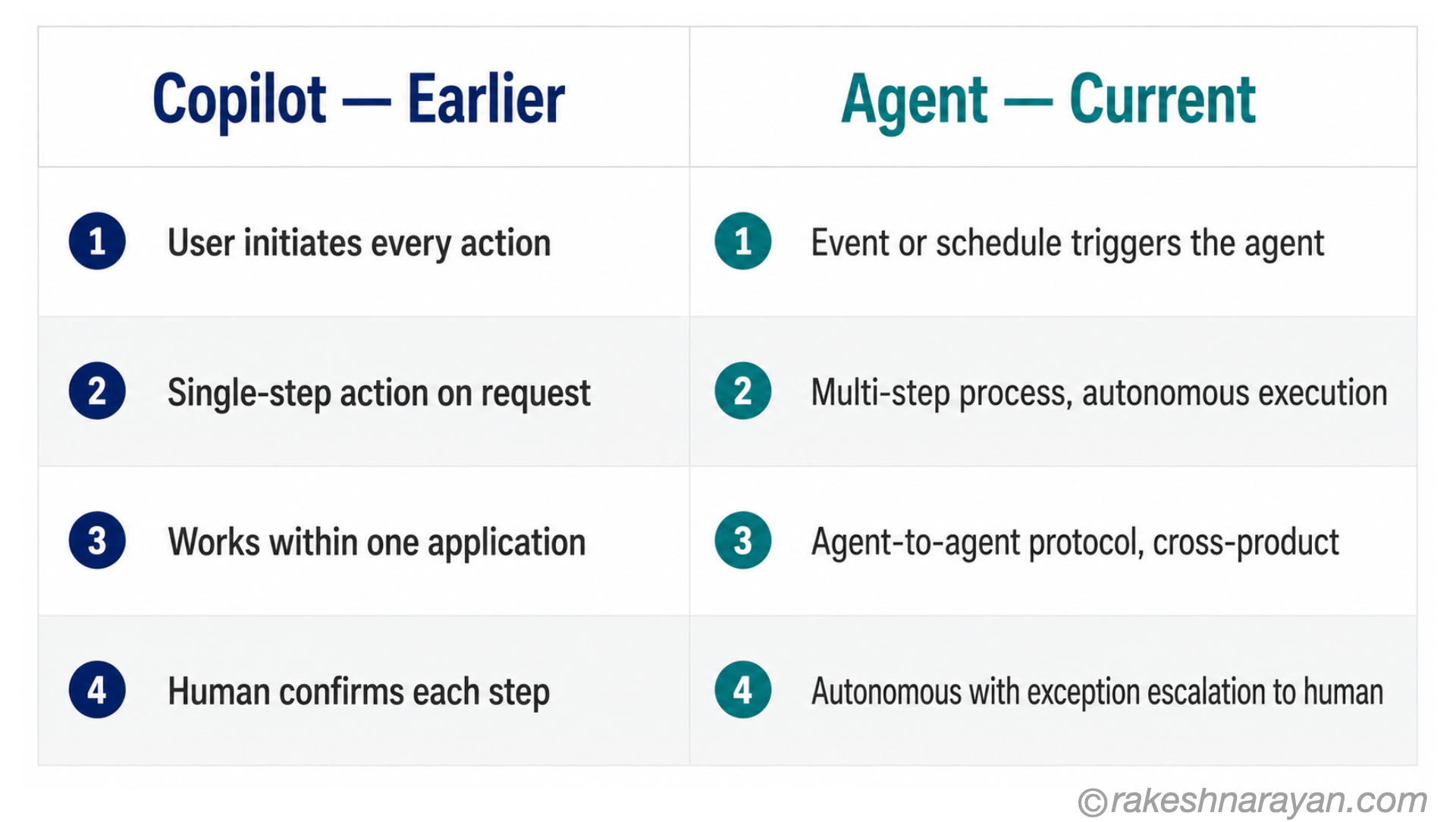
The most significant shift in SAP’s AI story over 2025 and 2026 has been the move from copilot to agent. A copilot responds to questions and executes single actions on request. An agent operates more autonomously — it can plan a sequence of steps, execute them across multiple systems, and handle exceptions without constant human input.
SAP now ships over 40 specialised Joule Agents, each designed for a specific business process. Examples include a Tender Analysis Agent that extracts requirements and flags risks from procurement documents, a Project Setup Agent for S/4HANA project management, and a Product Data Maintenance Agent that works across S/4HANA editions. These agents can also communicate with each other using SAP’s agent-to-agent protocol.
| Copilot Pattern (Earlier) | Agent Pattern (Current) |
|---|---|
| User asks a question → Joule answers | Agent detects a condition → agent acts |
| Single-step action on request | Multi-step process executed autonomously |
| Human initiates every interaction | Agent can initiate based on events or schedules |
| Works within one application context | Agent-to-agent protocol — works across SAP products |
AI in the BTP Layer — AI Core and AI Launchpad
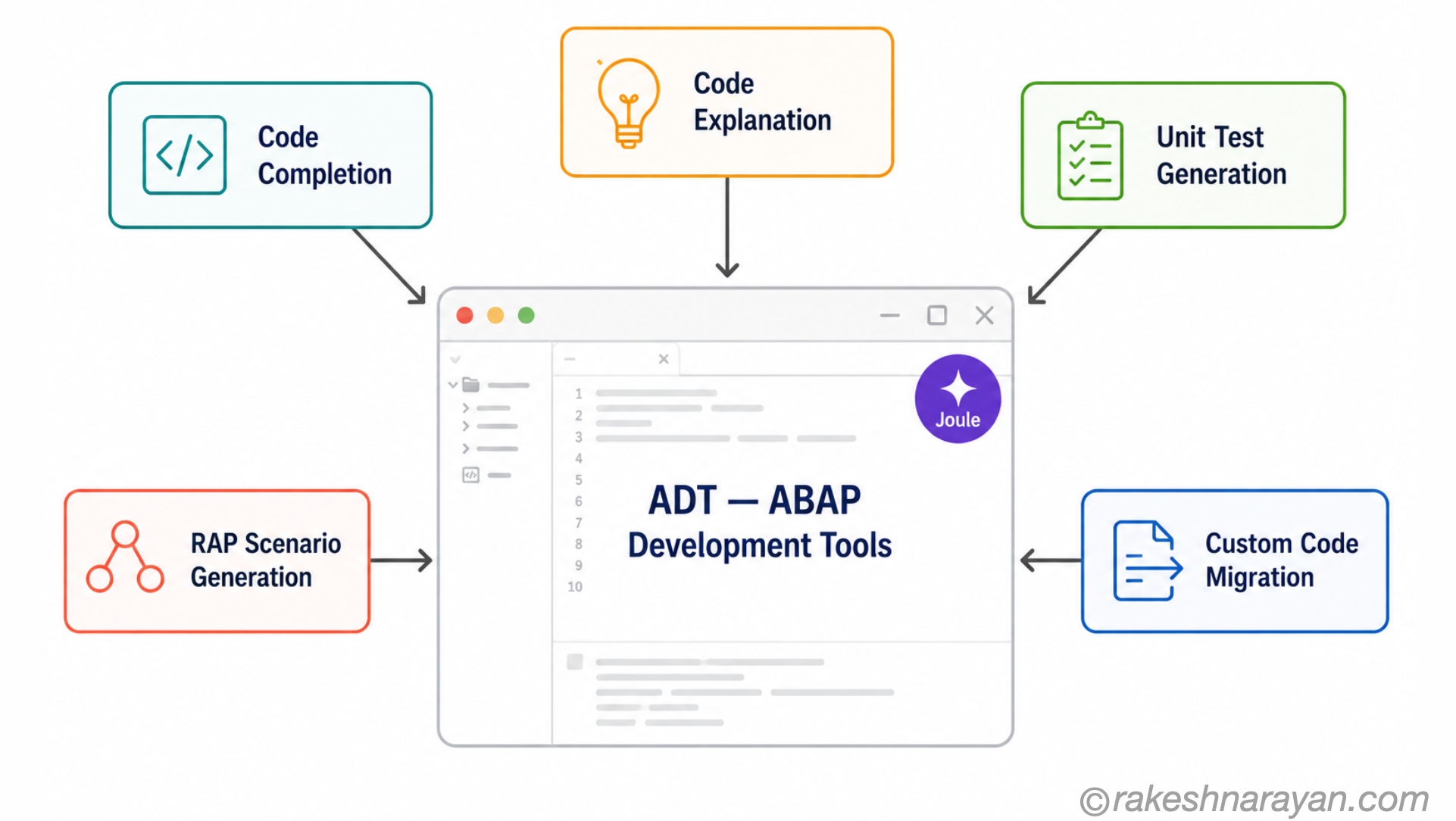
The infrastructure for SAP’s AI capabilities lives on BTP. Two services matter here.
SAP AI Core is the service that hosts and runs AI models. It supports both SAP’s own models and third-party models via a standardised API. If you are building a custom AI-powered application on BTP, AI Core is where you deploy your models and run inference.
SAP AI Launchpad is the management interface — it lets you monitor models, track experiments, and manage the lifecycle of AI scenarios. Together, AI Core and AI Launchpad give customers and partners the infrastructure to build custom AI capabilities using the same platform that SAP itself uses for Joule.
Joule for Developers — AI for ABAP
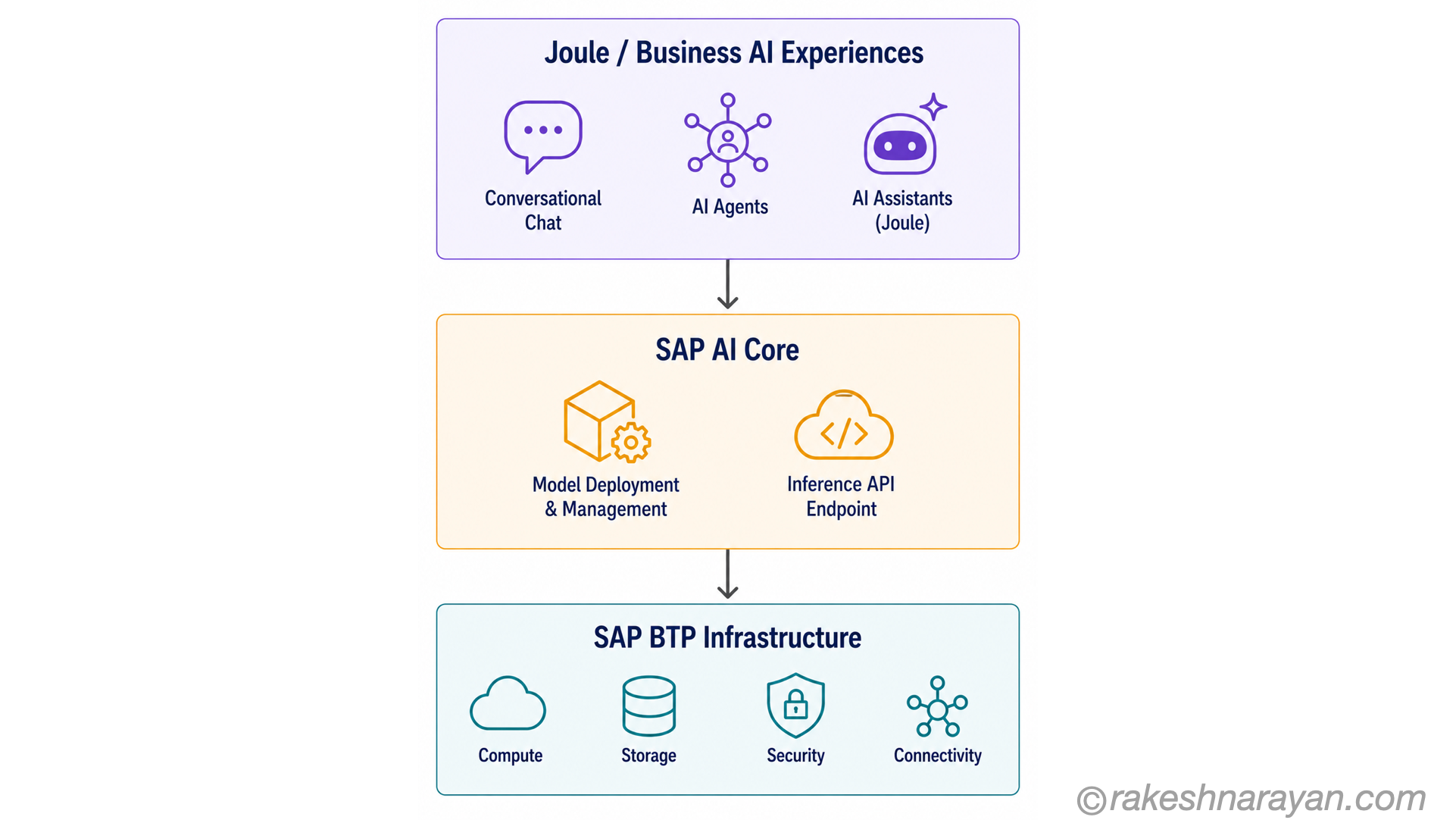
Joule for Developers is a separate product — an AI coding assistant integrated directly into ABAP Development Tools (ADT) in Eclipse. It is distinct from the end-user Joule. Its focus is developer productivity.
| Joule for Developers Capability | What It Does in Practice |
|---|---|
| Code completion | Predicts and generates subsequent lines of ABAP based on what you are writing and the ABAP language version. |
| Code explanation | Explains what a selected block of ABAP code does in plain language. Useful for legacy code analysis. |
| Unit test generation | Generates ABAP unit tests for existing methods and classes. |
| End-to-end scenario generation | Generates complete RAP objects — data model, behaviour definition, service definition — from a natural language description. |
| Custom code migration | Analyses classic ABAP for Cloud compatibility and suggests changes for ABAP Cloud. |
💡 Practical Tip
As of mid-2026, Joule for Developers is available as a free promotion (until October 2026) for SAP BTP ABAP Environment and S/4HANA Cloud customers. After October 2026 it becomes a paid Premium AI feature. If you develop ABAP, try it now — particularly the code explanation capability, which is genuinely useful for understanding legacy code quickly.
The Honest Assessment — Where SAP AI Is and Is Not
SAP’s AI capabilities in 2026 are real, expanding, and genuinely useful in specific scenarios. The Joule Skills count (over 2,500 as of early 2026), the agent-to-agent protocol, and the Knowledge Graph are substantive technical advances, not just marketing.
The gap is adoption. A Horváth survey of 200 large companies found that 60% of those actively migrating to S/4HANA consider themselves not agile enough to implement Joule alongside the migration. The SAP transformation journey itself is demanding enough that adding AI adoption on top is a stretch for many organisations.
The practical implication: Joule and SAP’s AI capabilities are worth understanding now, and worth piloting in specific high-value scenarios. Expecting them to transform the entire SAP landscape in 12 months is not a realistic framing.
At a Glance — The Mental Model
| Concept | One-Line Summary |
|---|---|
| SAP Business AI | SAP’s overarching AI framework. Relevant, reliable, responsible — applied across the product suite. |
| Joule | SAP’s AI copilot/agent. Conversational, cross-product, grounded in SAP’s Knowledge Graph. |
| Knowledge Graph | SAP’s semantic model of S/4HANA data structures and APIs. What makes Joule SAP-specific. |
| Joule Agents | Autonomous agents for specific business processes. 40+ available as of 2026. Can work cross-system. |
| SAP AI Core | BTP service for hosting and running AI models. Infrastructure for custom AI development. |
| Joule for Developers | ABAP coding assistant in ADT. Code completion, explanation, test generation, scenario scaffolding. |
What Will Not Change
The specific features and agent counts will continue to change quickly. What will not change is the architecture: AI grounded in business semantics, delivered through Joule as the interface, running on BTP’s AI infrastructure, and increasingly operating as agents rather than just assistants.
Understanding those structural layers is more durable than memorising the current capability list. When the next Joule release adds fifty new skills, the question to ask is not ‘what is new’ but ‘which layer of the architecture does this sit in, and does it change how I should design my system.’
🔗 Related Reading
What is a Large Language Model (LLM)? — the technical foundation that Joule is built on.
AI Agents — What They Are and How They Work — the concept that explains Joule’s evolution from copilot to autonomous agent.
SAP BTP — The Platform Explained — where SAP AI Core, AI Launchpad, and the AI infrastructure live.
ABAP Fundamentals That Still Matter — the ABAP development context for Joule for Developers.
RAG — Retrieval Augmented Generation Explained — the technique behind how Joule grounds its responses in SAP-specific data.
SAP Integration Suite MCP Gateway — AI Agents to SAP APIs — where Joule’s internal MCP usage ends and customer-managed MCP Gateway for external agents begins.
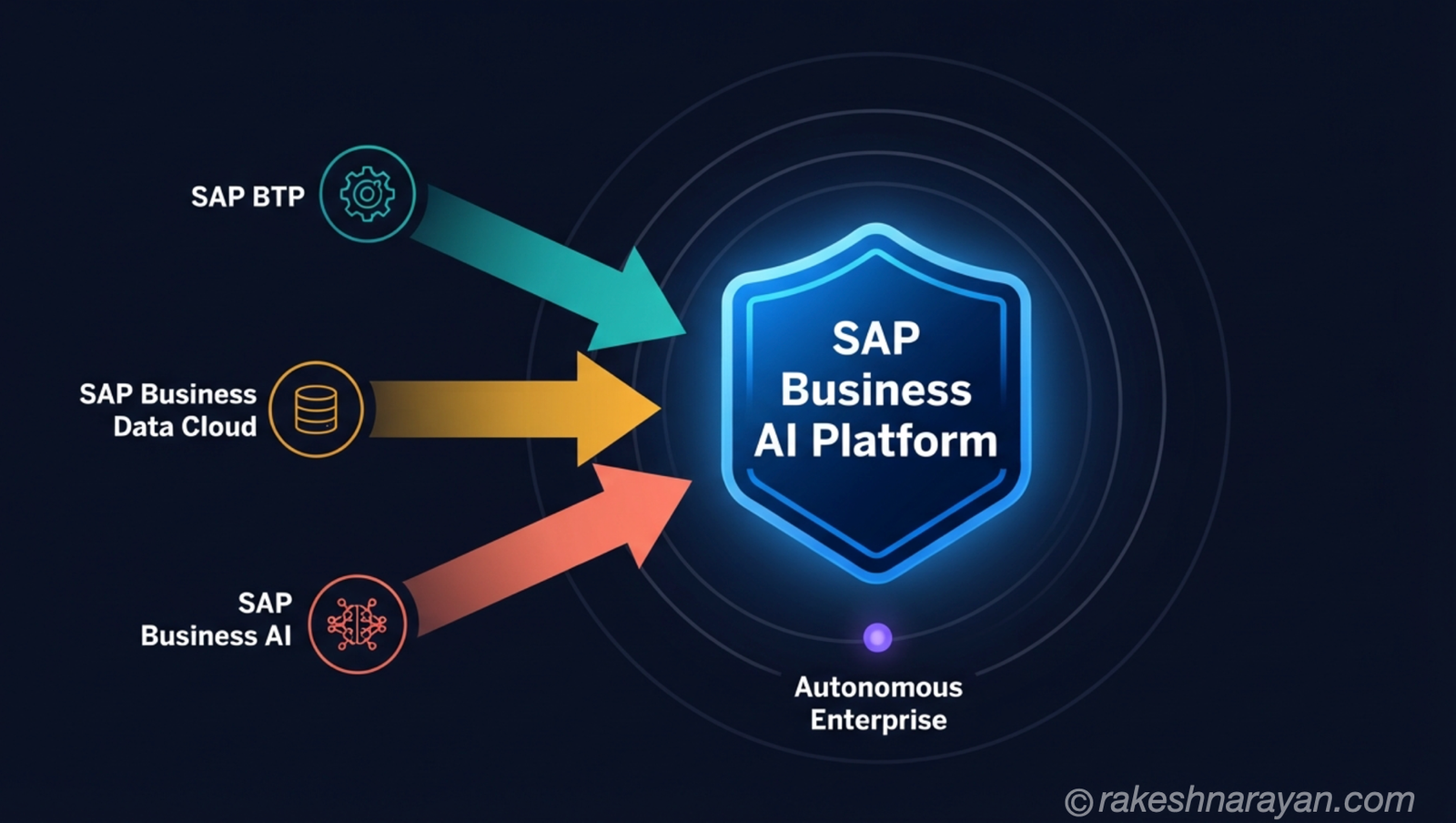
SAP Business Data Cloud — The Architecture Behind SAP’s AI Push — the governed semantic data layer feeding Joule and Business AI across SAP’s product line.
SAP Business AI Platform (BAIP) — BTP, BDC and AI Explained — how Joule and the AI Agent Hub fit into SAP’s unified architecture, one level above this post.
Published on rakeshnarayan.com — Articles
URL: https://rakeshnarayan.com/articles/ai-in-sap-how-joule-and-business-ai-actually-work/
Did you enjoy this article?
Let me know — it takes one click.
0 Comments
Leave a Comment
Looks like this one held your attention — I'd really appreciate a quick comment below.
Your comment has been submitted and will appear after review.