SQL vs NoSQL Databases — What the Difference Actually Means
Most people learn these two terms before they understand what problem each one solves. SQL gets taught first — tables, rows, joins — and then NoSQL arrives as an alternative that is somehow faster and more flexible. The natural conclusion is that NoSQL is the modern upgrade and SQL is the legacy approach.
That framing is wrong, and it leads to real mistakes. Teams pick MongoDB because it feels contemporary, then spend months fighting the lack of joins. Others stick to PostgreSQL for a use case it was never designed for, then wonder why it does not scale. The choice is not about old versus new. It is about what shape your data is in and what you need to do with it.
Once that reframe clicks, everything else — ACID, BASE, document stores, graph databases — falls into place naturally.
🔗 Foundation reading
SQL Fundamentals — if you want to understand what SQL actually looks like before reading this comparison, start there. Vector Databases Explained — the specialist NoSQL type that powers AI search and RAG systems, covered in depth.
The core difference — structure vs flexibility
A relational database organises data into tables — rows and columns — with a fixed schema defined upfront. Before you store a single record, you decide what fields every record will have and what type of data each field holds. Relationships between tables are enforced through foreign keys. You query everything with SQL.
The defining property is that structure is mandatory. Every row in a table must conform to the same schema. That constraint is a feature, not a limitation — it is what makes joins reliable and data integrity enforceable.
NoSQL means Not Only SQL — not no SQL at all. It is an umbrella term for any database that does not use the relational table model. That covers four distinct types of database (more on those shortly), each with a different data model. What they share is a more flexible approach to structure: you do not need a fixed schema, and you can often add fields to individual records without changing the whole database.
📌 The real fork in the road
The question is not which database is better. It is: does your data have a predictable, consistent structure that benefits from enforced relationships — or does it need the flexibility to evolve, vary per record, or scale horizontally across many servers?
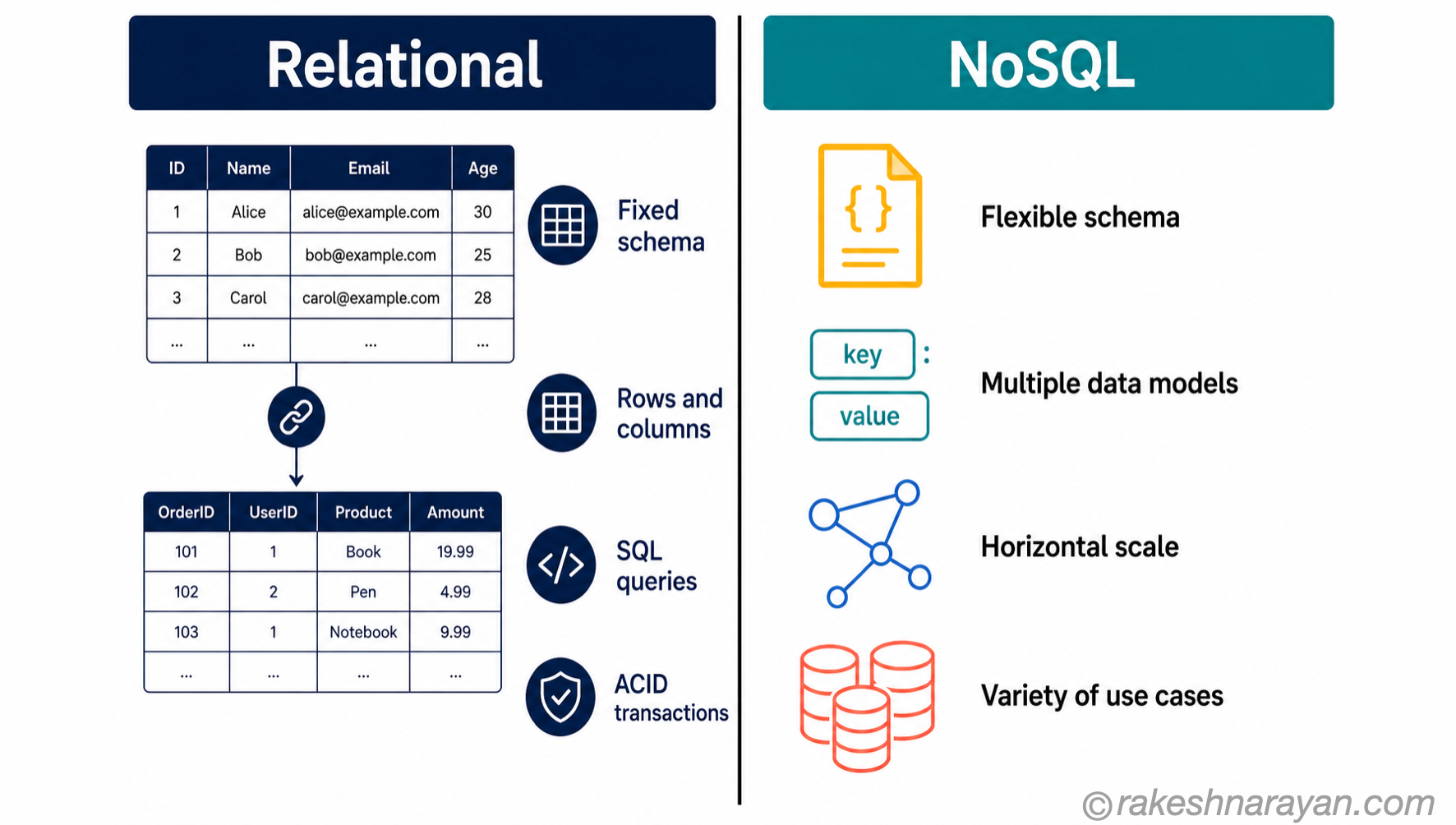
What relational databases do well
The reason relational databases have dominated enterprise systems for four decades is ACID — four properties that guarantee every transaction is handled reliably.
| Property | What it means | Why it matters |
|---|---|---|
| Atomicity | A transaction is all-or-nothing — if any part fails, the whole thing rolls back | No partial writes — a payment either completes fully or not at all |
| Consistency | Every transaction leaves the database in a valid state, according to defined rules | Data integrity is enforced at the database level, not left to the application |
| Isolation | Concurrent transactions do not interfere with each other | Two users editing the same record simultaneously get predictable results |
| Durability | Once a transaction is committed, it stays committed — even if the system crashes | You do not lose data after a confirmed write |
These properties matter most when the cost of a data error is high. Financial systems, inventory management, order processing, ERP — anything where a half-written record creates a real problem. This is why SAP S/4HANA runs on SAP HANA, a column-oriented in-memory relational database. ACID compliance is not optional in enterprise transactional systems.
Relational databases also handle complex queries well. When you need to join data across multiple tables — orders to customers to products to suppliers — a relational model with proper indexing is hard to beat. The schema that feels restrictive in early development becomes an asset when your data grows and the queries get complicated.
✅ Best practice
Choose a relational database when your data is structured, relationships between entities matter, transactions must be reliable, and complex queries across multiple entities are expected. PostgreSQL, MySQL and SAP HANA are the mature choices in 2026.
The four types of NoSQL — and why they are not the same thing
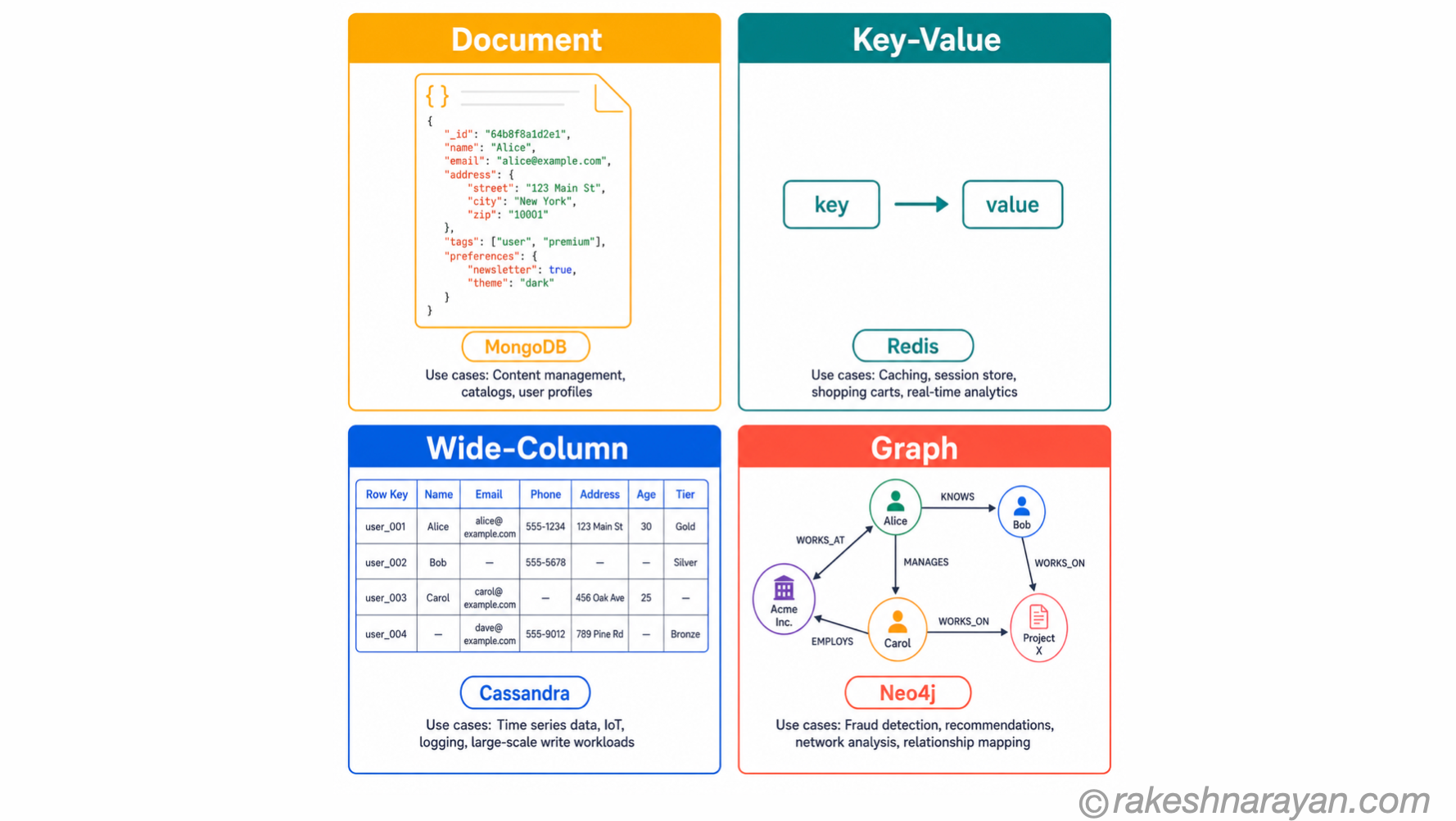
This is the part most comparisons get wrong. NoSQL is not one thing. It is four distinct data models, each designed for a different problem. Treating them as interchangeable is like saying relational databases and spreadsheets are the same because both use rows and columns.
1. Document databases
Data is stored as documents — typically JSON or BSON — where each document is a self-contained unit that can have its own structure. No two documents in a collection need to have the same fields.
Best for: Content management, user profiles, product catalogues — anything where records vary significantly in shape. MongoDB is the dominant example. CouchDB and Elasticsearch also fall into this category.
2. Key-value stores
The simplest NoSQL model: a unique key maps to a value. Think of it as a giant hash map. The value can be anything — a string, a number, a serialised object. No joins, no schema. Just fast reads and writes by key.
Best for: Session storage, caching, real-time leaderboards, shopping carts — any scenario where you need to retrieve a specific item by a known identifier as fast as possible. Redis is the benchmark here.
3. Wide-column stores
Data is organised into rows with a partition key, but unlike relational tables, different rows can have completely different columns. Designed to handle enormous datasets distributed across many servers.
Best for: Time-series data, IoT telemetry, activity logs, large-scale analytics — workloads with high write throughput and massive data volumes. Apache Cassandra and HBase are the primary examples.
4. Graph databases
Data is stored as nodes (entities) and edges (relationships). Traversing complex networks of relationships — which would require expensive joins in a relational database — is what graph databases are designed for.
Best for: Social networks, fraud detection (finding suspicious patterns across accounts), recommendation engines, knowledge graphs. Neo4j is the most widely used graph database.
The decision — how to actually choose
Three questions settle most database decisions. Answer them in order.
-
Does your data have a consistent, well-defined structure with relationships that need to be enforced? If yes — relational. This describes most enterprise business data: customers, orders, invoices, inventory. The schema is your safety net.
-
Does your application need to scale writes horizontally across many servers, or handle massive volumes of data that would not fit on a single machine? If yes — NoSQL, and then decide which type based on your data model. Relational databases can scale reads well, but horizontal write scaling is where they struggle.
-
What does your data actually look like? Structured and tabular — relational. JSON documents that vary per record — document store. Relationships between entities you will traverse — graph.
Simple lookups at high speed — key-value. Time-series or event streams — wide-column.
⚠️ The most common mistake
Choosing NoSQL because it ‘sounds more scalable’ without a specific scalability problem to solve. A relational database handles tens of millions of records with good indexing without breaking a sweat. NoSQL adds operational complexity — schema management moves to the application layer, joins become application-side logic, and eventual consistency can produce subtle bugs. Only accept that trade-off if you have a concrete reason.
| Scenario | Database type | Why |
|---|---|---|
| Bank transaction processing | Relational (PostgreSQL, Oracle) | ACID compliance is non-negotiable — partial writes are catastrophic |
| E-commerce product catalogue | Document (MongoDB) | Products vary wildly in attributes — a TV and a T-shirt have nothing in common structurally |
| User session and cache storage | Key-value (Redis) | Session lookup by ID at sub-millisecond speed — no joins needed |
| Social network friend graph | Graph (Neo4j) | Finding connections between users requires relationship traversal, not table joins |
| IoT sensor telemetry at scale | Wide-column (Cassandra) | Billions of time-stamped rows written continuously — needs horizontal scale and high write throughput |
| SAP S/4HANA ERP data | Relational (SAP HANA) | Complex transactional business data with strict integrity and reporting requirements |
Where the lines blur — polyglot persistence
Most real systems do not pick one database type and stick to it. They use multiple databases for different purposes — a pattern called polyglot persistence.
A typical e-commerce platform might use PostgreSQL for orders and customer accounts (ACID, joins), Redis for session data and caching (speed), Elasticsearch for product search (text search), and a graph database for recommendations (relationship traversal). Each database does what it is designed for.
This is not complexity for its own sake. It is the recognition that different parts of an application have genuinely different data requirements. The cost is operational — more databases to manage, monitor and back up. The benefit is that you are not forcing the wrong tool to do a job it was never built for.
💡 Practical tip — SAP context
SAP HANA is a column-oriented, in-memory relational database that also supports graph and text analytics. For SAP customers building AI systems on BTP, HANA Cloud added native vector storage in 2024 — meaning the same HANA instance can handle your structured SAP transactional data and the vector embeddings needed for RAG pipelines. That is polyglot persistence built into a single platform.
Vector Databases Explained covers the vector storage side in full.
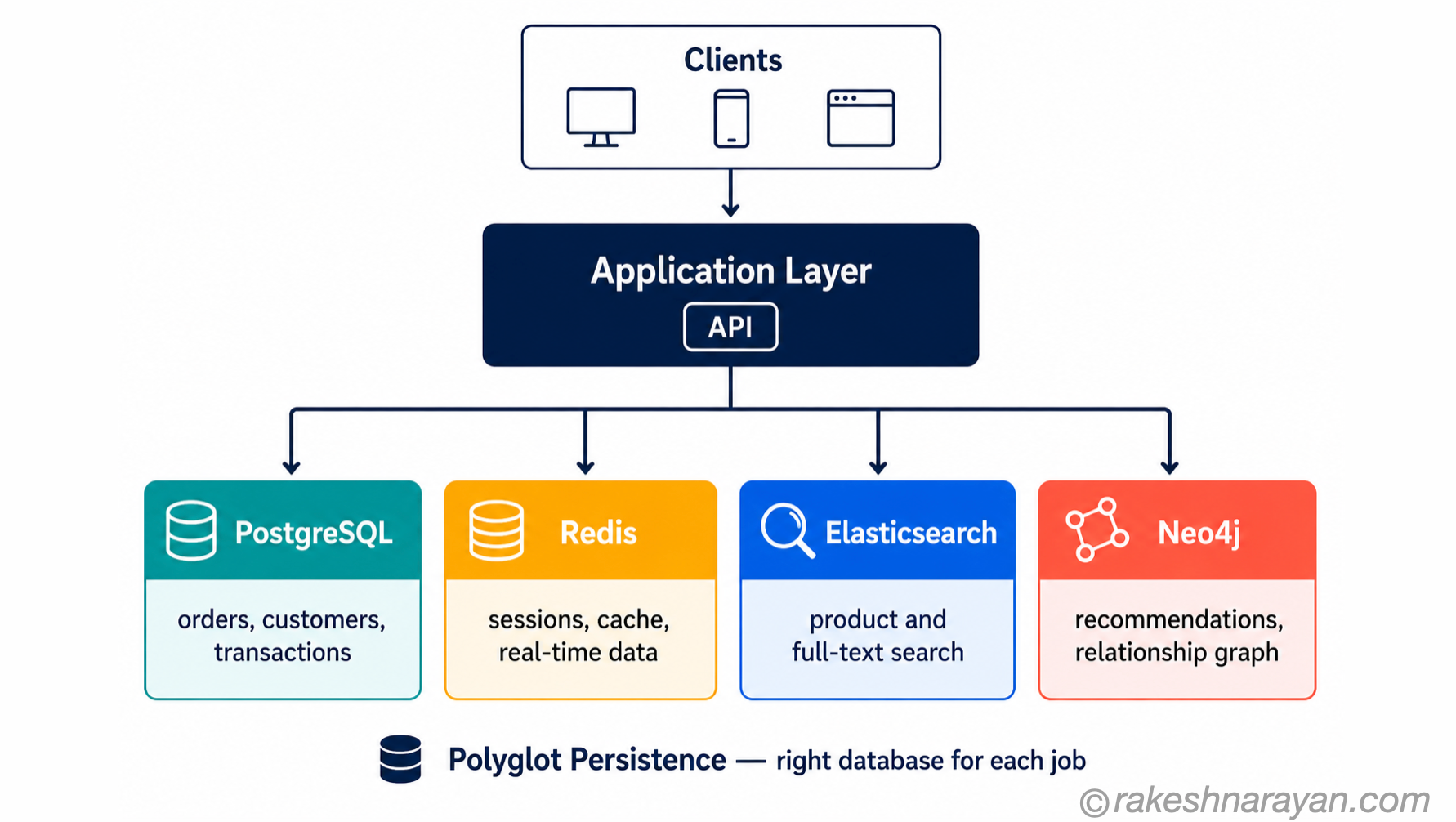
At a glance — SQL vs NoSQL
| Concept | One-line summary |
|---|---|
| Relational database | Tables, rows, columns, fixed schema — structured data with enforced relationships |
| SQL | The query language for relational databases — also the name for the database category |
| NoSQL | Not Only SQL — an umbrella term for databases that do not use the relational table model |
| ACID | Four guarantees (Atomicity, Consistency, Isolation, Durability) that make relational transactions reliable |
| Document database | Stores JSON-like documents — flexible schema, no fixed structure per record (MongoDB) |
| Key-value store | Stores data as key → value pairs — the fastest retrieval model, no joins (Redis) |
| Wide-column store | Rows with varying columns — built for massive write throughput and horizontal scale (Cassandra) |
| Graph database | Nodes and edges — designed for traversing complex relationships (Neo4j) |
| Polyglot persistence | Using multiple database types in one system — each doing what it was built for |
| SAP HANA | Column-oriented, in-memory relational database — the foundation for SAP S/4HANA |
What to take away
The SQL vs NoSQL debate is not a debate about which technology won. Both are in production everywhere in 2026, and they will be in 2030. The question has always been about fit — does the database model match the shape and access patterns of your data?
What surprises most people is that the wrong database choice is rarely obvious at the start. It becomes obvious six months in, when you are writing application-side join logic in MongoDB or watching your Postgres instance sweat under a billion-row time-series load. The schema decision you make on day one shapes every query you write for years.
The best engineers are not loyal to a database type. They are loyal to the problem. Pick the relational model when your data is structured, relationships matter and consistency is critical. Pick the right NoSQL type when the data model, scale or access pattern genuinely demands it. And when your system grows, do not be afraid to use both.
🔗 Related posts on this site
SQL Fundamentals — the queries that cover most of what you need: SELECT, JOIN, GROUP BY and more.
Vector Databases Explained — the specialist NoSQL type that powers semantic AI search and RAG systems.
Event-Driven Architecture — wide-column and key-value stores are often the database layer behind event-driven systems.
SAP BTP — The Platform Explained — SAP HANA Cloud on BTP: where relational and vector storage converge for enterprise AI.
Published on rakeshnarayan.com — Articles
https://rakeshnarayan.com/articles/sql-vs-nosql-databases-what-the-difference-actually-means/
Did you enjoy this article?
Let me know — it takes one click.
0 Comments
Leave a Comment
Looks like this one held your attention — I'd really appreciate a quick comment below.
Your comment has been submitted and will appear after review.