AI Data Sovereignty — The Three Concepts That Matter
Most enterprises have sent data to an AI provider without knowing which country processed it. Not because they were careless — because nobody asked the question. You connect to an API, you get results, and the infrastructure in between is somebody else’s problem.
That worked when the stakes were low. It does not work when the data includes customer records, financial transactions, or personally identifiable information — and when regulators in multiple jurisdictions are paying attention to exactly where that data went.
The challenge is that the vocabulary around this topic is genuinely confusing. Sovereignty, residency, localisation — these three terms are used interchangeably in vendor marketing, in procurement conversations and in boardroom risk discussions. They are not the same thing. And the differences between them have direct consequences for how you architect AI systems.
🔗 Foundation posts
This post connects directly to AI in the Enterprise — A Practical Map , which covers how organisations are deploying AI in 2026 and where governance fits in. Also relevant: Ethics and Responsible AI — the governance principles that make sovereignty decisions meaningful.
Why AI changes the data sovereignty question
Data sovereignty is not a new concept. Enterprises have been dealing with data residency requirements and cross-border transfer rules since GDPR came into force in 2018. But AI introduces a category of data flow that most existing frameworks were not designed to handle.
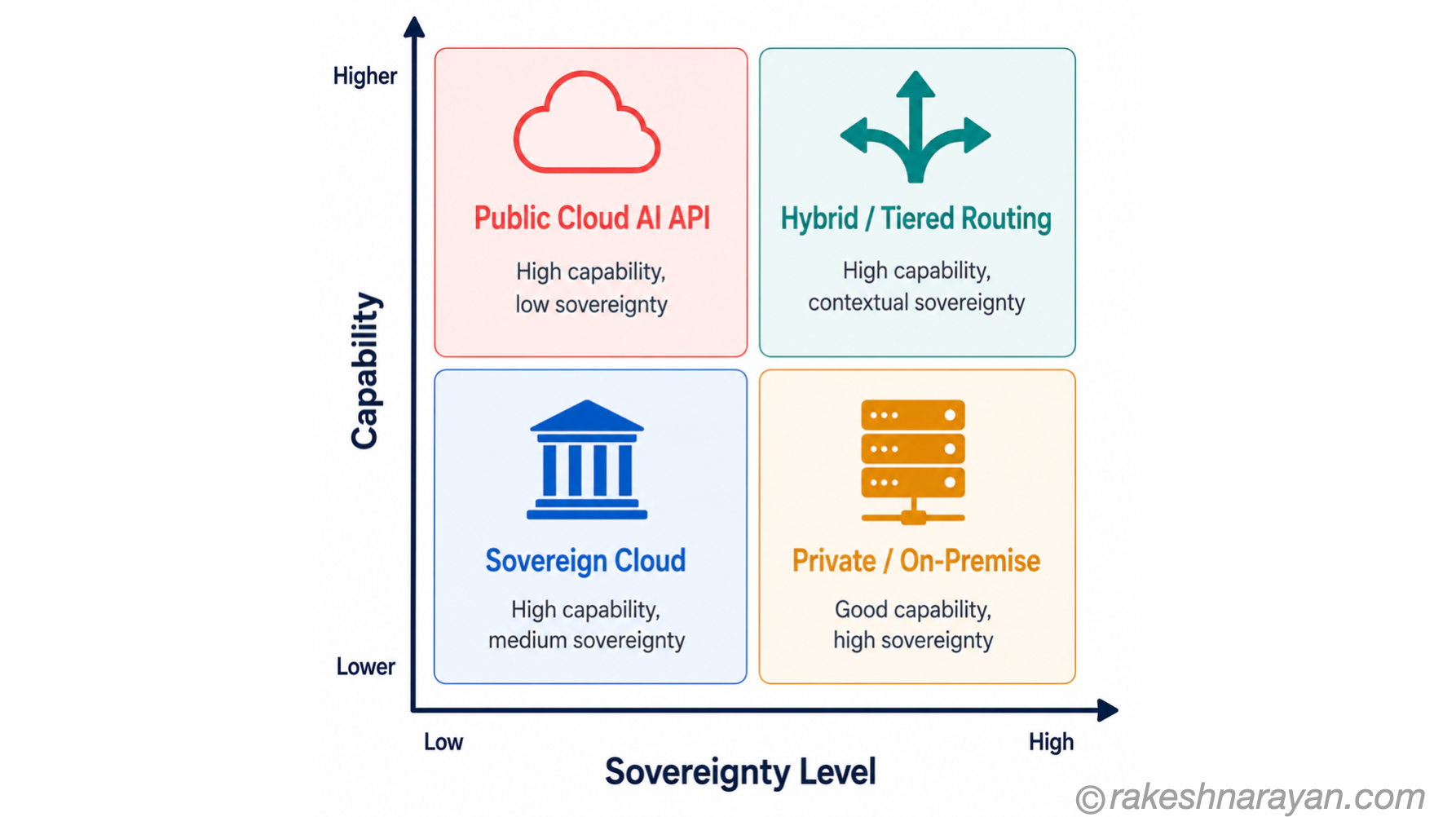
Every time you send a prompt to a cloud LLM API, that query — which may contain contract excerpts, customer names, internal financial figures, or strategic context — travels to a server you do not own, in a jurisdiction you may not have verified. The model processes it, generates a response, and the query may or may not be retained. Most organisations have no visibility into any part of that pipeline.
This is what makes AI different from conventional data storage. A database stores records. An AI pipeline processes meaning. Every query is a potential data transfer. Every RAG lookup chunks and embeds your documents on infrastructure you do not control. Every fine-tuning job sends your proprietary data to a training environment. The attack surface for sovereignty risk is not a data centre — it is every API call your systems make.
📌 Key Takeaway
AI workloads create data flows at query time, not just at storage time. The question is not only where your data sits — it is where your data goes every time someone uses your AI system.
The three concepts — and why they are not the same thing
This is the section that most posts skip. They use sovereignty, residency and localisation as synonyms. They are not.
| Concept | What it means | Who sets it |
|---|---|---|
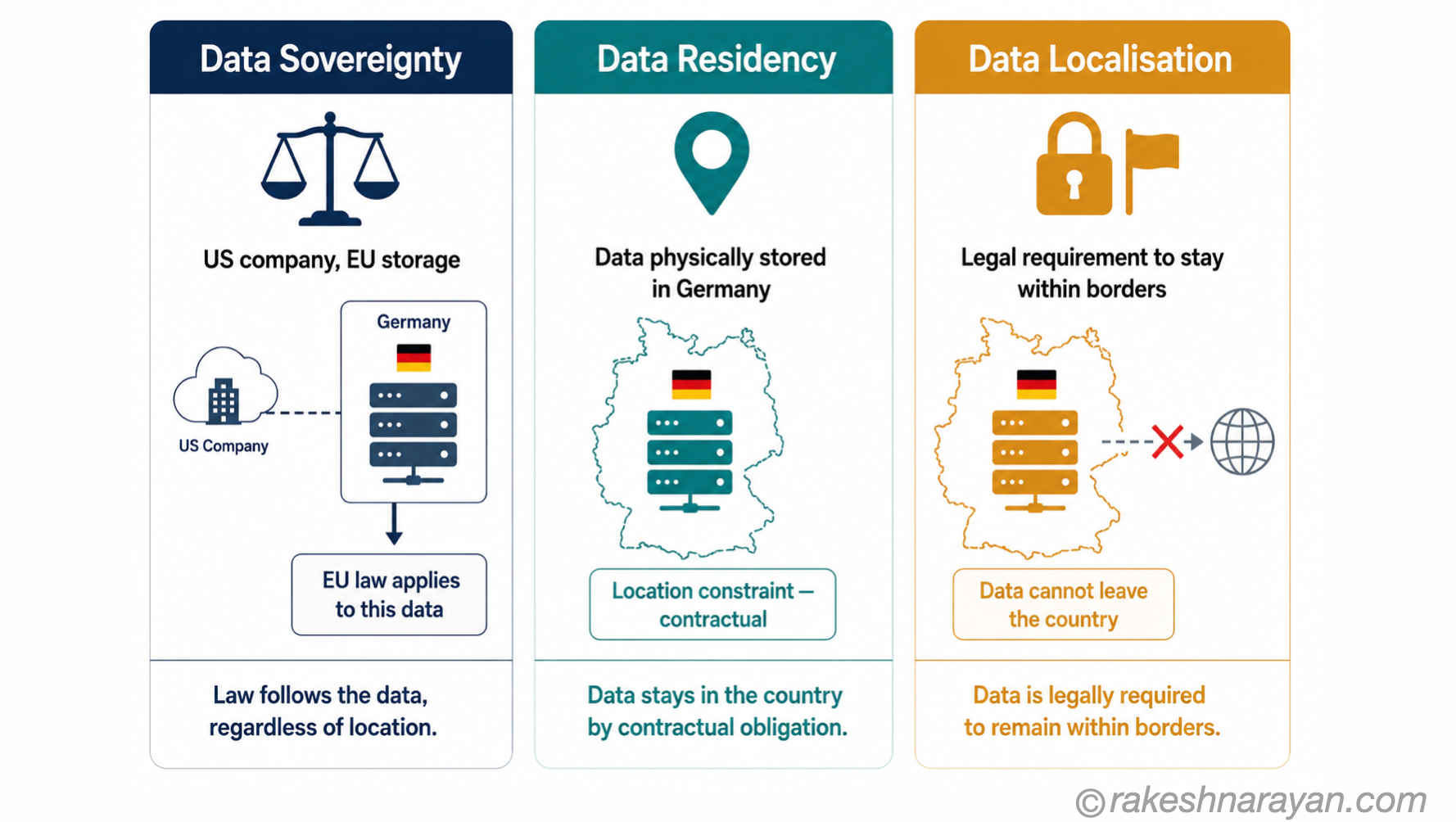
| Data Sovereignty | Data is governed by the laws of the country where it is stored or processed — not where your company is headquartered. A US company storing data in Germany is subject to German and EU law for that data. | Legal jurisdiction — set by where data is processed, not where the company is based |
| Data Residency | Data is physically stored within a specific geographic location — a country, region or cloud availability zone. Residency is a location constraint. It does not by itself determine legal jurisdiction. | Contractual — agreed between your organisation and your provider |
| Data Localisation | A legal requirement — imposed by a government — that data about its citizens or residents must be stored and processed within its borders. Localisation is a mandatory form of residency. It cannot be contracted away. | Regulatory — imposed by national law, not negotiable |
The practical consequence: data residency in the EU does not guarantee data sovereignty in the EU. If the provider is a US company — AWS, Azure, Google Cloud, OpenAI — US law still applies to that data regardless of where the servers are located. More on this in the next section.
Localisation is the hardest constraint. China’s PIPL requires that personal data on Chinese citizens be processed domestically. Russia has similar requirements. Saudi Arabia’s PDPL mandates local processing for certain categories. If your AI system processes data subject to these laws, you cannot route it through a global cloud provider and remain compliant — regardless of which data centre region you select.
The CLOUD Act problem nobody talks about
Here is the scenario that surprises most enterprises. You are a European company. You sign a contract with a major US cloud provider that guarantees your data stays in EU data centres. Your legal team reviews the Data Processing Agreement. Your procurement team ticks the GDPR compliance box.
None of that protects you from the US CLOUD Act.
The Clarifying Lawful Overseas Use of Data Act, passed by the US Congress in 2018, allows US authorities to compel access to data held by US companies — regardless of where that data is physically stored. A US government request directed at a US provider reaches their EU servers just as easily as their US servers. Location is irrelevant. Jurisdiction follows ownership.
⚠️ Warning
A US provider operating EU data centres cannot fully guarantee EU data sovereignty. US law applies to the provider, not just to the physical infrastructure. ‘GDPR-compliant’ and ‘sovereign’ are not the same claim — and vendors often use them interchangeably.
This creates a direct conflict with GDPR Article 48, which prohibits handing personal data to non-EU authorities without a recognised international agreement. The EU Data Act (applying from September 2025) adds a further layer — Chapter VII requires providers operating in the EU to challenge unlawful government access requests. But challenging a request is not the same as blocking it.
The EU–US Data Privacy Framework (adopted July 2023) provides a transfer mechanism for certified US companies. It does not resolve the underlying CLOUD Act conflict. Multiple EU data protection authorities have stated publicly that the framework does not fully address the tension between US surveillance law and GDPR. For organisations in regulated sectors — finance, healthcare, government — that legal uncertainty is not theoretical. It is audit exposure.
📝 Note
GDPR cumulative fines since 2018 now exceed €7.1 billion (DLA Piper GDPR Fines and Data Breach Survey, January 2026). Data transfer violations are no longer edge cases in enforcement — they represent some of the largest penalties on record.
Where AI workloads create sovereignty exposure
Most sovereignty conversations focus on databases and file storage. For AI, the exposure is different — and it is spread across the entire pipeline.
| AI workload | Where the exposure sits | Example |
|---|---|---|
| Cloud LLM API calls | Every prompt sent to a third-party model — GPT-4o, Claude, Gemini — is a cross-border data transfer if the processing happens outside your jurisdiction. | Employee submits a prompt containing a customer contract to a cloud AI assistant |
| RAG pipelines | Documents are chunked, embedded and stored in a vector database that may be hosted in any region. The embedding process itself sends document content to an external model endpoint. | Internal policy documents embedded and stored in a managed cloud vector store |
| Fine-tuning | Proprietary or personal data is sent to a provider’s training environment. Retention and deletion practices vary by provider and are rarely audited by customers. | HR performance data used to fine-tune an internal HR AI assistant |
| AI agents and MCP tools | Agents pull live business data — ERP records, CRM data, financial figures — to complete tasks. Each tool call is a real-time data exposure event, not a stored transfer. | An AI agent reads open purchase orders from SAP to draft a supplier response |
🔗 Related reading
RAG pipelines are one of the highest-risk workloads for sovereignty exposure. See RAG — Retrieval Augmented Generation Explained for the full architecture. AI agents create data flows at runtime that are especially hard to govern. MCP — Model Context Protocol Explained covers how agents connect to live business data — every one of those connections is a potential sovereignty event.
The four deployment models — and what each gives up
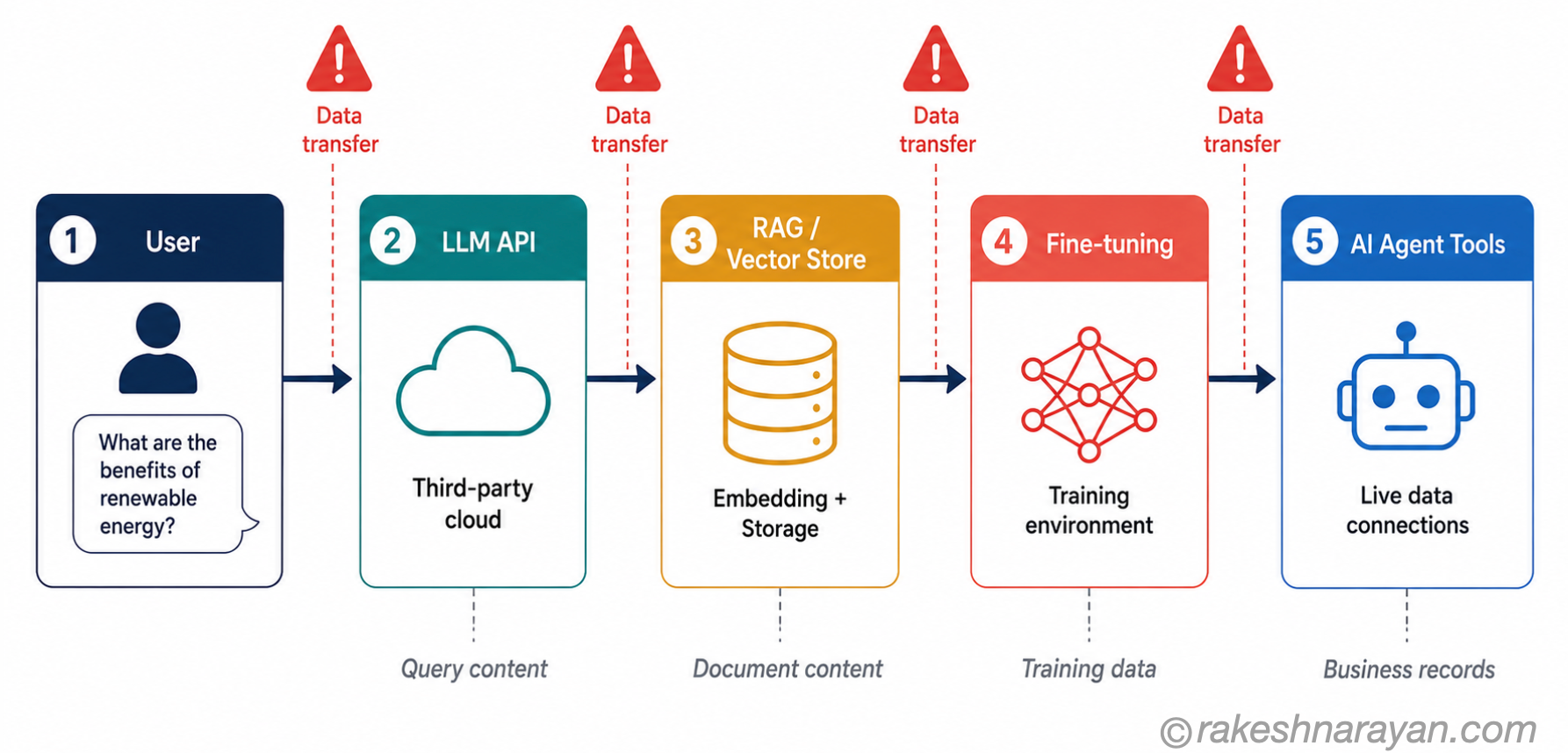
Once you understand where the exposure sits, the deployment decision becomes a trade-off between sovereignty and capability. There is no option that maximises both. The question is where you draw the line based on the data involved.
| Deployment model | Sovereignty level | Capability | Trade-off |
|---|---|---|---|
| Public cloud AI API (OpenAI, Anthropic, Google) | Low — data processed by a US provider under US jurisdiction, regardless of server location | Highest — access to frontier models, regular updates, no infrastructure overhead | Maximum capability, minimum sovereignty. Acceptable only for non-personal, non-regulated data. |
| Sovereign cloud / regional deployment (EU-only Azure region, sovereign cloud provider) | Medium — data residency guaranteed, but CLOUD Act risk remains for US-owned providers. True sovereignty requires a non-US provider. | High — full-scale cloud AI, but model selection may be narrower than public endpoints | Better compliance posture, but not a complete solution if the underlying provider is US-based. |
| Private cloud / on-premise open-weight models (Llama, Mistral on your infrastructure) | High — data never leaves infrastructure you control. No CLOUD Act exposure. | Good and improving — open-weight models now handle most enterprise use cases at competitive quality levels for the majority of tasks (as of 2026) | Infrastructure overhead and engineering cost. No automatic updates. Model quality ceiling below frontier. |
| Hybrid / tiered routing (sensitive data local, non-sensitive to cloud) | Contextual — sovereignty applied where the data warrants it | High — you use frontier models where safe, local models where required | Requires robust data classification before every AI query. The hardest to govern consistently but the most practical for large enterprises. |
✅ Best Practice
Classify your data before you choose your deployment model — not after. The instinct is to pick the AI tool first and worry about data governance later. That order produces expensive rework. Start with: what data will this system touch? Then choose the deployment model that fits the sensitivity of that data.
💡 Practical Tip
If you are building on SAP BTP, SAP HANA Cloud’s native vector storage means your RAG pipeline can keep embeddings within your existing SAP infrastructure — reducing the number of external data flows you need to govern. This does not solve sovereignty entirely, but it removes one of the highest-risk components from third-party hands.
At a glance — AI data sovereignty
| Concept | One-line summary |
|---|---|
| Data sovereignty | Data is governed by the laws of the country where it is processed — not where your company is based |
| Data residency | Data is physically stored in a specific geographic location — a contractual constraint, not a legal guarantee of sovereignty |
| Data localisation | A legal requirement — imposed by national law — that data must be stored and processed within a country’s borders |
| Inference sovereignty | Where your AI query is processed, not just where your data is stored — the new dimension most governance frameworks have not yet caught up to |
| CLOUD Act (US, 2018) | US authorities can compel access to data held by US companies regardless of where it is physically stored — location does not equal sovereignty if the provider is US-owned |
| EU AI Act (August 2026) | High-risk AI system obligations become enforceable on 2 August 2026 — requires documented data governance, risk management and conformity assessments |
| GDPR enforcement | Cumulative fines now exceed €7.1 billion since 2018 — data transfer violations account for some of the largest penalties |
| Public cloud AI API | Maximum capability, minimum sovereignty — acceptable only for non-personal, non-regulated data |
| Private / on-premise AI | High sovereignty, infrastructure overhead — open-weight models now handle most enterprise use cases at near-frontier quality |
| Hybrid / tiered routing | Most practical for large enterprises — frontier models for non-sensitive data, local models for regulated data — requires robust classification |
| Classify before you deploy | The data classification decision must happen before the deployment model decision — not after |
What to take away
Sovereignty, residency and localisation are not different words for the same thing. They describe different types of control over data — legal, geographic and regulatory — and conflating them is how organisations end up with an EU data centre that does not actually protect them from US government access, or a GDPR-compliant vendor that cannot meet China’s PIPL requirements.
The deeper shift is this: for conventional data storage, sovereignty was primarily a question of where files sit at rest. For AI, it is a question of where data moves at query time — and that happens constantly, across every API call, every RAG lookup, every agent tool invocation. Governance frameworks built for databases do not automatically cover AI pipelines. They need to be extended deliberately.
The EU AI Act’s high-risk obligations go live on 2 August 2026. They require documented data governance practices — not just privacy policies, but auditable records of what AI systems process, where, and under what controls. Organisations that are still treating sovereignty as a procurement question rather than an architectural one are going to find that a very tight timeline to meet.
🔗 Related posts on this site
AI in the Enterprise — A Practical Map — how organisations are deploying AI in 2026 and where data governance fits into that picture.
Ethics and Responsible AI — The Essentials — the governance principles behind responsible AI deployment, including accountability and transparency requirements that connect directly to sovereignty obligations.
RAG — Retrieval Augmented Generation Explained — RAG pipelines are one of the highest-risk workloads for sovereignty exposure — understanding the architecture helps you govern it.
MCP — Model Context Protocol Explained — AI agents connecting to live business data via MCP tools create real-time data flows that need sovereignty consideration at the design stage.
AI Regulation — How Risk-Based Rules Actually Work — the risk-based regulatory logic, including the EU AI Act, that data sovereignty obligations are increasingly built on top of.
Published on rakeshnarayan.com — Articles
URL: https://rakeshnarayan.com/articles/ai-data-sovereignty-the-three-concepts-that-matter/

Did you enjoy this article?
Let me know — it takes one click.
0 Comments
Leave a Comment
Looks like this one held your attention — I'd really appreciate a quick comment below.
Your comment has been submitted and will appear after review.