AI in the Enterprise — A Practical Map
Every board deck has an AI slide. Every technology conference has an AI track. Every vendor has rebranded their product as AI-powered. The noise level in 2026 is extraordinary.
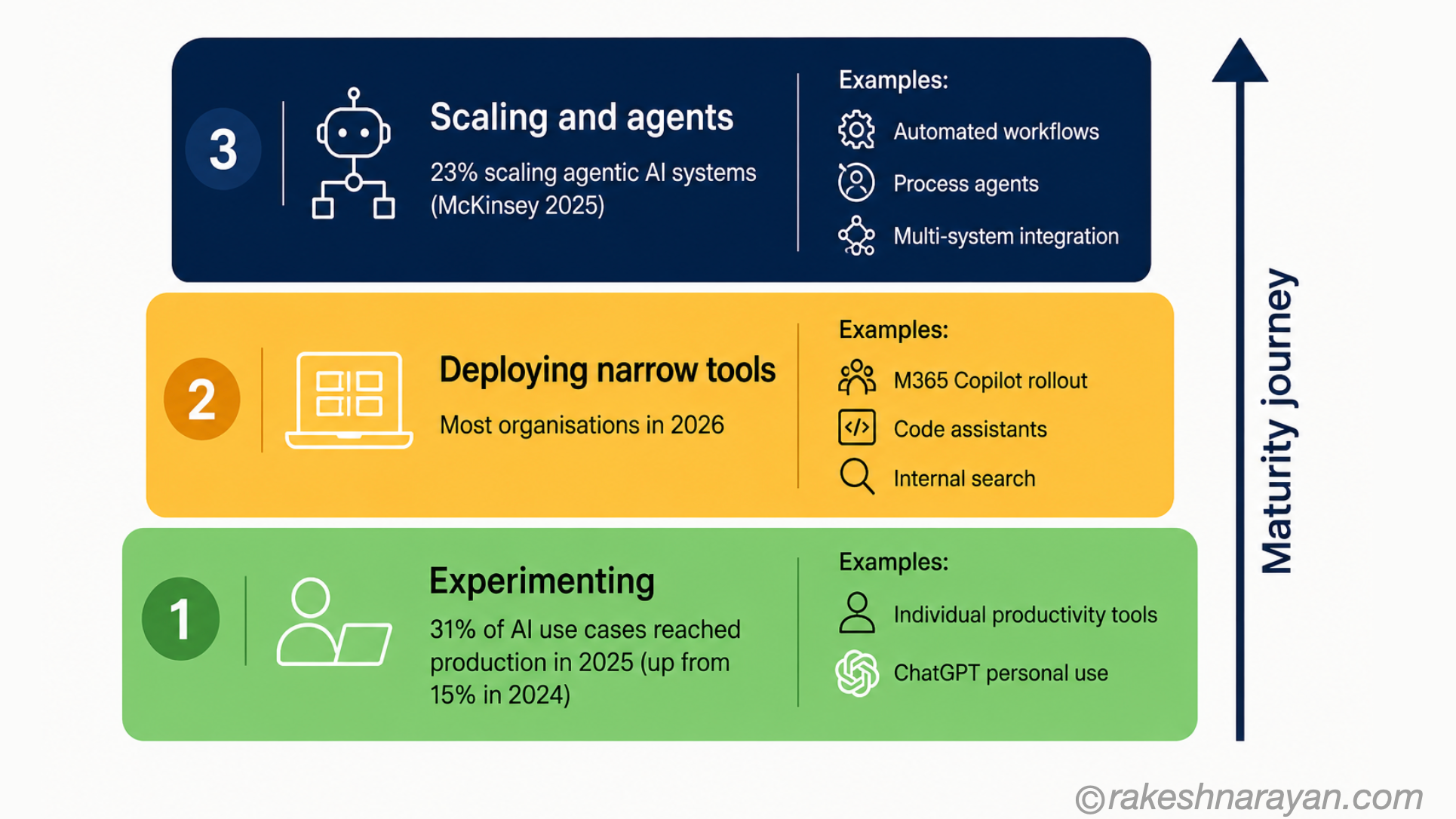
Here is what is actually happening: 78% of organisations are using AI in some form. But most of them are in early stages — experimenting, running pilots or deploying narrow tools for specific tasks. The gap between the AI narrative and the AI reality is still significant.
This post is a map of where AI is genuinely gaining traction in enterprise, what the real patterns look like, and how to think about it as a consultant or architect — not as a vendor.
🔗 Foundation posts
This post connects the technical foundations covered elsewhere in this series to the business reality. For the technical concepts — What is a Large Language Model? , AI Agents — What They Are and How They Work and RAG — Retrieval Augmented Generation — read those posts first.
Where AI is genuinely working in 2026
1. Copilots embedded in existing tools
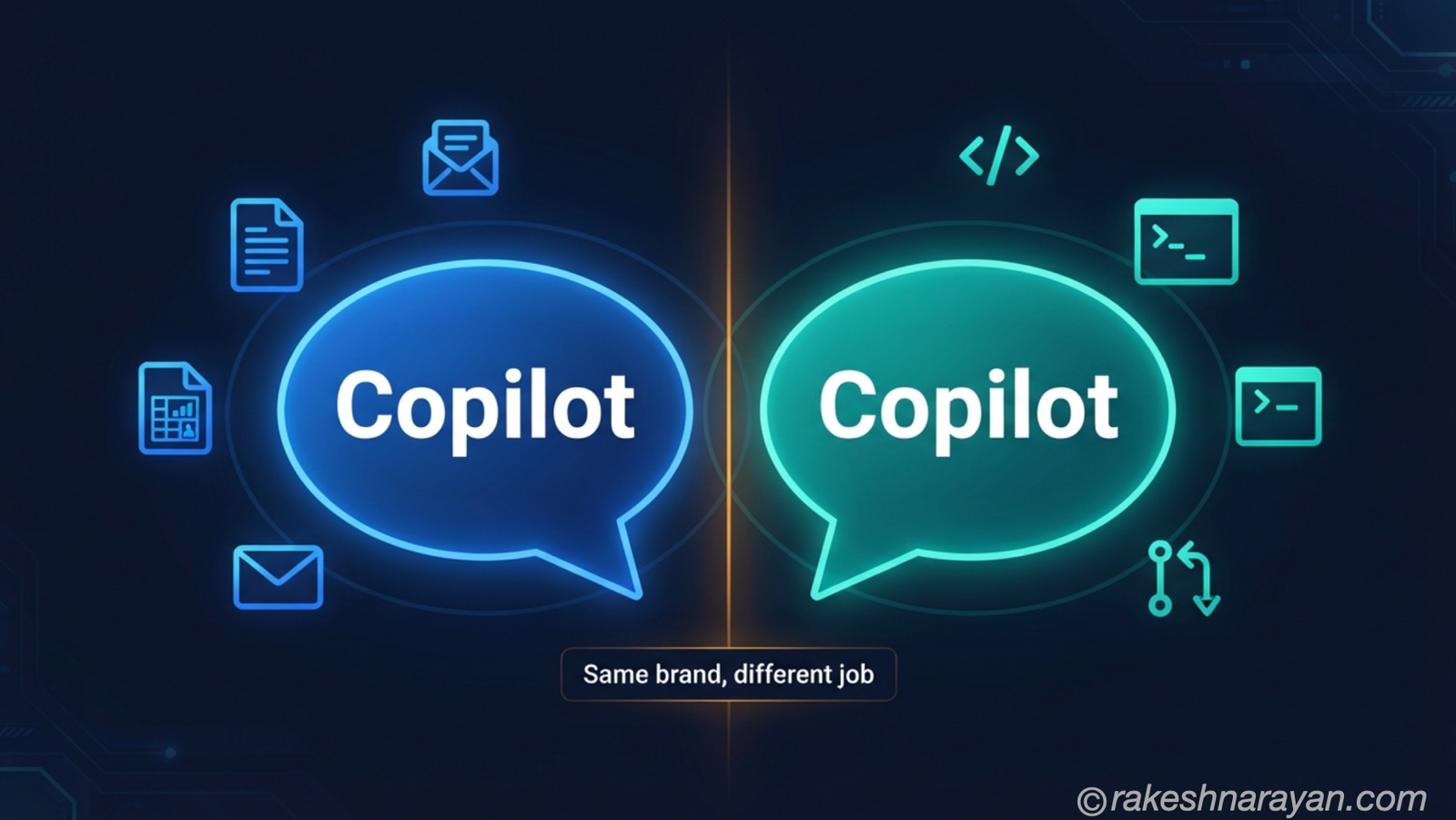
The biggest AI deployment in enterprise is not a new AI product. It is AI embedded in tools people already use. Microsoft 365 Copilot has over 15 million paid seats. GitHub Copilot has reached 4.7 million paid subscribers and approximately 77,000 enterprise customers as of early 2026. IDC projects that AI copilots will be embedded in nearly 80% of enterprise workplace applications by the end of 2026.
The pattern that works: AI that lives inside the tool you already have, doing a task you already do. Summarise this email. Suggest code for this function. Draft a reply. The friction is low because the workflow does not change.
| Copilot tool | What it does | Adoption signal |
|---|---|---|
| Microsoft 365 Copilot | Summarises emails, drafts documents, generates meeting summaries, creates slide outlines in Office apps | 15M+ paid seats. Automatically installed for enterprise M365 users from October 2025. |
| GitHub Copilot | Suggests code completions, generates functions from comments, explains existing code | 4.7M paid subscribers, 77,000 enterprise customers. 40-55% productivity boost in controlled studies. |
| SAP Joule | Answers SAP-specific questions, suggests field values, initiates workflows across S/4HANA and SuccessFactors | Embedded across SAP’s cloud portfolio — S/4HANA, SuccessFactors, Ariba, BTP |
| Google Workspace AI | Writes in Docs, summarises in Gmail, generates in Slides | Embedded in Workspace for paying customers worldwide |
2. AI-assisted code generation
Code generation is the AI use case with the clearest productivity evidence. GitHub Copilot research consistently shows 40-55% more code output per week for developers using it. This does not mean the code is always right — it means less time on boilerplate, scaffolding and documentation.
The pattern: AI drafts, humans review and accept or reject. This human-in-the-loop model works because the output is immediately verifiable. You run the code and it either works or it does not.
3. Knowledge base and document search
The use case most organisations discover first after copilots: internal knowledge search. Instead of hunting through SharePoint, Confluence or internal wikis, users ask a natural language question and get an answer drawn from internal documents.
This is RAG in practice. The organisation’s documents are indexed in a vector database. User queries retrieve the relevant passages. An LLM synthesises an answer with citations. The question ‘What is our return policy for enterprise accounts?’ gets a direct answer from the actual policy document.
This is one of the highest-ROI AI applications because the problem — finding information in internal systems — is universal and well-defined.
4. Business process automation with AI decisions
Traditional RPA automates deterministic processes — if the form looks like this, enter that. AI extends this to processes with variability and judgement — reading an unstructured invoice, classifying a customer complaint, routing a support ticket to the right team.
Business process automation leads AI agent deployment in 2026, with 64% of AI agent deployments focused on automating workflows across support, HR, sales operations and admin tasks. The pattern: high-volume, repetitive tasks with clear success criteria and human escalation paths for edge cases.
5. AI agents — still in early innings
McKinsey’s 2025 global survey (1,993 participants across 105 nations) found that 23% of organisations are actively scaling an agentic AI system and 39% are experimenting. That is significant movement. But the honest reality: most enterprises deploying agents are doing so for narrow, well-defined tasks — not broad autonomous agents that operate across systems.
The use cases that work today: exception handling with a defined resolution path, document review with clear criteria, data extraction from structured documents. Still difficult: open-ended research, multi-system orchestration with side effects, autonomous decision-making in high-stakes domains.
The SAP-specific picture
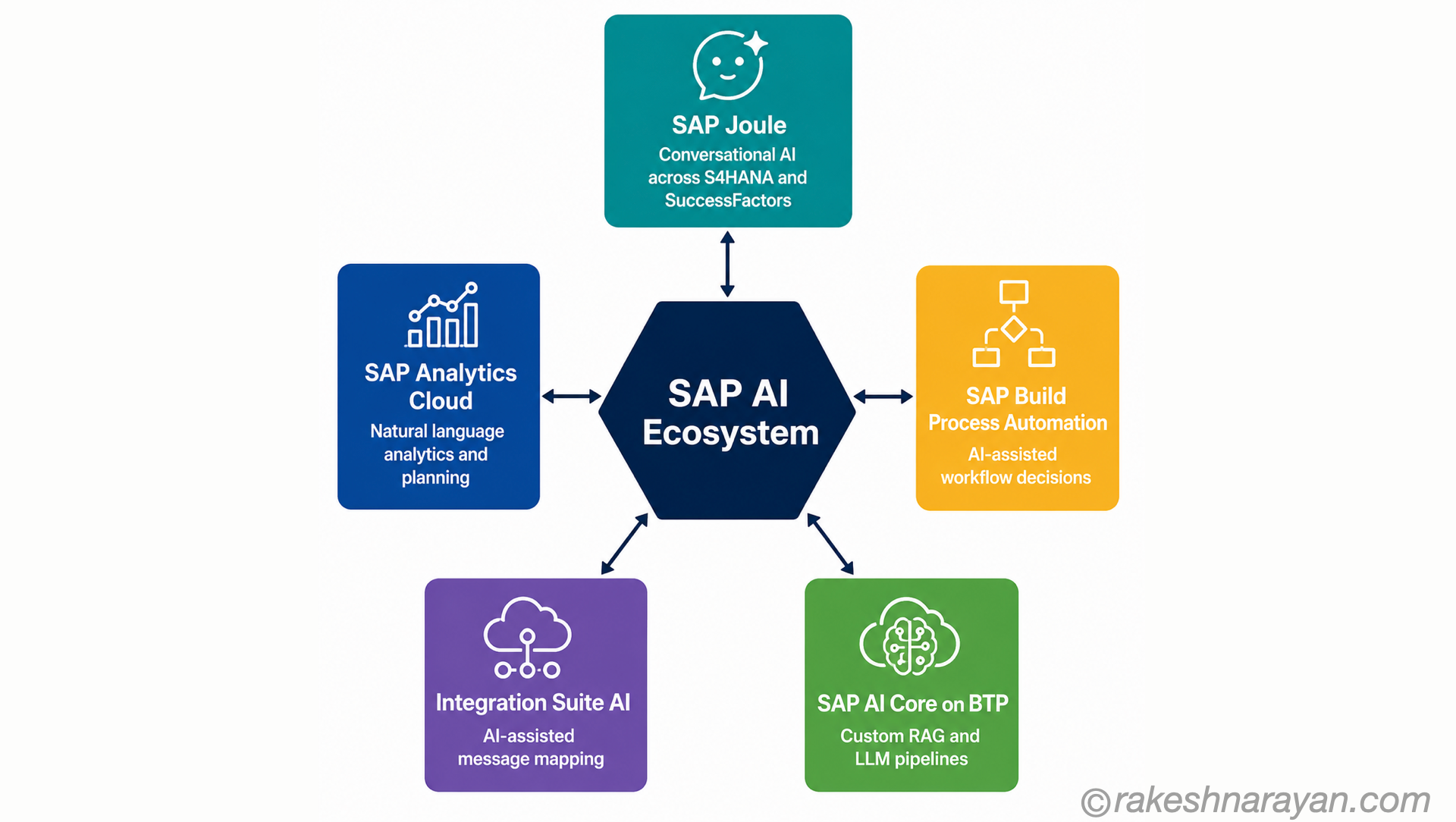
| SAP AI deployment | What is happening in 2026 |
|---|---|
| SAP Joule | Embedded across S/4HANA, SuccessFactors, Ariba — answering questions, suggesting values, triggering simple workflows |
| SAP Build Process Automation | AI-assisted decision steps in approval workflows — classifying requests, suggesting responses, routing exceptions |
| SAP AI Core on BTP | Custom RAG pipelines, domain-specific AI assistants, integration with LLMs for enterprise knowledge search |
| Integration Suite with AI | AI-assisted message mapping in CPI, Integration Advisor using AI for B2B mapping suggestions |
| SAP Analytics Cloud AI | AI-driven planning, anomaly detection, natural language queries against SAP data |
What is not working — the honest view
The gap between AI ambition and AI reality in enterprise is still large. A few patterns that consistently cause problems:
| Common failure pattern | Why it happens |
|---|---|
| Pilots that never reach production | AI builds impressive demos but production requires data quality, security review, change management and integration work that pilots skip |
| Copilots adopted but not used | Tool is installed, licences are paid, but adoption requires workflow change and training that was not funded |
| Agents deployed without guardrails | An agent with access to irreversible actions without human checkpoints causes errors that are hard to roll back |
| AI on poor data | Garbage in, garbage out. RAG on unstructured, outdated or inconsistent documents produces unreliable answers that erode trust fast. |
| Measuring the wrong thing | Teams count AI interactions rather than business outcomes. 10,000 queries handled is not success if accuracy is poor. |
💡 The most important success factor
Organisations that succeed with AI in production pick problems with clear success criteria, verifiable output and defined human escalation paths. ‘Use AI for everything’ is a strategy for expensive pilots. ‘Use AI for these specific high-volume tasks where we can measure accuracy and escalate errors’ is a strategy for production.
The five patterns that work
| Pattern | Why it works | Examples |
|---|---|---|
| Copilot for existing workflows | Zero workflow change — AI assists inside the tool the user already has | M365 Copilot, GitHub Copilot, SAP Joule |
| Knowledge search with RAG | Clear problem, measurable outcome, verifiable output — check the source | Internal policy search, product knowledge bases, technical documentation assistants |
| High-volume structured classification | Large volume, clear categories, fast feedback on accuracy | Support ticket routing, invoice classification, document type detection |
| Automation of rule-based exceptions | Well-defined exception handling with a clear decision path for the AI | Purchase order blocks, payment exceptions, integration error triage |
| Code assistance | Immediate feedback loop — run the code, it works or it does not | GitHub Copilot, SAP ABAP code assistance tools |
At a glance — enterprise AI in 2026
| Use case | Maturity | Key metric |
|---|---|---|
| Copilots in productivity tools | Scaling — 15M+ M365 Copilot seats, 80% enterprise apps by end 2026 | Adoption rate and tasks automated per user |
| AI code generation | Scaling — 4.7M GitHub Copilot subscribers | 40-55% more code per developer per week |
| Internal knowledge search (RAG) | Growing — high ROI, clear problem | Query resolution rate and time saved vs traditional search |
| Business process automation | Growing — 64% of agent deployments | Straight-through processing rate and exception handling accuracy |
| AI agents for complex tasks | Emerging — 23% scaling, 39% experimenting | Task completion rate and error rate in production |
| Autonomous multi-system agents | Early — still mostly pilot stage | Not yet standardised at enterprise scale |
What to take away
AI in enterprise in 2026 is real, growing and producing genuine productivity improvements in specific well-scoped use cases. It is also overhyped, unevenly deployed and frequently adopted without the change management or data quality foundations that make it reliable.
As a consultant or architect, the most valuable skill is not knowing which AI tool to recommend. It is knowing how to scope an AI use case so that the business outcome is measurable, the failure modes are manageable and the deployment can actually reach production.
The organisations winning with AI are not the ones with the most AI projects. They are the ones with the clearest problems, the best data and the most honest view of what AI can and cannot reliably do in 2026.
🔗 Related posts on this site
AI Agents — What They Are and How They Work — the agent architecture behind enterprise automation use cases.
RAG — Retrieval Augmented Generation — the technology behind enterprise knowledge search and document AI.
MCP — Model Context Protocol Explained — the standard enabling agents to connect to enterprise tools and SAP systems.
AI Hallucinations — Why They Happen — essential for setting realistic expectations with stakeholders on AI accuracy.
Ethics and Responsible AI — The Essentials — governance and accountability for enterprise AI deployments.
Published on rakeshnarayan.com — Articles
URL: https://rakeshnarayan.com/articles/ai-in-the-enterprise-a-practical-map/
Did you enjoy this article?
Let me know — it takes one click.
0 Comments
Leave a Comment
Looks like this one held your attention — I'd really appreciate a quick comment below.
Your comment has been submitted and will appear after review.