Ethics and Responsible AI — The Essentials Every Organisation Needs to Know
AI systems make decisions. They screen job applications, assess loan eligibility, flag insurance claims, route customer service tickets, generate medical summaries. When those decisions are wrong, the consequences are real — for individuals, for organisations and for the trust that AI needs to be useful.
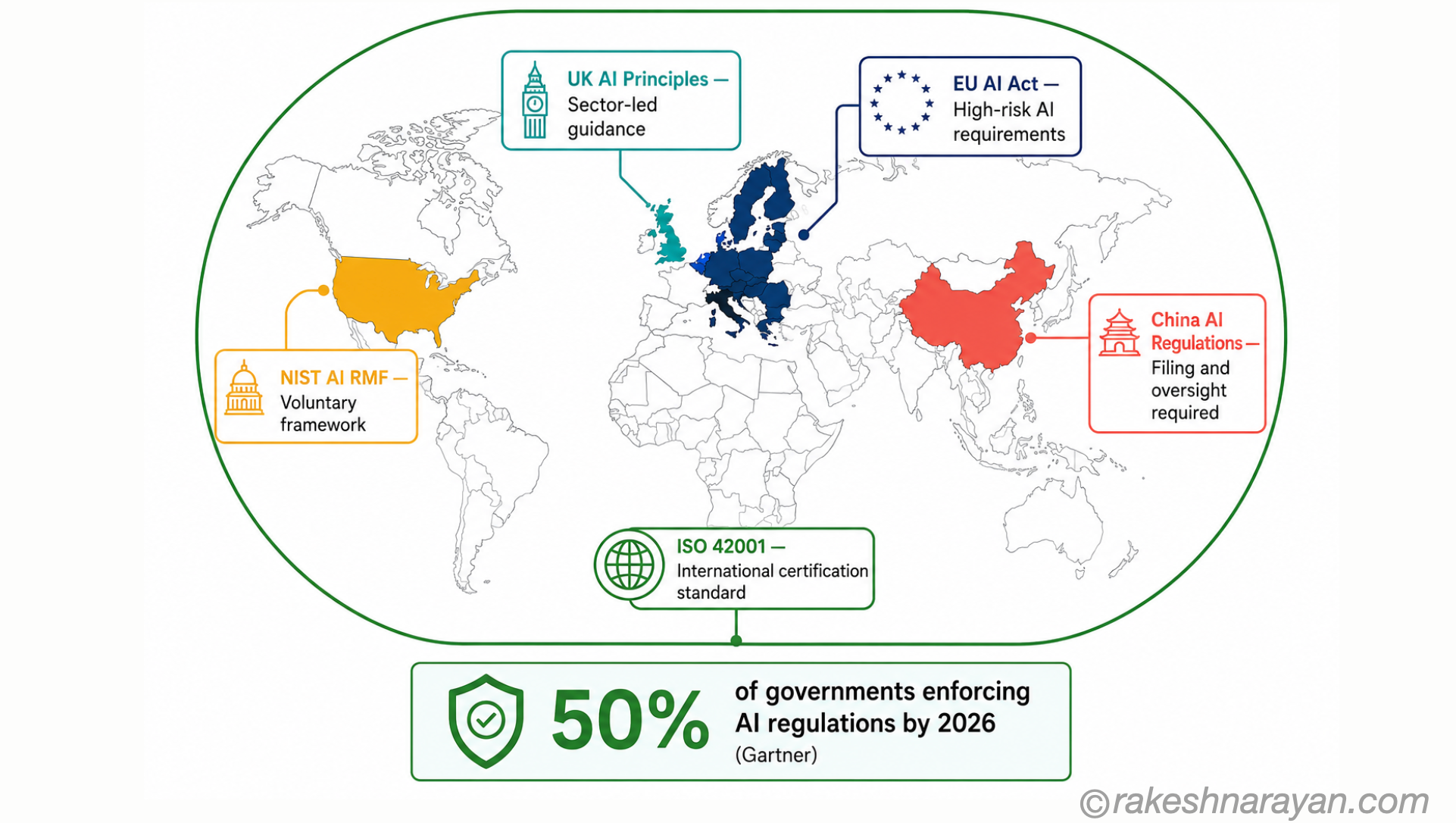
Responsible AI is not a new topic. But in 2026, it has moved from a research conversation to a regulatory and operational one. By 2026, 50% of governments worldwide enforce responsible AI regulations. Organisations that have not built governance structures are not just taking an ethical risk — they are taking a legal and financial one.
This post explains what responsible AI actually means — the core principles, the real risks, the regulatory landscape and what practical governance looks like.
🔗 Connected posts
This post connects directly to AI in the Enterprise — A Practical Map — responsible AI governance is what makes enterprise AI deployments defensible and sustainable. Also connects to AI Hallucinations — Why They Happen — hallucination is one of the concrete failure modes that responsible AI governance must address.
The four core principles
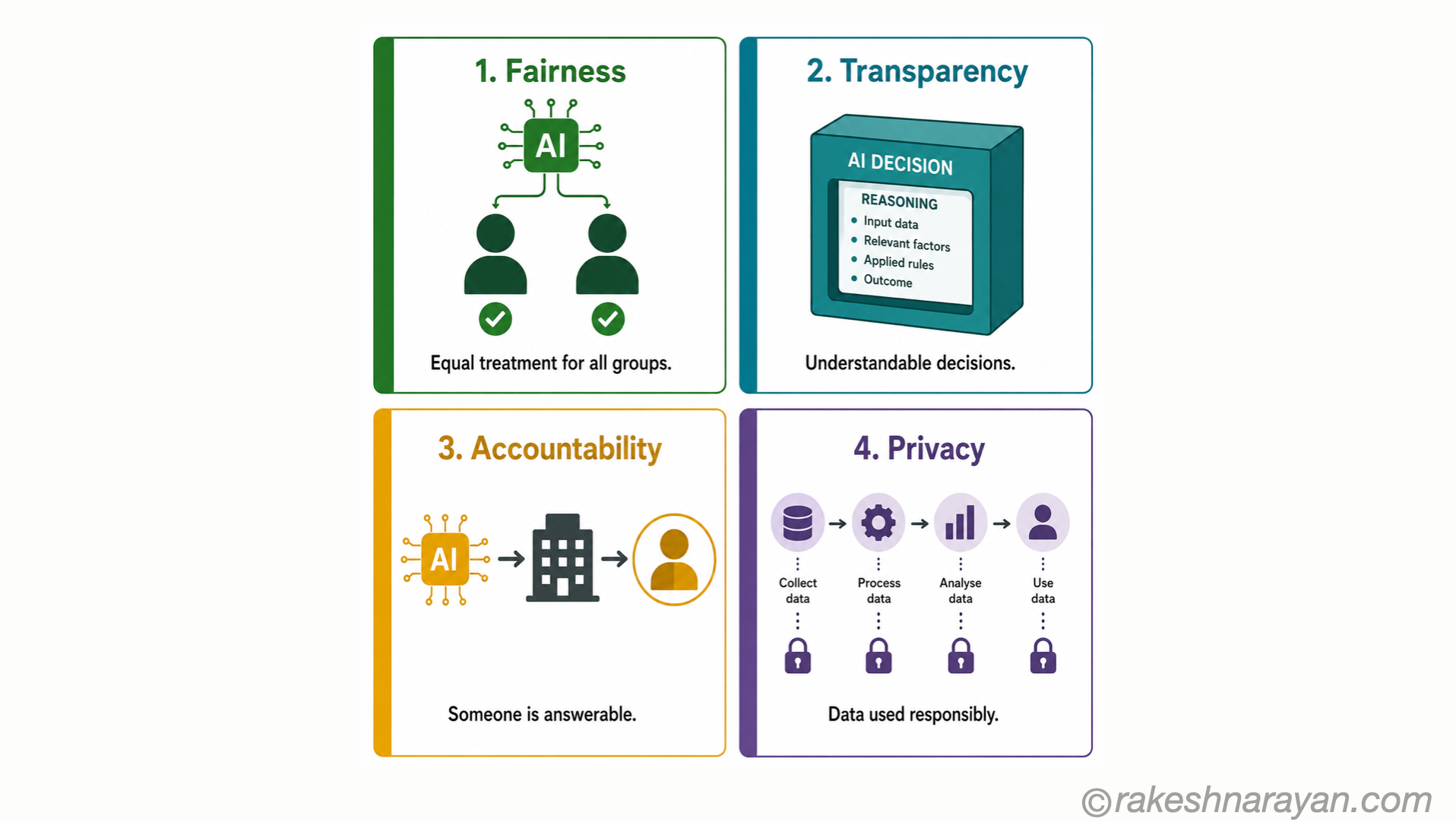
Responsible AI frameworks — from the EU AI Act to NIST’s AI Risk Management Framework to SAP’s own AI principles — cluster around four core concepts. The specific language varies by framework, but the substance is the same.
| Principle | What it means | Why it matters |
|---|---|---|
| Fairness | AI systems treat all groups equitably — they do not discriminate based on protected characteristics like race, gender, age or disability | An AI hiring tool that systematically disadvantages certain demographics causes real harm and opens the organisation to legal liability |
| Transparency | The way an AI system works and makes decisions is understandable to relevant stakeholders — developers, auditors, affected individuals | If nobody can explain why the model made a decision, nobody can identify when it is wrong, challenge it or correct it |
| Accountability | Clear lines of responsibility exist for AI systems and their outcomes — a human or organisation is answerable when AI causes harm | ’The algorithm decided’ is not an acceptable defence. Someone built it, trained it, deployed it and operates it. |
| Privacy | AI systems handle personal data in ways that respect individual rights — data minimisation, consent, access controls, right to erasure | AI models trained on personal data must comply with privacy regulations including GDPR in Europe |
AI bias — what it is and where it comes from
Bias in AI is not the same as bias in a human. An AI model does not have prejudices in the human sense. What it has is patterns learned from data — and if the data reflects historical inequalities or underrepresents certain groups, the model will reproduce and sometimes amplify those patterns.
| Type of bias | How it gets into the model | Real example |
|---|---|---|
| Historical bias | Training data reflects past discrimination — the model learns to replicate it | Hiring AI trained on historical data learns to prefer resumes resembling past hires — who were predominantly male in technical roles |
| Representation bias | Certain groups are underrepresented in training data — the model is less accurate for them | Facial recognition performing significantly worse on darker skin tones — because training datasets were not representative |
| Measurement bias | The data used to measure success is itself biased | Credit scoring models using ZIP code as a proxy for creditworthiness — which correlates with race in many geographies |
| Feedback loop bias | Model outputs influence future training data — errors compound over time | Content recommendation amplifying engagement signal — which correlates with outrage — over quality |
77% of organisations acknowledge they still need to do more to understand data bias in their AI systems, according to 2026 research. The gap between awareness and action is still significant.
⚠️ Bias is not always visible
An AI system can appear to perform well on average while performing poorly for specific subgroups. Aggregate accuracy metrics hide subgroup performance problems. Responsible AI evaluation requires testing performance across demographic groups — not just on the overall test set.
Transparency and explainability — why they are different
These two terms are often used interchangeably. They mean different things.
| Concept | What it means | In practice |
|---|---|---|
| Transparency | The system’s purpose, training data, known limitations and decision logic are documented and disclosed to relevant stakeholders | The organisation publishes what the AI does, what data it uses and what its known failure modes are |
| Explainability | For a specific decision, a meaningful explanation can be provided to the affected person — why did the AI make this recommendation? | A loan applicant denied by an AI model can receive a plain-English explanation of which factors led to the decision |
Explainability is technically harder for deep learning models — they are not inherently interpretable the way a decision tree is. Techniques like SHAP values, LIME and attention visualisation exist to approximate explanations, but none produces a complete causal explanation. This remains an active research area in 2026.
Accountability — the hardest principle
When an AI system causes harm, the question ‘who is responsible?’ does not have a simple answer. The training data provider? The model developer? The organisation that deployed it? The individual who approved the use case?
In 2026, this question is being answered through regulation rather than industry consensus. The EU AI Act, which began applying to high-risk AI systems from August 2024 and continues phased implementation through 2026, places accountability primarily on the deploying organisation — the entity that puts the AI into use in their context.
| Accountability question | Practical answer |
|---|---|
| Who is accountable for an AI hiring decision that turns out to be discriminatory? | The organisation that deployed the hiring tool — not the tool vendor. Vendor liability clauses are increasingly common in contracts. |
| Who is accountable for an AI medical diagnosis error? | The clinical organisation that used the AI and the clinicians who acted on its output — AI does not replace clinical judgement |
| Who is accountable for a hallucinated fact in an AI-generated customer response? | The organisation that deployed the customer-facing AI — which is why human review processes exist for high-stakes outputs |
💡 Human-in-the-loop is not bureaucracy
Requiring a human to review AI outputs for high-stakes decisions is accountability made operational. The human review step is where ‘who is responsible’ gets a clear answer. 71% of AI users in 2026 prefer a human-in-the-loop setup for high-stakes decisions.
The regulatory landscape in 2026
| Regulation / Framework | Jurisdiction | What it requires |
|---|---|---|
| EU AI Act | European Union | Classifies AI by risk level. High-risk AI (hiring, credit, healthcare, law enforcement) requires conformity assessment, transparency, human oversight and documentation. Phased application 2024-2027. |
| NIST AI Risk Management Framework | United States | Voluntary framework. Four functions: Govern, Map, Measure, Manage. Increasingly referenced in US government contracts. |
| ISO/IEC 42001 | International | First international AI management system standard. Published 2023. Organisations can certify against it. |
| UK AI principles | United Kingdom | Sector-led, non-statutory. Five principles: safety and security; transparency and explainability; fairness; accountability and governance; contestability and redress. |
| China AI regulations | China | Multiple regulations covering generative AI, recommendation algorithms and deep synthesis. Filing requirements and mandatory human oversight. |
What responsible AI governance looks like in practice
The gap between principles and practice is where most organisations struggle. Operationalising responsible AI requires more than a policy document.
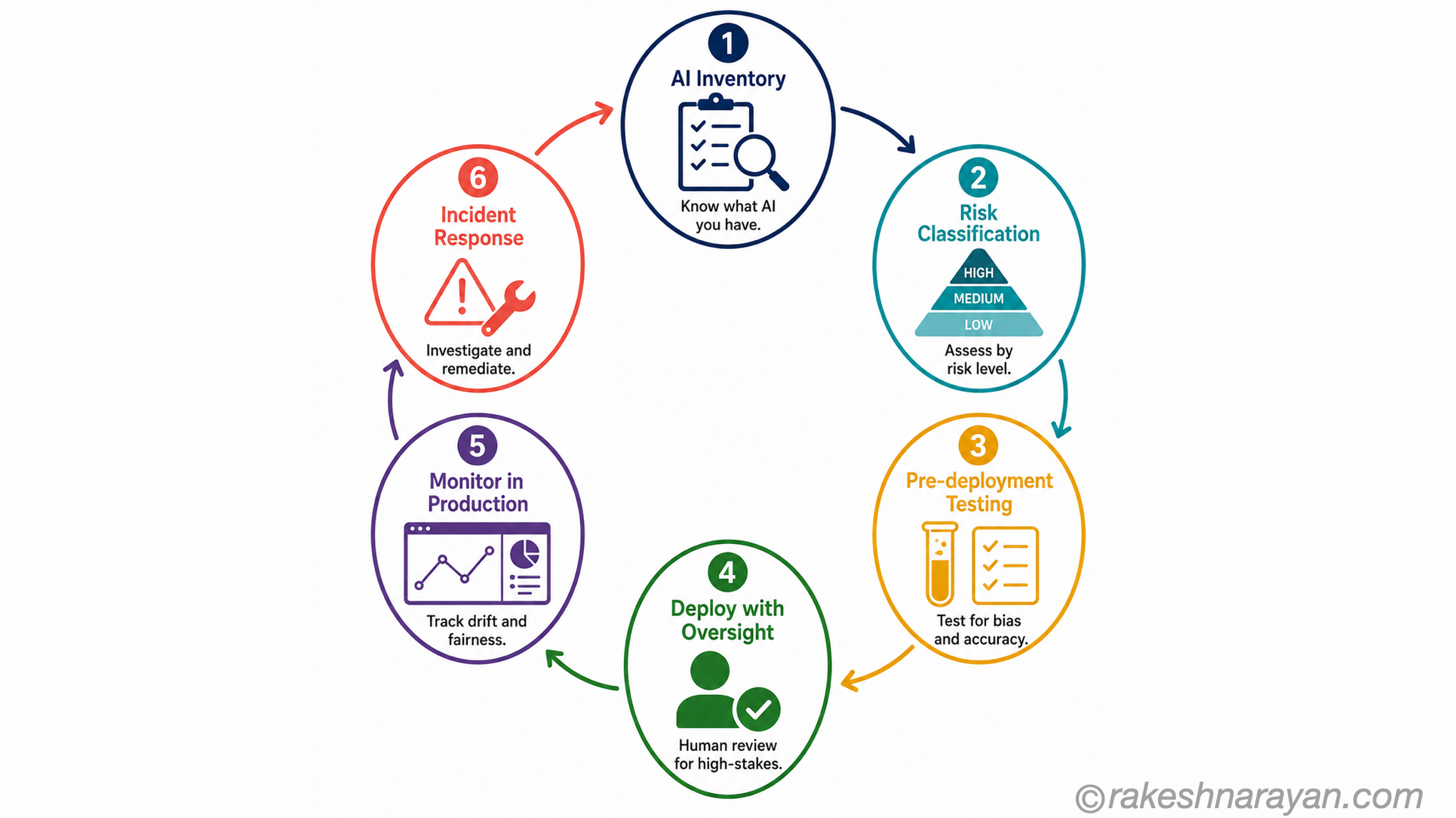
- AI inventory — know what AI systems you have, who deployed them, what decisions they influence and what data they use. You cannot govern what you cannot see.
- Risk classification — not all AI systems carry the same risk. A content recommendation tool and a hiring screening tool need very different oversight levels. The EU AI Act risk tier framework is a practical starting point.
- Pre-deployment testing — test for bias across demographic subgroups before going live. Aggregate accuracy is not sufficient.
- Monitoring in production — model performance degrades as real-world data drifts from training data. Set up ongoing monitoring for accuracy, fairness metrics and output quality.
- Human escalation paths — for any AI system making high-stakes decisions, define who can override, appeal or escalate. Document it. Test it.
- Incident response — when AI causes harm (it will eventually), have a defined process for investigation, remediation and disclosure.
Responsible AI in the SAP context
| SAP scenario | Responsible AI consideration |
|---|---|
| SAP Joule answering business questions | Transparency: users should know they are talking to AI. Accuracy: Joule’s grounding in SAP documentation reduces hallucination but does not eliminate it. |
| AI screening in SuccessFactors Recruiting | High risk under EU AI Act. Requires bias testing, human oversight for decisions, transparency to candidates that AI is involved. |
| AI-generated invoice processing | Lower risk if output is reviewed by humans. Higher risk if automated straight-through processing without exception review. |
| Predictive analytics for employee attrition | Privacy considerations (sensitive HR data), fairness testing across groups, accountability (who acts on predictions). |
| Custom AI built on SAP AI Core | The organisation building the solution carries accountability — not SAP. Governance structures must be in place before deployment. |
At a glance — responsible AI essentials
| Concept | One-line summary |
|---|---|
| Responsible AI | A framework for developing and deploying AI that is fair, transparent, accountable and privacy-respecting |
| Fairness | AI systems do not discriminate — they perform equitably across demographic groups |
| Bias | Errors in training data or model design that cause systematically different outcomes for different groups |
| Transparency | The purpose, data, limitations and logic of an AI system are documented and disclosed |
| Explainability | For a specific decision, a meaningful explanation can be given to the affected person |
| Accountability | A human or organisation is answerable for AI outcomes — ‘the algorithm decided’ is not a defence |
| EU AI Act | EU regulation classifying AI by risk — high-risk AI requires conformity assessment and human oversight |
| NIST AI RMF | US voluntary framework — Govern, Map, Measure, Manage across AI risk |
| Human-in-the-loop | Human review of AI outputs for high-stakes decisions — accountability made operational |
| AI inventory | Know what AI systems you have and what decisions they influence — the foundation of governance |
What to take away
Responsible AI is not a constraint on AI capability. It is the work that makes AI deployments sustainable over time — that keeps stakeholder trust, avoids regulatory penalty and produces systems that remain useful as circumstances change.
The organisations that treat responsible AI as a compliance checkbox will find themselves retrofitting governance after a failure. The ones that build it in from the start — AI inventory, risk classification, bias testing, monitoring, accountability structures — will be the ones whose AI projects reach and stay in production.
In a world where AI systems make increasingly consequential decisions, the question is not whether ethics matters. It is whether you have built the structures to ensure it is actually applied.
🔗 Related posts on this site
AI in the Enterprise — A Practical Map — the enterprise AI deployment context where responsible AI governance applies.
AI Hallucinations — Why They Happen — hallucination is one of the concrete reliability failures that governance must address.
AI Agents — What They Are and How They Work — agentic AI raises the accountability stakes further — agents take actions, not just produce outputs.
What is a Large Language Model (LLM)? — understanding how LLMs work is the foundation for understanding why responsible AI governance is necessary.
AI Regulation — How Risk-Based Rules Actually Work — the regulatory model, like the EU AI Act, that turns these governance principles into enforceable obligations.
Published on rakeshnarayan.com — Articles
URL: https://rakeshnarayan.com/articles/ethics-and-responsible-ai/
Did you enjoy this article?
Let me know — it takes one click.
0 Comments
Leave a Comment
Looks like this one held your attention — I'd really appreciate a quick comment below.
Your comment has been submitted and will appear after review.