Multi-Agent Systems — How Orchestration and Coordination Work
Every AI demo looks clean. One agent, one task, one impressive result. What the demo never shows is what happens when the task is actually complex — when it spans multiple systems, requires different kinds of expertise, and cannot be completed in a single context window by a single model.
That is the problem multi-agent systems solve. Not by making one agent smarter. By coordinating many agents — each focused, each scoped — so the combined system handles work that no single agent could manage alone.
Understanding how that coordination works is what separates people who can evaluate agentic AI seriously from people who are still impressed by the demos.
🔗 Foundation posts for this topic
This post builds on two earlier posts in the AI Agents series.
AI Agents — What They Are and How They Work covers what an individual agent is.
How AI Agents Actually Think — ReAct, Planning and Reflection explains how a single agent reasons.
This post is what happens next — when you have more than one.
Why one agent is not enough
A single agent has three hard limits. The first is the context window. Every agent works within a fixed token limit — load too much information in, and earlier context starts falling out. A single agent trying to research 20 sources, write a report, validate the output and format it for publication will degrade badly as the context fills.
The second limit is specialisation. One agent asked to do everything ends up doing everything adequately and nothing well. A coding agent and a compliance-checking agent need different instructions, different tools and different evaluation criteria. Combining them into one creates a system that is mediocre at both.
The third limit is parallelisation. A single agent works sequentially. If you need to analyse five documents simultaneously, one agent does it one at a time. Five specialist agents do it at once. The output is more thorough. The time is a fraction.
📌 Key Takeaway
Multi-agent systems do not make AI smarter. They make it wider — distributing work across focused agents that run in parallel rather than stacking everything onto one.
What orchestration actually means
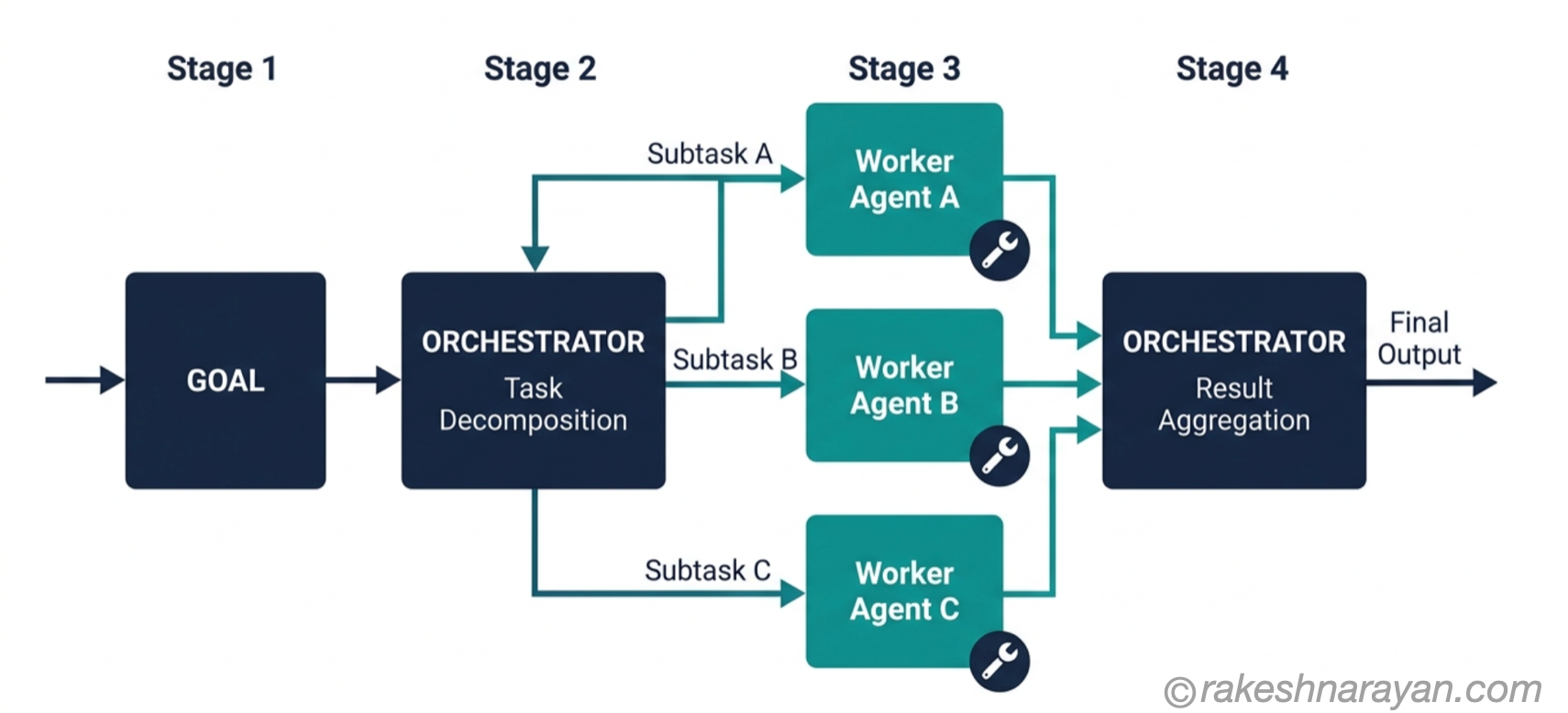
Orchestration is the layer that decides: which agent does what, in what order, with what inputs, and what happens to the outputs. Without it, you have a collection of agents. With it, you have a system.
The simplest mental model is a kitchen. The head chef — the orchestrator — does not cook every dish. They decompose the meal into components, assign each component to the right station, and bring the results together into a coherent whole. The orchestrator knows the goal. The workers know their craft.
In a multi-agent system, this translates to four concrete functions: task decomposition, agent routing, result aggregation, and error handling. The orchestrator breaks the goal into subtasks, routes each subtask to the right agent, collects and combines the outputs, and decides what to do when an agent fails or produces an unexpected result.
The three coordination patterns
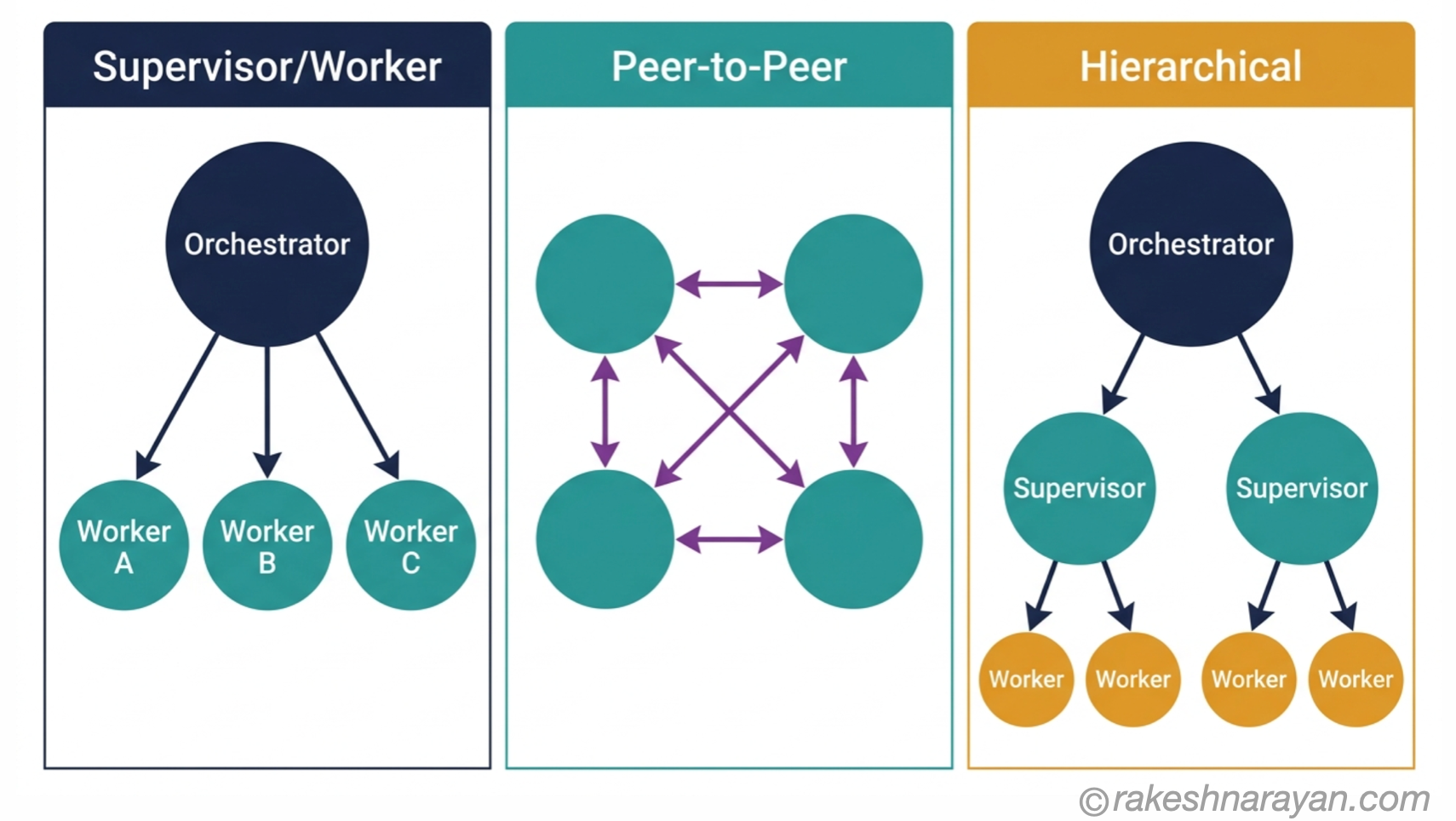
Not all multi-agent systems use the same structure. Three patterns dominate in practice. Each suits a different type of problem.
| Pattern | How it works | Best for | Trade-off |
|---|---|---|---|
| Supervisor / Worker | A central orchestrator routes tasks to specialist worker agents and synthesises their results. Workers do not communicate with each other. | Structured workflows with clear subtask boundaries — document processing, data pipelines, report generation | Single point of failure at the orchestrator. Bottleneck if the supervisor becomes overloaded. |
| Peer-to-peer | Agents communicate and collaborate directly without a central supervisor. Each agent can delegate to any other. | Dynamic, exploratory tasks where the required steps cannot be predetermined — research, complex reasoning chains | Harder to debug and audit. Coordination failure is more difficult to detect and recover from. |
| Hierarchical | Nested supervisor layers — a top-level orchestrator manages mid-level supervisors, each of which manages their own worker agents. | Large-scale systems spanning multiple domains or organisations — enterprise workflows, cross-system automation | Significant coordination overhead. Latency increases with each layer. Governance complexity grows fast. |
💡 Practical Tip
Most production systems start with supervisor/worker. It is the easiest pattern to implement, debug and audit.
Move to hierarchical only when the problem genuinely spans multiple domains that cannot be managed by a single orchestrator.
Peer-to-peer works well for research and exploration tasks but is rarely the right choice for transactional enterprise workflows.
How agents talk to each other — MCP and A2A
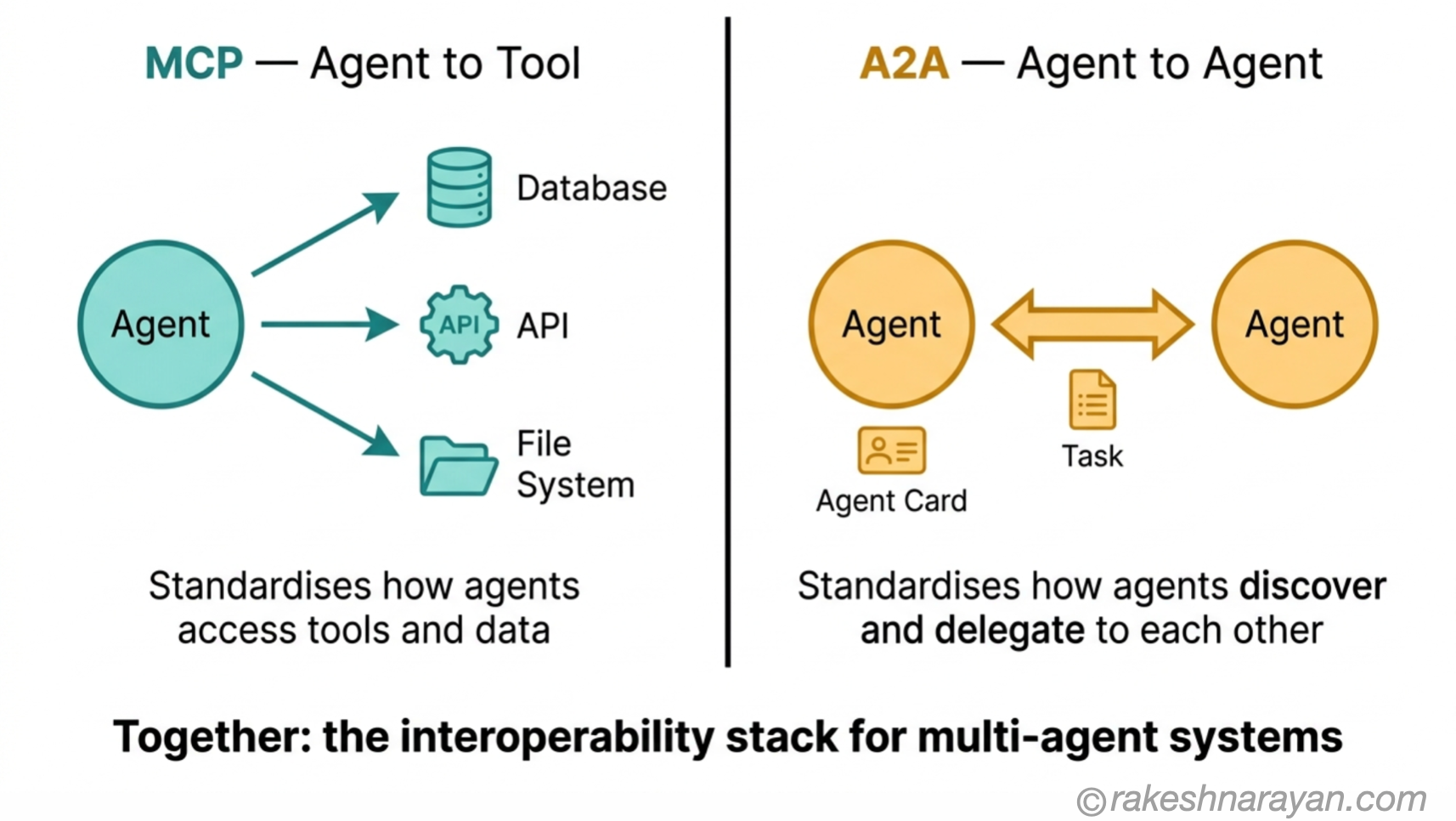
Coordination patterns describe the structure. Protocols define the language. Two protocols now form the interoperability stack for multi-agent systems, and understanding the difference between them is essential.
MCP — agent to tool
The Model Context Protocol, launched by Anthropic in November 2024 and donated to the Linux Foundation’s Agentic AI Foundation in December 2025, handles the connection between an agent and its tools. When an agent needs to query a database, call an API, read a file or access an external service — MCP defines how that happens in a standardised way.
Think of MCP as the protocol that gives an agent its hands. Without it, every tool integration is a custom build. With it, any MCP-compatible agent can use any MCP-compatible tool without bespoke code.
A2A — agent to agent
The Agent-to-Agent protocol, announced by Google in April 2025 and now also governed by the Linux Foundation, handles something different: how agents communicate with each other across frameworks, organisations and platforms.
Where MCP gives an agent its hands, A2A gives it a voice. An agent built on one framework can discover, delegate to and receive results from an agent built on an entirely different framework — without custom integration code.
A2A works through three core concepts. Agent Cards are machine-readable JSON documents that advertise what an agent can do, what its endpoints are and how to authenticate with it. Tasks are structured units of work with a defined lifecycle — submitted, working, input-required, completed, failed. Messages carry the actual content exchanged between agents across that lifecycle.
📝 Note
As of June 2026, A2A has reached v1.0 stable with more than 150 organisations in production, including Microsoft, AWS, SAP, Salesforce and ServiceNow. Azure AI Foundry, Amazon Bedrock AgentCore and Google Cloud all support it natively. IBM’s Agent Communication Protocol merged into A2A in August 2025 — effectively leaving A2A with no serious competitor for inter-agent communication.
🔗 Related Reading
MCP — Model Context Protocol Explained - Covers MCP in full — what it is, how it works and why it matters for enterprise AI. Read that post next if you want the complete picture on the tool-access side.
Where multi-agent systems break
Most writing on multi-agent systems covers what they can do. This section covers what goes wrong — because in practice, coordination is where agentic systems fail most often and most silently.
Coordination overhead
Adding agents adds cost. Every agent needs its own context, every handoff requires a message, every result needs to be summarised before being passed on. A task that takes one agent ten seconds can take three coordinated agents thirty — because the coordination itself consumes tokens and time. Parallelisation helps with thoroughness, not always with speed.
Context drift between agents
Each agent in a multi-agent system has its own context window. Information does not flow automatically between them — it has to be explicitly passed. When summarisation happens at every handoff, detail gets lost. An agent downstream from three summarisation steps is working from a significantly degraded version of the original information. The final output reflects that degradation.
Error propagation
A single agent making an incorrect assumption produces one wrong output. In a multi-agent system, that wrong output gets passed to the next agent as fact. The downstream agent builds on it. The error compounds through the pipeline. By the time the final result is produced, the original mistake is buried several layers deep and significantly harder to diagnose.
Cascading failures
When one agent in a supervisor/worker system fails, the orchestrator has to decide what to do. Retry, skip, escalate or abort. Without explicit failure handling, the most common outcome is that the orchestrator stalls — waiting for a result that is not coming. In hierarchical systems, a failure at one level can propagate upward, taking down the agents that depend on it.
⚠️ Warning
These are not edge cases. They are the normal operating conditions of production multi-agent systems.
Any evaluation of a multi-agent platform should include explicit questions about how it handles context loss between agents, error propagation across the pipeline, and cascading failures when a worker agent becomes unavailable.
If the answer is vague, the system is not production-ready.
At a glance — multi-agent systems
| Concept | One-line summary |
|---|---|
| Multi-agent system | Multiple specialised AI agents working together on a task that no single agent can handle reliably alone |
| Orchestrator | The agent that decomposes goals into subtasks, routes them to workers and aggregates the results |
| Supervisor / Worker | The most common pattern — a central orchestrator directs specialist workers with no direct communication between workers |
| Peer-to-peer | Agents communicate directly with each other — suited to exploratory tasks where the required steps cannot be predetermined |
| Hierarchical | Nested orchestrator layers managing sub-orchestrators and workers — suited to large-scale, multi-domain systems |
| MCP (Model Context Protocol) | The protocol that standardises how an agent connects to tools and data sources — agent to tool |
| A2A (Agent-to-Agent) | The protocol that standardises how agents communicate with and delegate to each other — agent to agent |
| Agent Card | A machine-readable JSON document that advertises an agent’s capabilities, endpoints and authentication requirements |
| Context drift | Information loss that occurs when agent outputs are summarised at each handoff — a core failure mode in multi-agent pipelines |
| Error propagation | The compounding of a single agent’s mistake as it is passed downstream and built upon by subsequent agents |
What to take away
The shift from single-agent to multi-agent AI is not primarily a technical shift. It is an architectural one. You are no longer asking how to make one model smarter. You are asking how to divide work intelligently, pass information without losing it, and handle failure gracefully when individual agents break down.
The patterns — supervisor/worker, peer-to-peer, hierarchical — are not abstract theory. They are real design decisions with real trade-offs. The protocols — MCP for tools, A2A for agents — are now stable, production-grade standards supported by every major platform. The question is no longer whether to use them. It is whether your system design is coherent enough to use them well.
The teams that are building reliable agentic AI in 2026 are not doing anything exotic. They are being disciplined about task decomposition, explicit about what information passes between agents, and rigorous about failure handling. That discipline is what separates a demo from a production system.
🔗 Related posts on this site
AI Agents — What They Are and How They Work - The foundation: what an individual agent is, how it uses tools and why agents differ from standard LLM calls.
How AI Agents Actually Think — ReAct, Planning and Reflection - The reasoning mechanics inside a single agent: ReAct loops, planning and self-reflection.
Autonomous AI — The Spectrum from Assistant to Agent - Where multi-agent systems sit on the autonomy spectrum and what governance implications follow.
MCP — Model Context Protocol Explained - The full picture on MCP: the protocol that gives agents standardised access to tools, data and services.
Published on rakeshnarayan.com — Articles
URL: https://rakeshnarayan.com/articles/multi-agent-systems-how-orchestration-and-coordination-work/
Did you enjoy this article?
Let me know — it takes one click.
0 Comments
Leave a Comment
Looks like this one held your attention — I'd really appreciate a quick comment below.
Your comment has been submitted and will appear after review.