Autonomous AI — The Spectrum from Assistant to Agent
🔗 Read These First
AI Agents — What They Are and How They Work — this post builds on the agent concept. Read that first for grounding. What is a Large Language Model (LLM)? — understanding how LLMs work gives context for why autonomy is a design choice, not just a capability.
When ChatGPT answers a question, it is not autonomous. It waits. You ask, it responds. Nothing happens unless you initiate it. When an AI agent books a meeting, sends a follow-up email, and updates a CRM record in response to a calendar event — without you asking — that is something different.
The word autonomous gets used loosely in AI conversations. It is applied to everything from a chatbot that remembers your name to a system that manages a supply chain without human input. That range is not a coincidence — autonomy in AI is genuinely a spectrum, and understanding where a system sits on that spectrum is one of the most practically useful things you can know about it.
This post defines the spectrum clearly, explains the three human oversight models that sit between the extremes, and gives you the mental model to assess any AI system — including the ones already running in enterprises today.
The Core Distinction — Reactive vs Proactive
The simplest way to understand AI autonomy is to ask one question: does the AI wait for a human to initiate action, or does it initiate action on its own?
A reactive AI waits. You provide input, it produces output. A spell checker, a recommendation engine, a chatbot — all reactive. They are useful, often powerful, but they do nothing unless prompted. The human is always in the driver’s seat.
A proactive AI acts. It monitors conditions, makes decisions, and executes actions on its own schedule. It might send a message when it detects an anomaly, reroute a delivery when a supplier fails, or execute a trade when market conditions match a predefined strategy. The human may have set the rules, but the AI is the one acting.
Most real-world AI systems sit somewhere between these two poles. The interesting question is not which extreme a system represents, but exactly where between them it sits — and whether that position is the right one for the task.
The Autonomy Spectrum — Five Positions
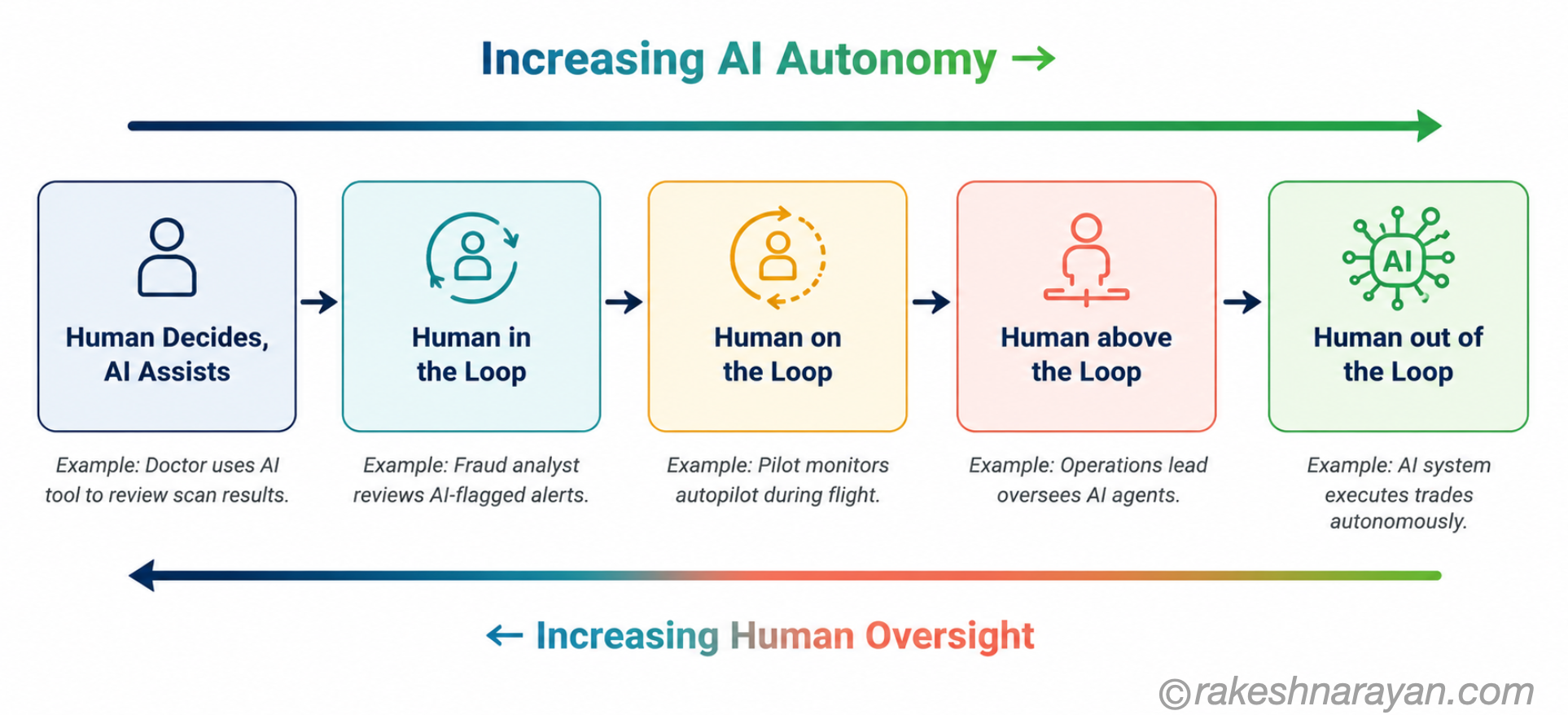
Rather than a binary, think of AI autonomy as a spectrum with five recognisable positions. Most AI systems you encounter will fall somewhere on this line.
| Position | How It Works | Everyday Example |
|---|---|---|
| 1. Human Decides, AI Assists | AI provides information, suggestions, or drafts. Human makes every decision and takes every action. | Grammar suggestions in a word processor. The writer decides what to accept. |
| 2. Human in the Loop (HITL) | AI prepares outputs and recommends actions. Human must explicitly approve before anything takes effect. | AI flags a suspicious transaction. A fraud analyst reviews and approves before the account is frozen. |
| 3. Human on the Loop (HOTL) | AI acts autonomously but a human monitors in real time and can intervene or override. | A self-driving car handles the driving. The driver remains attentive and can take control immediately. |
| 4. Human above the Loop | AI executes entire workflows autonomously. Humans set goals, review outcomes, and handle exceptions — but are not in the operational flow. | An AI agent processes invoices, matches them to purchase orders, and routes exceptions to a human. Humans only see what the AI cannot resolve. |
| 5. Human out of the Loop | Full autonomy. AI senses, decides, and acts with no human involvement — often at speeds where human intervention is not physically possible. | High-frequency trading algorithms. Thousands of trades execute in milliseconds. No human can review each one. |
Human in the Loop — the Approval Model
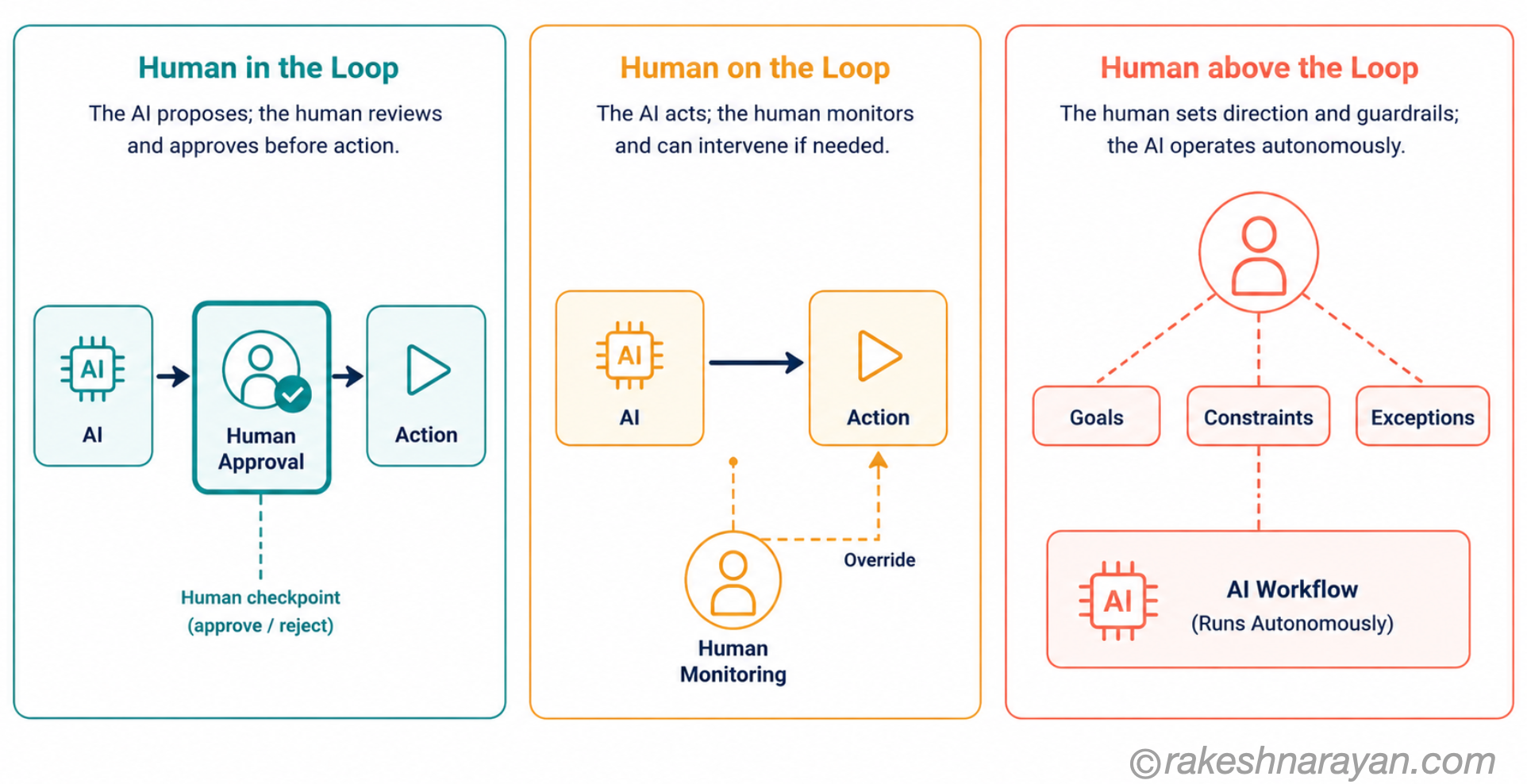
Human-in-the-loop (HITL) is the most discussed oversight model, and also the most misunderstood. It does not mean a human is watching every step the AI takes. It means the AI stops and waits for human approval at defined decision points before consequential actions take effect.
The key design question for HITL is: where do you put the checkpoint? Too early, and you are asking humans to approve trivial actions — which defeats the purpose of automation. Too late, and by the time a human reviews the output, the action has already had consequences.
HITL works best for high-stakes, relatively low-volume decisions where the cost of a wrong action is high. A loan approval. A medical diagnosis that triggers treatment. A compliance decision with regulatory consequences. These are cases where the speed benefit of full autonomy is outweighed by the risk of an unchecked error.
💡 Practical Tip
Regulators across multiple jurisdictions have increasingly required formal human review at defined decision points for AI in high-stakes domains — financial services, healthcare, and critical infrastructure. In practice, HITL is becoming a compliance expectation in regulated industries, not just a design preference.
Human on the Loop — the Monitoring Model
Human-on-the-loop (HOTL) shifts the human’s role from approver to supervisor. The AI acts; the human watches and can intervene. This model accepts that requiring approval for every action would eliminate the speed advantage of autonomous operation — but it maintains a safety net.
The self-driving car is the clearest illustration. The car handles all the driving decisions continuously — steering, braking, speed adjustments — at a pace no human could manually approve one by one. But the driver remains present, aware, and able to take control. The human is on the loop, not in it.
HOTL requires two things to work: the AI must behave predictably enough that the human can detect when something is wrong, and the human must be genuinely engaged rather than passively present. The failure mode of HOTL is automation complacency — humans stop paying attention because the AI almost always gets it right, and then miss the rare case where it does not.
Human above the Loop — the Emerging Model
The phrase ‘human above the loop’ has emerged from the 2025–2026 wave of agentic AI. It describes a model where humans are not inside the workflow at all — they set goals, define constraints, review outcomes, and handle exceptions, but the AI executes the operational work end to end.
This is the model that enterprise AI agents are pushing toward. An accounts payable agent that processes invoices, matches purchase orders, and flags discrepancies does not need a human to approve each step. It needs humans to set the rules, review the exception queue, and audit the outcomes. The human is above the process, not inside it.
The shift from human-in-the-loop to human-above-the-loop is significant. It changes what humans are responsible for — less about reviewing individual AI outputs, more about designing the systems, setting the guardrails, and maintaining oversight at the level of outcomes rather than actions.
The Right Level of Autonomy — It Depends on the Task
There is no correct position on the autonomy spectrum. The right level depends on three factors: the consequence of a wrong decision, the reliability of the AI system, and the speed at which decisions need to be made.
| Factor | Low Autonomy Makes Sense When… | High Autonomy Makes Sense When… |
|---|---|---|
| Consequence of error | A wrong decision causes significant harm — financial, legal, physical, reputational. | A wrong decision is easily corrected and has low cost. |
| AI reliability | The system is new, operating in an unfamiliar domain, or has known edge cases. | The system has a proven track record in a well-defined, stable domain. |
| Decision speed | Human review time does not significantly affect the outcome. | Decisions must happen faster than humans can operate — milliseconds, or at massive scale. |
A useful rule of thumb: match the autonomy level to the reversibility of the action. An AI drafting an email that a human sends — highly reversible, high autonomy is fine. An AI that sends the email on your behalf — less reversible, more oversight warranted. An AI that commits your organisation to a contract — irreversible, HITL is appropriate.
Where Real AI Systems Sit Today
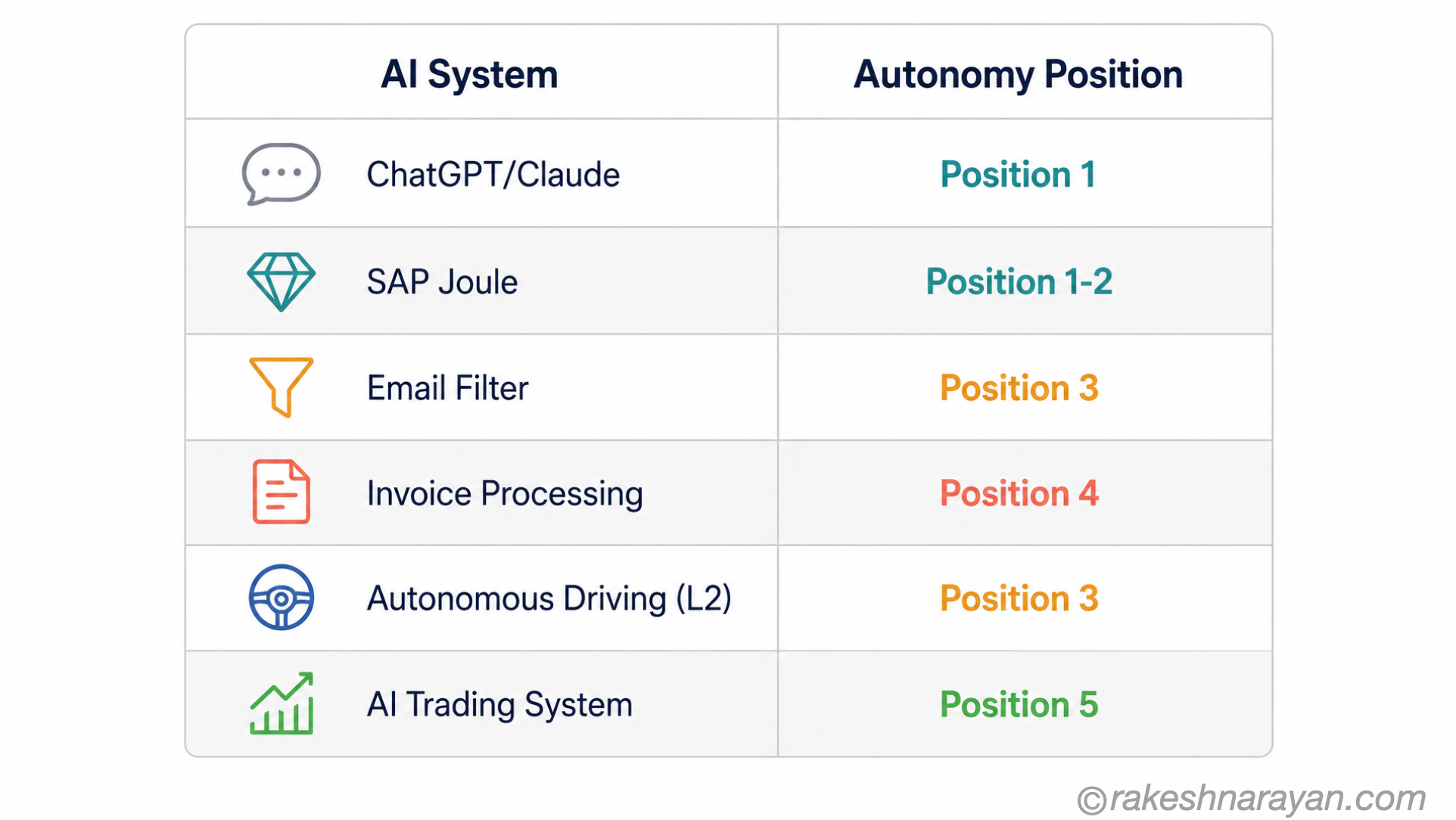
Most AI systems deployed in enterprises in 2026 sit between positions 2 and 4 on the spectrum — human-in-the-loop to human-above-the-loop. Full autonomy (position 5) is still rare outside of specific domains like high-frequency trading and certain industrial control systems.
| AI System | Autonomy Position |
|---|---|
| ChatGPT / Claude answering a question | Position 1 — Human Decides, AI Assists. You ask, it responds. |
| Joule in S/4HANA suggesting a transaction | Position 1–2 — AI recommends, human confirms before action. |
| Email spam filter | Position 3 — Human on the Loop. Filters act automatically; you can review and recover. |
| AI agent processing invoices | Position 4 — Human above the Loop. Handles routine cases; escalates exceptions. |
| Autonomous vehicle on a motorway | Position 3 — Human on the Loop. Drives automatically; driver monitors and can override. |
| High-frequency trading algorithm | Position 5 — Human out of the Loop. Operates at speeds that preclude human involvement. |
Why This Matters More Than It Used To
For most of AI’s history, the autonomy question was largely theoretical. AI systems were narrow — they classified images, recommended products, filtered spam — and the stakes of any individual decision were low enough that autonomy levels were not a serious design concern.
Agentic AI changes that. An AI agent that can send emails, book meetings, update records, and execute transactions on your behalf is operating with a level of consequence that earlier AI systems never had. The question of where the human sits in that loop is no longer an academic one — it is a governance and risk management decision with real business implications.
The organisations getting this right in 2026 are not the ones asking ‘how autonomous can we make this?’ They are asking ‘what is the right level of autonomy for this specific task, and how do we maintain meaningful oversight as the AI takes on more of the operational work?‘
At a Glance — The Mental Model
| Concept | One-Line Summary |
|---|---|
| Reactive AI | Waits for human input. Acts only when prompted. No autonomy. |
| Proactive AI | Initiates action on its own based on conditions or schedules. |
| Human in the Loop (HITL) | AI prepares, human approves before action takes effect. Best for high-stakes, low-volume decisions. |
| Human on the Loop (HOTL) | AI acts, human monitors and can override. Best when speed matters but oversight is still needed. |
| Human above the Loop | AI runs the workflow end to end. Humans set goals and handle exceptions. The emerging enterprise model. |
| Human out of the Loop | Full autonomy. No human in the operational flow. Appropriate only in narrow, proven, high-speed domains. |
| Reversibility rule | Match autonomy level to how reversible the action is. Irreversible actions need more oversight. |
The Question That Does Not Go Away
As AI systems become more capable, the temptation is to remove humans from the loop entirely — because it is faster, cheaper, and the AI is usually right. The flaw in that reasoning is the word usually.
In high-volume systems, ‘usually right’ means a lot of wrong decisions at scale. In high-stakes systems, the rare failure can be catastrophic. The oversight models — HITL, HOTL, human above the loop — are not limitations on AI capability. They are the design choices that make autonomous AI deployable in environments where the consequences of failure actually matter.
Understanding the spectrum is understanding that autonomy is not a goal in itself. It is a design variable. The goal is the right outcome — and the right level of autonomy is whatever produces that outcome reliably, safely, and accountably.
🔗 Related Reading
AI Agents — What They Are and How They Work — the agent architecture that makes human-above-the-loop possible.
AI in SAP — How Joule and Business AI Actually Work — how SAP’s Joule positions itself on the autonomy spectrum across different use cases.
What is a Large Language Model (LLM)? — the foundation model layer that most AI assistants and agents are built on.
AI Hallucinations — Why They Happen and What You Can Do About Them — a key reason why human oversight still matters.
Published on rakeshnarayan.com — Articles
URL: https://rakeshnarayan.com/articles/autonomous-ai-the-spectrum-from-assistant-to-agent/
Did you enjoy this article?
Let me know — it takes one click.
0 Comments
Leave a Comment
Looks like this one held your attention — I'd really appreciate a quick comment below.
Your comment has been submitted and will appear after review.