SAP Signavio — Process Mining, Intelligence and Where It Fits
Every S/4HANA project eventually has the same conversation. Someone asks how the current purchase-to-pay process actually runs. The business explains it. IT explains it slightly differently. The consultant sketches something on a whiteboard. Nobody fully agrees. Signavio is the tool SAP built to end that conversation — by replacing it with data.
SAP acquired Signavio in March 2021, bringing it into the Business Process Intelligence portfolio. It now ships as part of RISE with SAP Premium and is the process intelligence layer sitting behind most large-scale SAP transformation programmes. If you have been on an S/4HANA project in the last two years, you have almost certainly seen it mentioned. Fewer people can explain what it actually does.
This post builds the mental model — what process mining is, how the Signavio suite is structured, and where it fits in the SAP landscape. Not a feature tour. The concepts you need to use it confidently.
🔗 Related reading
This post sits in the SAP section of this site. If Signavio’s AI capabilities are on your radar, AI in SAP: How Joule and Business AI Actually Work covers the broader picture. For the platform context, SAP BTP — The Platform Explained is the right foundation.
The problem Signavio solves — as-is vs should-be
Every organisation has two versions of its processes. The version documented in flowcharts and procedure manuals — the should-be. And the version that actually runs in the system every day — the as-is. The gap between them is where efficiency is lost, compliance breaks down, and transformation projects get surprised.
The traditional way to close that gap is workshops. Interview process owners, map the steps, validate with the team. It works — but it is slow, expensive, and limited by what people remember and are willing to admit. People describe the process as it is supposed to work, not as it actually runs.
Process mining does it differently. It reads the digital footprints that SAP — and any other connected system — leaves behind and reconstructs what actually happened. No workshops. No guesswork. Just data.
How process mining works — the event log
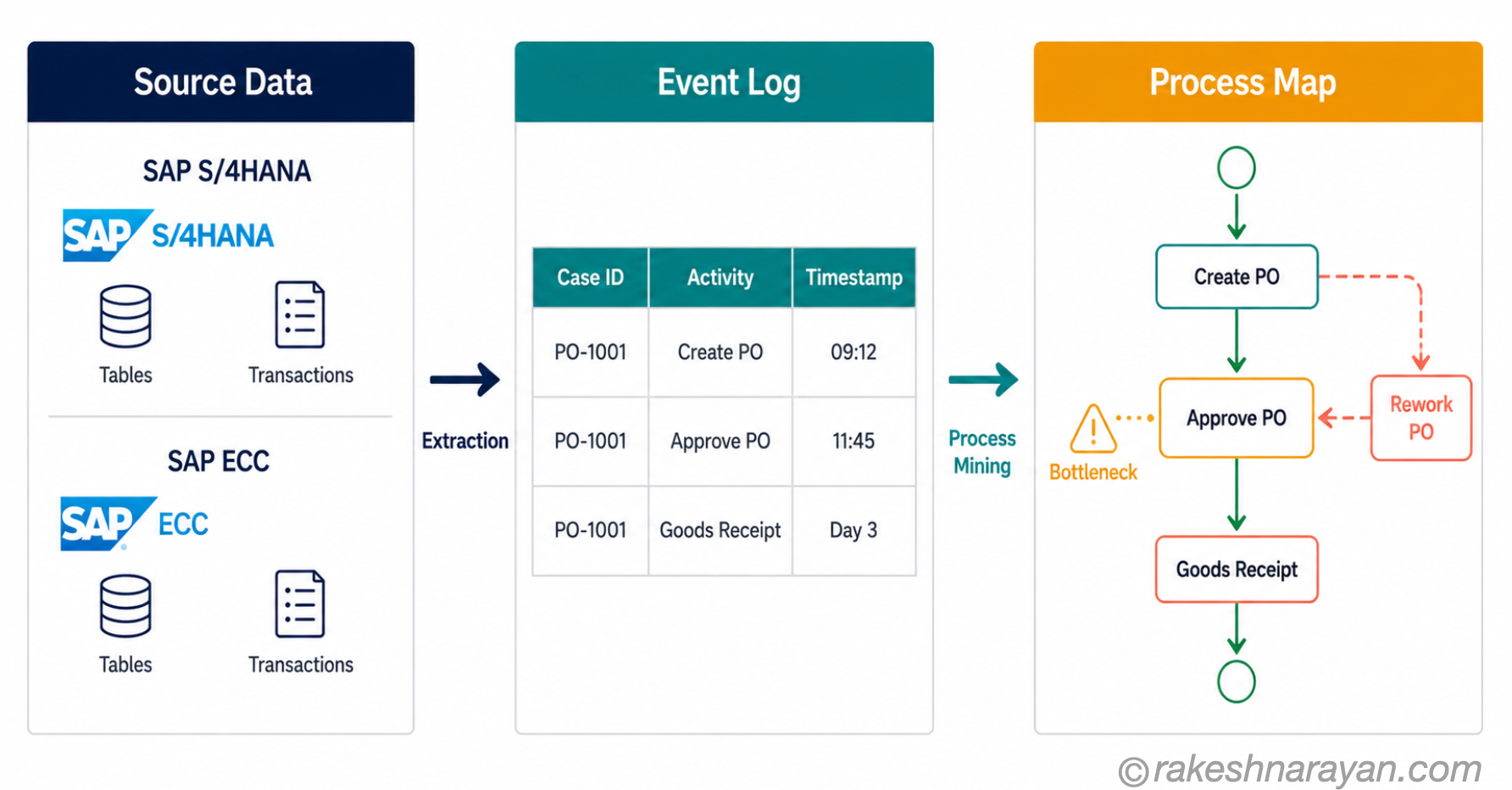
Every time a user completes a step in SAP — creates a purchase order, posts an invoice, releases a payment — the system records it. Timestamp, transaction, user, case reference. These records are the raw material of process mining.
Signavio extracts this data from SAP tables and transforms it into an event log — a structured dataset with three mandatory columns: a case ID (the purchase order number, for example), an activity (what happened), and a timestamp (when it happened). Everything else — the user, the org unit, the document value — is additional context that enriches the analysis.
From the event log, Signavio reconstructs the actual end-to-end process — every path taken, every variant, every exception. It then visualises this as a process flow showing not just the happy path but every deviation: the invoices that bypassed approval, the purchase orders that were created after the goods receipt, the cases that looped back through correction three times.
💡 Practical tip
Signavio connects to SAP S/4HANA and ECC via RFC (Remote Function Call) for on-premise systems, or via SAP Datasphere replication flows for cloud. It also supports non-SAP data sources. For on-premise connections, your Basis team will need to configure the RFC connection and ensure the relevant SAP tables are accessible. This is usually straightforward but plan for it in the project schedule — it is not instant.
Three things process mining lets you do
Once the event log is built, Signavio supports three types of analysis. Understanding these distinctions is what separates people who use the tool well from people who generate dashboards nobody acts on.
| Analysis type | What it answers | Typical use case |
|---|---|---|
| Process discovery | What process do we actually run? What variants exist? | As-is documentation before an S/4HANA migration. Understanding the real process landscape before Fit-to-Standard workshops. |
| Conformance checking | Does the actual process match the intended process? Where are the deviations? | Compliance and audit — finding where approvals are bypassed, controls are missing, or the sequence of steps violates policy. |
| Root cause analysis | Why does the process deviate? Which attributes predict a slow case or a rework loop? | Performance improvement — finding that cases over €50k in a specific purchasing org take 3× longer due to a missing approval step. |
📌 Key takeaway
Process discovery shows you what is happening. Conformance checking tells you where it breaks the rules. Root cause analysis explains why. Most projects start with discovery, get value from conformance checking, and build to root cause analysis over time. Trying to do all three at once without a clear business question is how Signavio projects stall.
The Signavio suite — what’s in it
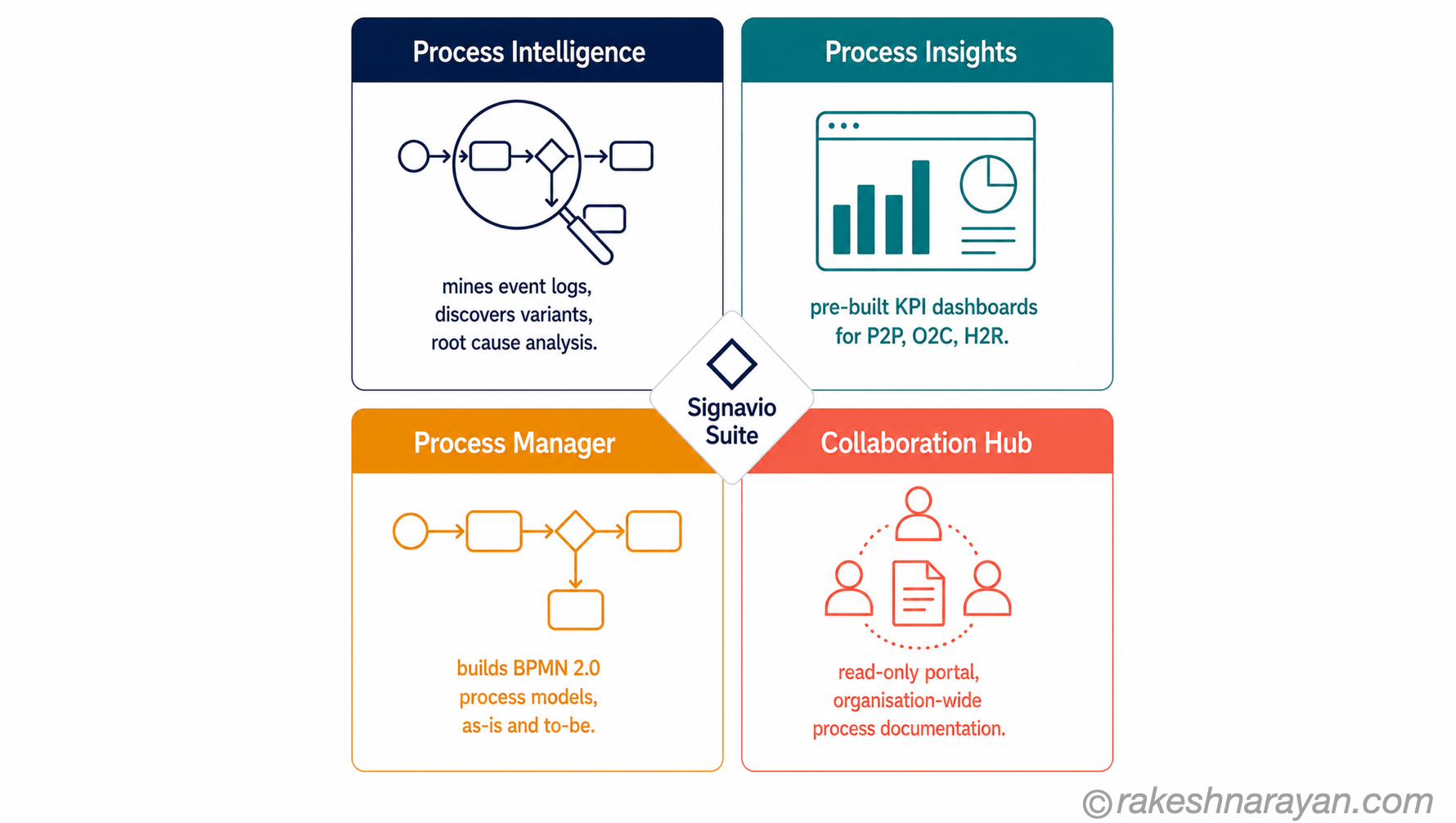
Signavio is not a single tool. It is a suite — the SAP Signavio Process Transformation Suite — with modules that serve different purposes. You do not need all of them to get value, but you need to know which one does what.
| Module | What it does |
|---|---|
| Process Intelligence | The process mining engine. Connects to source systems, builds event logs, runs discovery, conformance checking and root cause analysis. This is the module most people mean when they say ‘Signavio’. |
| Process Insights | Pre-built dashboards and KPIs for common SAP processes — Purchase-to-Pay, Order-to-Cash, Hire-to-Retire. Faster to get started; less flexible for custom analysis. SAP has been converging Process Insights and Process Intelligence since 2024, treating the two as an integrated experience. |
| Process Manager | The modelling tool. Build BPMN 2.0 process models — as-is and to-be. Where process designers document how processes should run. |
| Process Collaboration Hub | The read-only portal. Publishes process models and documentation to the broader organisation. The single source of truth for process content — accessible to anyone without needing authoring access. |
📝 Note
SAP has been converging Process Insights and Process Intelligence since 2024, and as of 2026 the two are increasingly treated as a single integrated experience rather than two separate tools. If you are evaluating Signavio today, think of the mining and insights capabilities as one unified layer.
Where Signavio fits in the SAP landscape
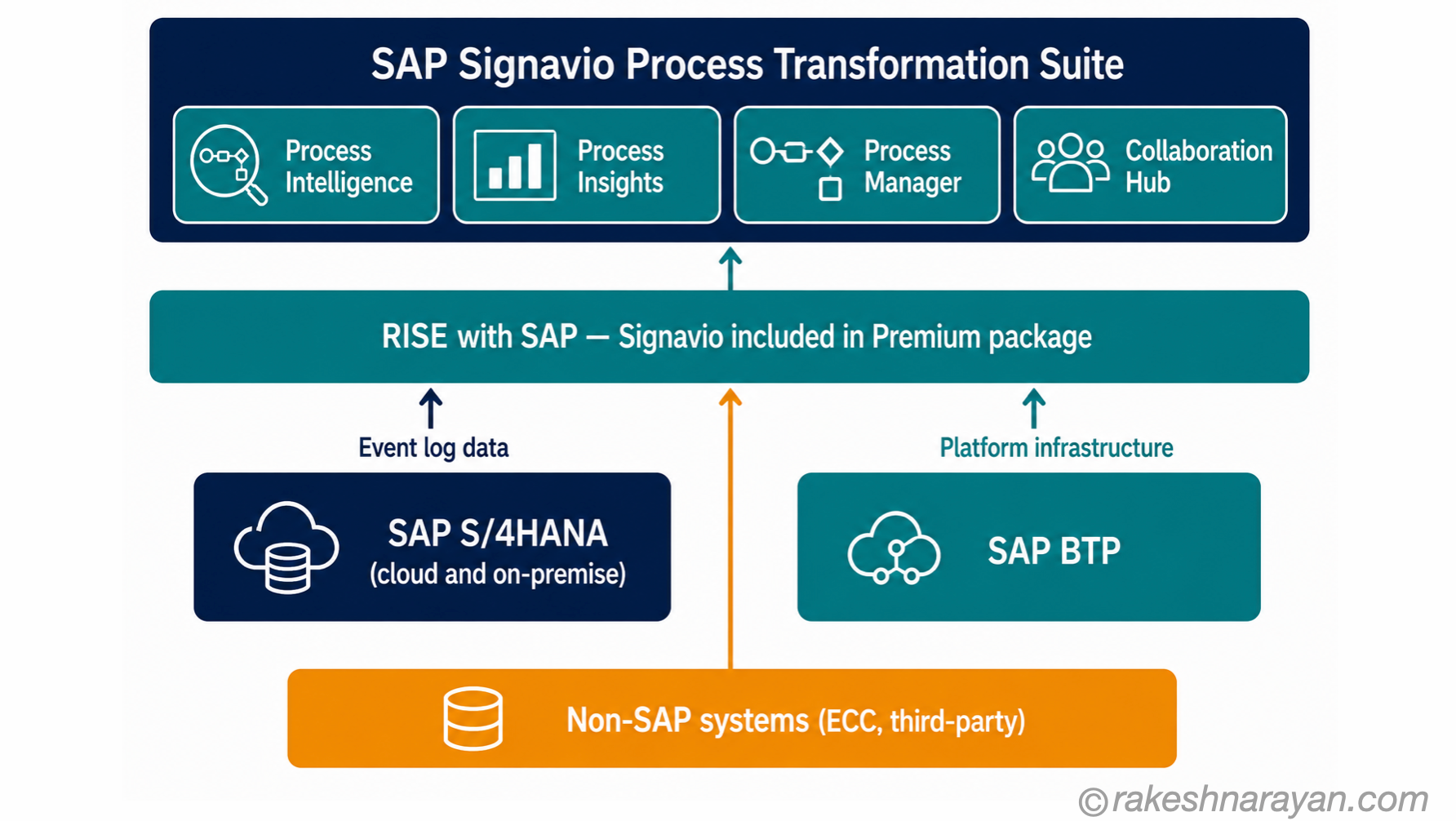
This is the question that confuses most people encountering Signavio for the first time. Is it a BTP tool? A RISE add-on? Something separate? The answer: it sits across all three contexts, and the way it is licensed depends on how you come to it.
| Context | What you need to know |
|---|---|
| RISE with SAP | Signavio is included in the RISE with SAP Premium package. For most large enterprise S/4HANA transformations, this is how customers access it. The RISE Base package does not include Signavio — it must be purchased separately. |
| SAP BTP | Signavio runs on SAP BTP infrastructure. It is provisioned through SAP for Me. Your BTP landscape does not need to be separately configured to use Signavio, but the two products are increasingly integrated — Signavio can trigger actions in SAP Build Process Automation, for example. |
| S/4HANA migration | This is the most common entry point. Signavio is used to document the as-is process landscape before migration, identify what can be standardised, and provide the fact base for Fit-to-Standard workshops. It turns a workshop-led activity into a data-led one. |
| Continuous improvement | Signavio is not just a migration tool. After go-live, it monitors whether the implemented processes are running as designed and flags deviations. This is the continuous monitoring use case — less common but increasingly the goal for mature implementations. |
🔗 Related reading
For the S/4HANA migration context, SAP S/4HANA vs ECC — The Real Difference explains the transformation drivers that make process intelligence relevant at all. Signavio is most valuable when you understand what you are transforming towards.
What it does well — and where it has limits
Signavio is genuinely powerful for organisations running standard SAP processes. If your purchase-to-pay or order-to-cash processes are broadly aligned to SAP best practice — even if messy in execution — the tool surfaces insights quickly and the built-in benchmarks are meaningful.
The limit is the assumption embedded in that design. Signavio is built around the idea that SAP best-practice processes are the reference point. If your processes have evolved over decades of custom development — Z-transactions, bespoke approval workflows, non-standard document types — the tool’s baseline assumptions start to break down. The data still gets extracted, but the interpretation of what counts as a deviation or a bottleneck becomes less reliable.
This is not a flaw unique to Signavio — it is an honest consequence of how it is designed. Know it going in, and you can manage around it. Discover it halfway through a project and it costs real time.
⚠️ Warning
Do not start a Signavio engagement without a clearly defined business question. ‘Show us our processes’ is not a question — it is a data dump. The tool will produce vast amounts of output. Without a specific process in scope (P2P, O2C, a specific plant or purchasing org), teams drown in variants and lose the stakeholder confidence that process mining projects need to deliver value. Define the scope first. Then connect the data.
At a glance — SAP Signavio
| Concept | One-line summary |
|---|---|
| SAP Signavio | A process transformation suite — mines, models, and monitors business processes using data from SAP and non-SAP systems |
| Process mining | Reconstructs actual process execution from system event logs — showing what really happens, not what is documented |
| Event log | The dataset process mining runs on — case ID, activity, and timestamp extracted from SAP tables |
| Process discovery | Finds all the process variants that actually exist in the data — including exceptions and workarounds |
| Conformance checking | Compares actual process execution against the intended design — surfaces deviations and compliance gaps |
| Root cause analysis | Identifies why deviations happen — which attributes predict slow cases, rework, or control failures |
| Process Insights | Pre-built dashboards for standard SAP processes — faster to start, less flexible |
| Process Intelligence | The full mining engine — flexible, configurable, deeper analysis across any connected system |
| Collaboration Hub | Read-only process documentation portal — the organisation’s single source of process truth |
| RISE with SAP | Signavio is included in the RISE Premium package — the most common route to the tool for large enterprises |
| Best fit | Organisations running broadly standard SAP processes — strongest for P2P, O2C, Hire-to-Retire scenarios |
| Honest limitation | Assumes SAP best-practice alignment — heavily customised landscapes require more careful interpretation of findings |
What to take away
Signavio does not tell you what to fix. That distinction matters more than it sounds. It tells you what is actually happening — precisely, at scale, without the distortion that comes from interviews and workshops. What to fix is still a judgement call that requires process knowledge, business context, and stakeholder alignment. The tool removes the argument about what the facts are. Everything after that is still human work.
The teams that get the most from Signavio treat it as a fact-finding layer, not an answer machine. They come in with a specific process in scope, a clear business question, and a stakeholder who owns the outcome. The tool then accelerates everything — the as-is documentation, the Fit-to-Standard workshops, the deviation analysis, the post-go-live monitoring.
If you are on an S/4HANA programme and Signavio is in the toolkit, understand what it can and cannot tell you before the first data extraction. The mental model in this post is the foundation. The rest is the project.
🔗 Related posts on this site
SAP S/4HANA vs ECC — The Real Difference — the transformation drivers that make process intelligence relevant; Signavio is most commonly deployed in this context.
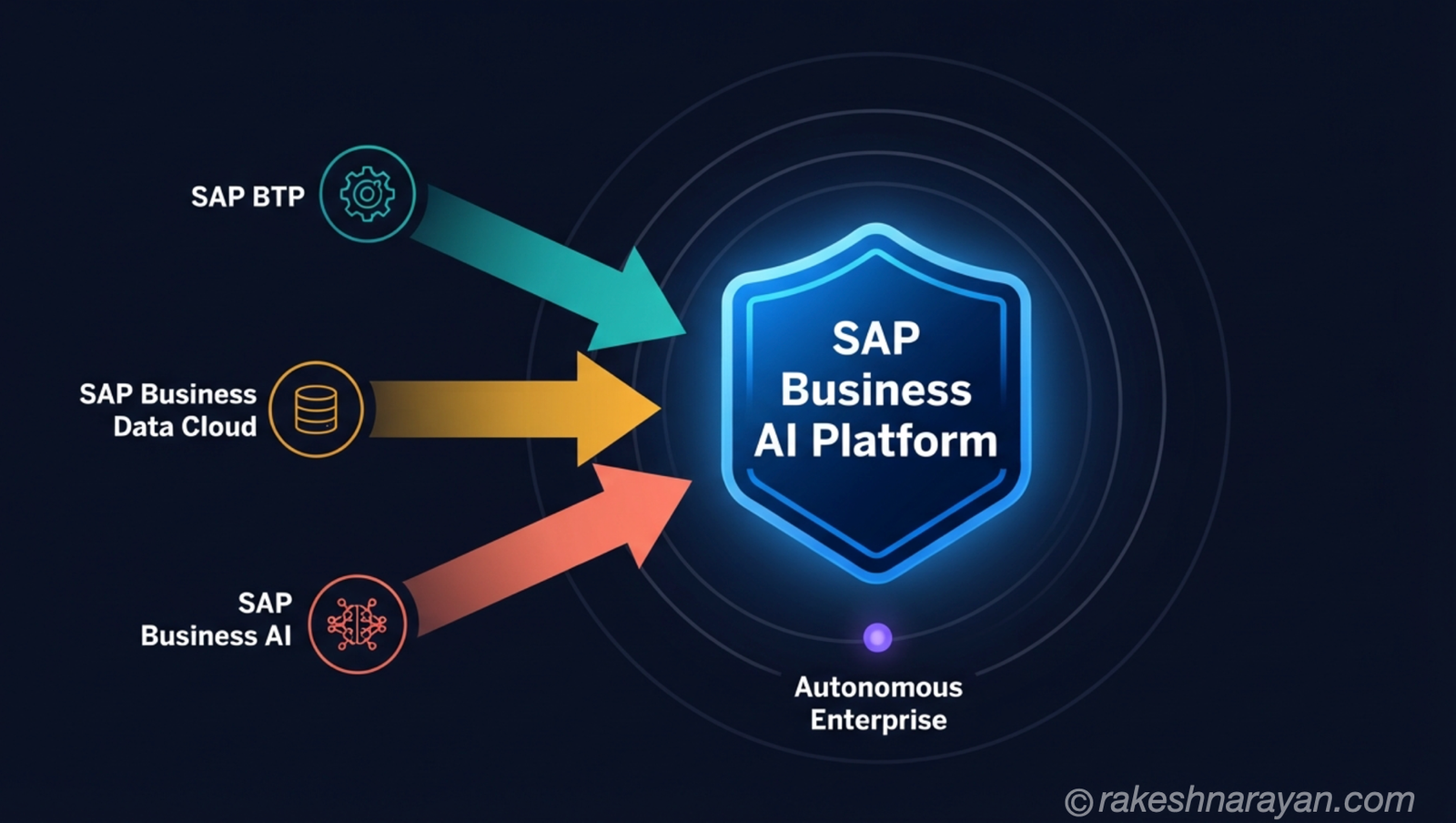
AI in SAP: How Joule and Business AI Actually Work — Signavio’s embedded AI capabilities connect directly to SAP’s broader AI strategy covered here.
SAP BTP — The Platform Explained — Signavio runs on BTP infrastructure; this post explains the platform it sits on.
SAP Integration Patterns — The Decisions That Matter — Signavio’s trigger-to-action integrations connect to SAP Build and third-party RPA tools; integration patterns become relevant when moving from insight to action.
Published on rakeshnarayan.com — Articles
URL: https://rakeshnarayan.com/articles/sap-signavio-process-mining-intelligence-and-where-it-fits/
Did you enjoy this article?
Let me know — it takes one click.
0 Comments
Leave a Comment
Looks like this one held your attention — I'd really appreciate a quick comment below.
Your comment has been submitted and will appear after review.