SAP Business Data Cloud — The Architecture Behind SAP's AI Push
Ask someone in a typical SAP landscape what happens when finance wants to combine S/4HANA revenue data with SuccessFactors headcount and Ariba spend in a single report. The answer is usually a long pause, followed by ‘we build a custom extract’. That extract takes weeks, breaks every upgrade, and produces numbers nobody fully trusts.
That is the problem SAP Business Data Cloud was built to solve. Not the report. The underlying reason the report is hard — data from different SAP applications does not automatically connect. Each application manages its own version of a customer, an employee, a supplier. Without a layer that unifies those definitions, analytics and AI are working on fragments, not on the full picture.
BDC is that layer. This post explains what it is, how the components fit together, and what the architecture actually means for your SAP roadmap.
🔗 Foundation context
SAP BTP — The Platform Explained — BTP provides the infrastructure layer BDC is built on.
SAP Security Roles and Authorisation — how role-based access connects to the governed data layer BDC provides.
The data problem nobody talks about honestly
Most SAP landscapes run the same pattern. S/4HANA for financials and logistics. SuccessFactors for HR. Ariba for procurement. SAP CX for sales and service. Each one is excellent at what it does. Each one holds its own version of the same business entities.
A customer in S/4HANA is a business partner with a credit limit, payment terms, and transactional history. The same customer in SAP Sales Cloud is a contact with opportunities and engagement history. The same customer in SAP Service Cloud is a case submitter. These three representations do not automatically connect.
When a CFO asks for a view of a customer’s full commercial relationship — revenue, service cost, open credit exposure — the answer requires an integration project, not a report. That is the gap BDC addresses. And it is the same gap that makes AI fail before it starts. Joule cannot reason across your business if its data is fragmented across six application boundaries.
What SAP Business Data Cloud actually is
SAP Business Data Cloud is a fully managed SaaS platform that unifies data from SAP and non-SAP applications into a single governed, semantically consistent layer — and makes that layer available to analytics, planning, and AI.
SAP describes its strategic direction as a three-corner flywheel: Applications generate data, Data enables AI, and AI improves Applications. BDC is the data corner of that flywheel. Without it, the flywheel does not turn. AI has no unified foundation to operate on, and application insights remain isolated within each application’s boundary.
| Flywheel Corner | What BDC’s role is |
|---|---|
| Applications — S/4HANA, SuccessFactors, Ariba, SAP CX | Source of all operational transaction data. BDC ingests from these applications and manages the replication automatically. |
| Data — SAP Business Data Cloud | Unifies, governs, and enriches data from all sources into a single semantic layer. This is BDC’s job. |
| AI — SAP Business AI and Joule | Operates on the unified data BDC provides. Joule’s cross-application intelligence is only possible because BDC connects the underlying data. |
📌 Key Takeaway
BDC is not a reporting tool. It is not an analytics layer. It is the data foundation that makes analytics and AI work across your entire SAP landscape — not within one application at a time.
The components — what is inside BDC
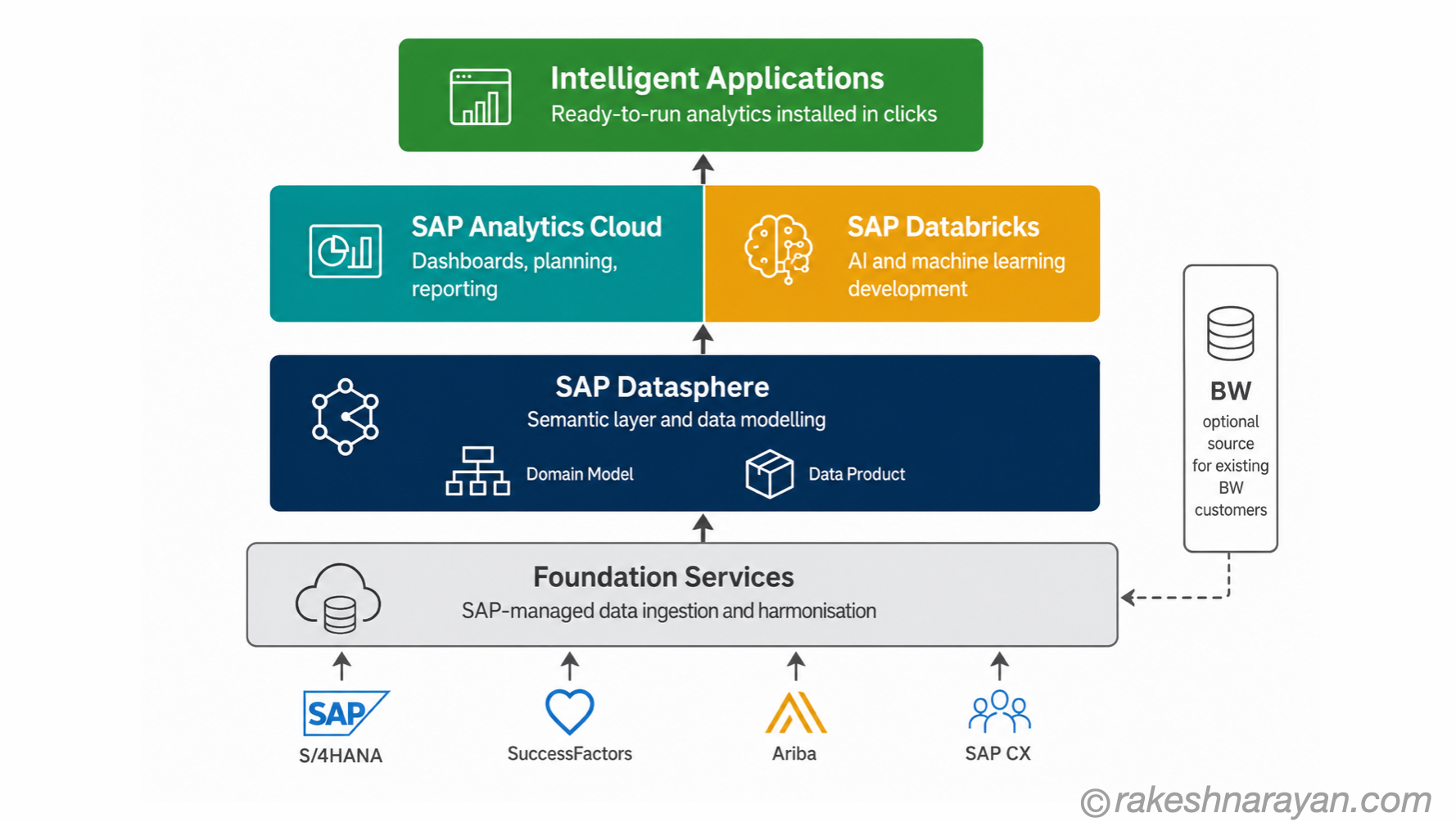
BDC is not a new product built from scratch. SAP took its two flagship data and analytics platforms, embedded a new AI/ML layer, and wrapped them in a managed SaaS model with a unified cockpit. Understanding the components removes most of the confusion about what BDC is.
| Component | What it does in BDC | New or existing | Optional? |
|---|---|---|---|
| Foundation Services | Manages data ingestion from SAP source applications — replication, harmonisation, and enrichment into data products. SAP handles this end-to-end; customers do not build or maintain the pipelines. | New | No — core |
| SAP Datasphere | The semantic layer and data modelling platform at the heart of BDC. Provides the domain model, data governance, and the business-meaningful objects (customers, orders, employees) that analytics and AI consume. | Existing — embedded | No — core |
| SAP Analytics Cloud (SAC) | The analytics and planning layer. Delivers the dashboards, reports, and planning models that business users interact with. Embedded inside BDC so it draws from the governed data layer, not from disconnected sources. | Existing — embedded | No — core |
| SAP Databricks | The AI and machine learning development environment. Data scientists use Databricks to build models on top of BDC data. Embedded version — specifically built through the SAP–Databricks partnership. | New — embedded | No for full BDC |
| SAP BW (private cloud) | For customers who already run SAP BW, it can be included as a data source — feeding BW data into the BDC data product layer. Allows BW investments to be preserved rather than replaced. | Existing — optional source | Yes — BW customers only |
📝 Note on BW
BDC is not a replacement for BW — it is a superset. If you run BW today, you can connect it to BDC as a data source and bring your BW content into the governed layer. SAP’s BW modernisation path runs through BDC, not away from it.
Data products — the key innovation
The most important concept in BDC is not a component. It is a data product. This is what makes BDC genuinely different from what most SAP customers have built manually.
A data product is a ready-to-use, SAP-managed dataset for a specific business entity — Customer, Product, Sales Invoice, Purchase Order, Employee. It is not a report. It is not a dashboard. It is a governed, semantically enriched, real-time dataset that includes all the fields required to make that entity useful for analytics and AI — along with the metadata that describes what those fields mean.
The critical shift: SAP manages the data pipeline. In the past, customers built custom extracts from each source application, aligned them against a common model, and then maintained that alignment through every system upgrade. With BDC data products, you select what you need from the cockpit, install it in a few clicks, and SAP handles the replication and maintenance. The IT team that previously maintained the extract pipeline can focus on something more valuable.
💡 Practical Tip
For implementation teams evaluating BDC: the data product catalogue is where your scope conversation starts, not the component architecture. Identify the cross-application analytics use cases your business needs — the data products that support those use cases define what you activate. Start with one or two Intelligent Applications to demonstrate value before expanding scope.
BDC vs Datasphere — what is the actual difference?
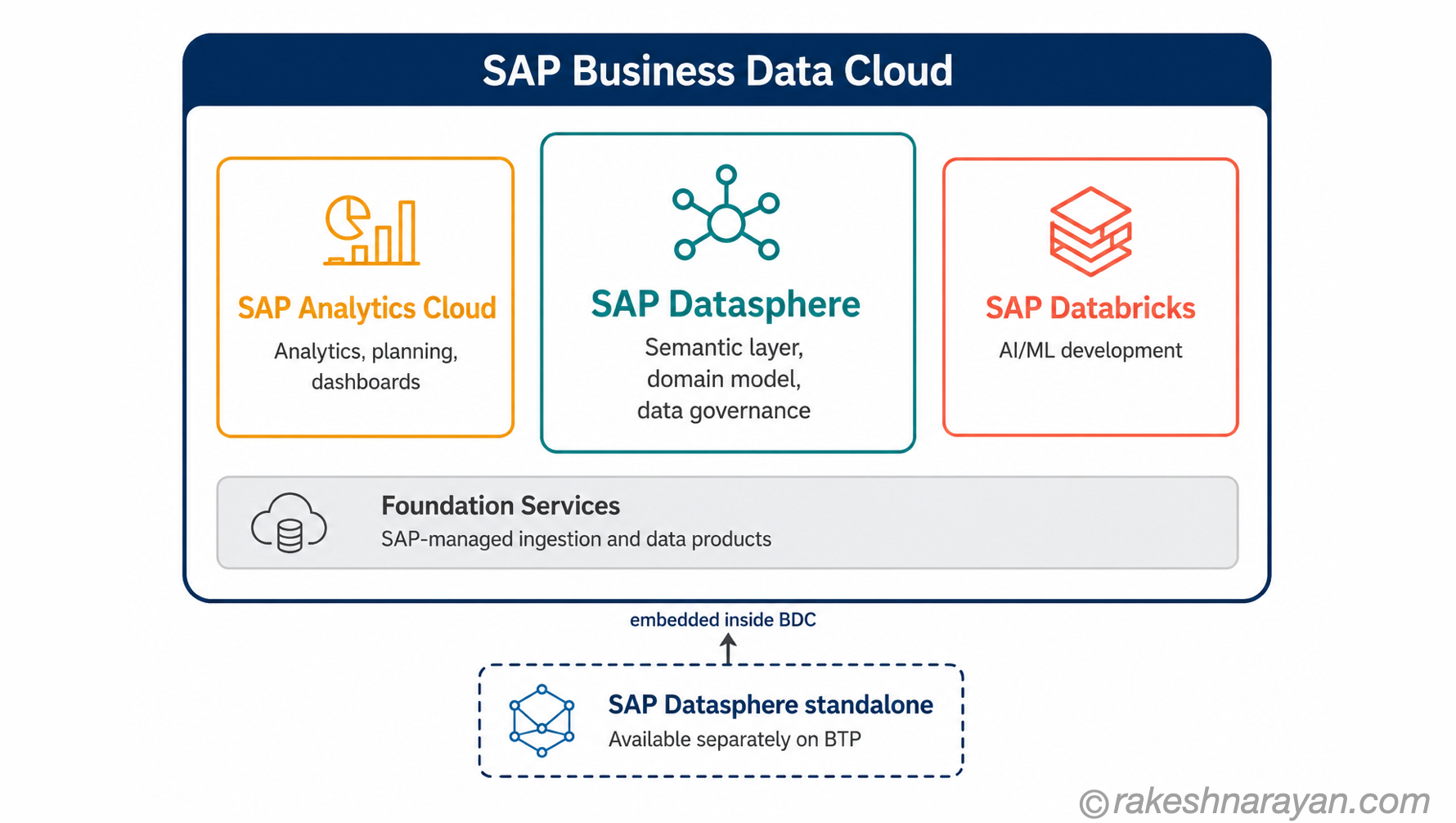
This is the question I hear most often in client conversations. The confusion is understandable — SAP Datasphere still exists as a standalone product, and BDC includes Datasphere as a core component. So which one do you need?
The answer: Datasphere is a component inside BDC. It is not a competitor to BDC. If you are starting fresh on an analytics modernisation today, the conversation is BDC — Datasphere standalone is for customers who want the data fabric capability without the full managed SaaS model and AI layer.
| Aspect | SAP Datasphere standalone vs SAP Business Data Cloud |
|---|---|
| What it is | Datasphere: SAP’s enterprise data management and semantic layer platform, available on BTP. BDC: A fully managed SaaS platform that includes Datasphere plus SAC, Databricks, Foundation Services, and the data product layer. |
| Data ingestion | Datasphere: Customer builds and maintains data pipelines from source systems. BDC: SAP-managed Foundation Services handle ingestion and replication automatically. |
| AI and ML | Datasphere: No embedded AI/ML development environment. BDC: SAP Databricks embedded — data scientists can build and deploy models directly on BDC data. |
| Data products | Datasphere: Not included — customer builds their own data models. BDC: SAP-delivered data products and Intelligent Applications included — installed in clicks. |
| Managed service | Datasphere: Customer manages configuration, upgrades, and content. BDC: SAP manages the full stack — infrastructure, data pipelines, content updates. |
| Pricing model | Datasphere: BTP Enterprise Agreement. BDC: Separate subscription model. |
| Right for… | Datasphere: Customers who want the semantic layer and data fabric without the full BDC stack. BDC: Customers building cross-application analytics and AI on SAP data at scale. |
Where Joule fits in — and why BDC matters for AI
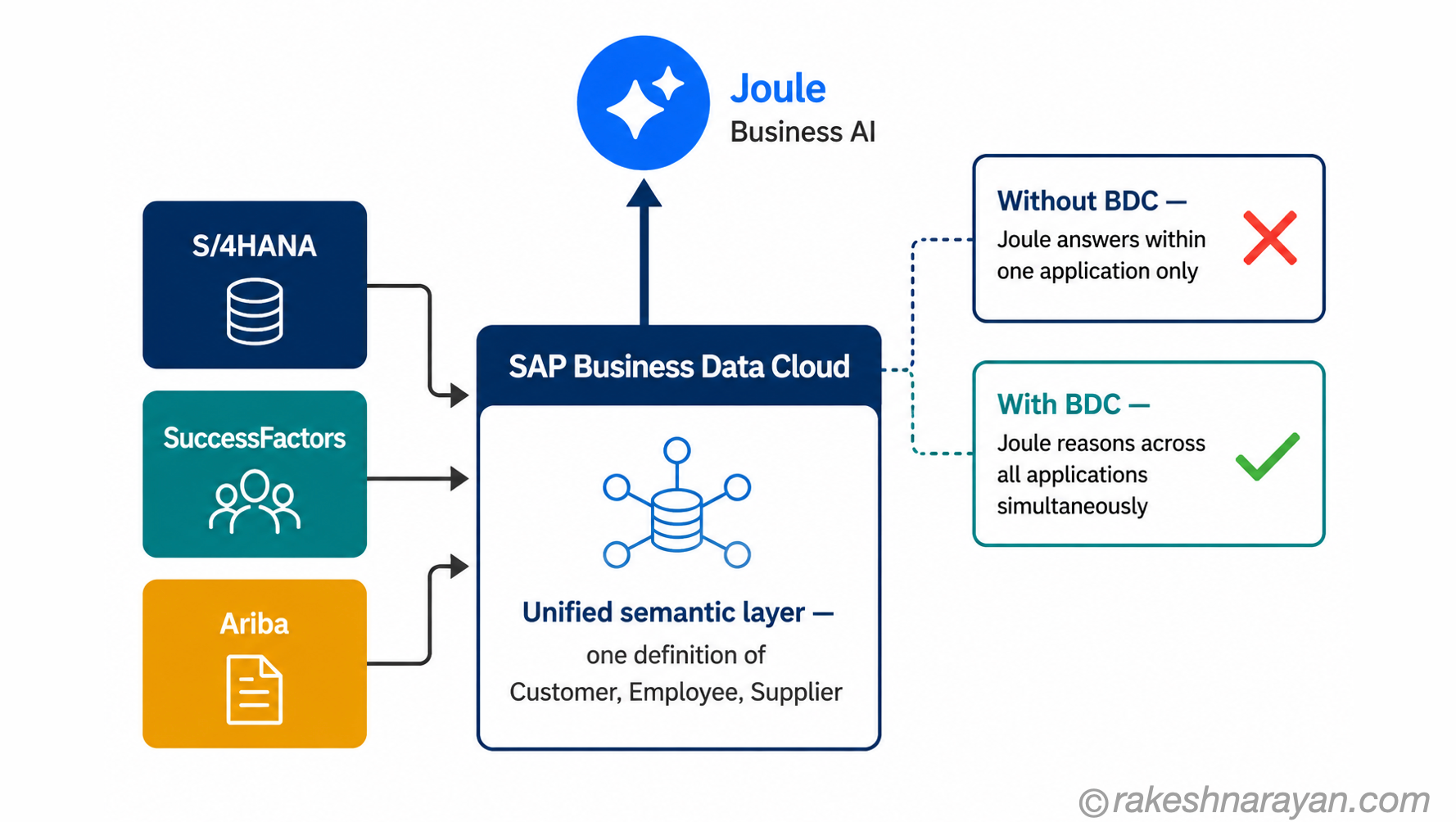
Joule is SAP’s generative AI copilot, embedded across SAP applications. It can answer questions, automate tasks, and surface insights. But Joule’s cross-application intelligence — its ability to reason across finance, HR, procurement and operations simultaneously — depends entirely on having unified data to reason across. That is what BDC provides.
Without BDC, Joule operates within application boundaries. It can tell you about a customer in S/4HANA or about a case in Service Cloud. It cannot connect them. With BDC’s unified semantic layer underneath, Joule can pull from a single definition of Customer that spans all applications — and reason across the full commercial, operational, and service picture at once.
📌 Sapphire 2026 — what changed
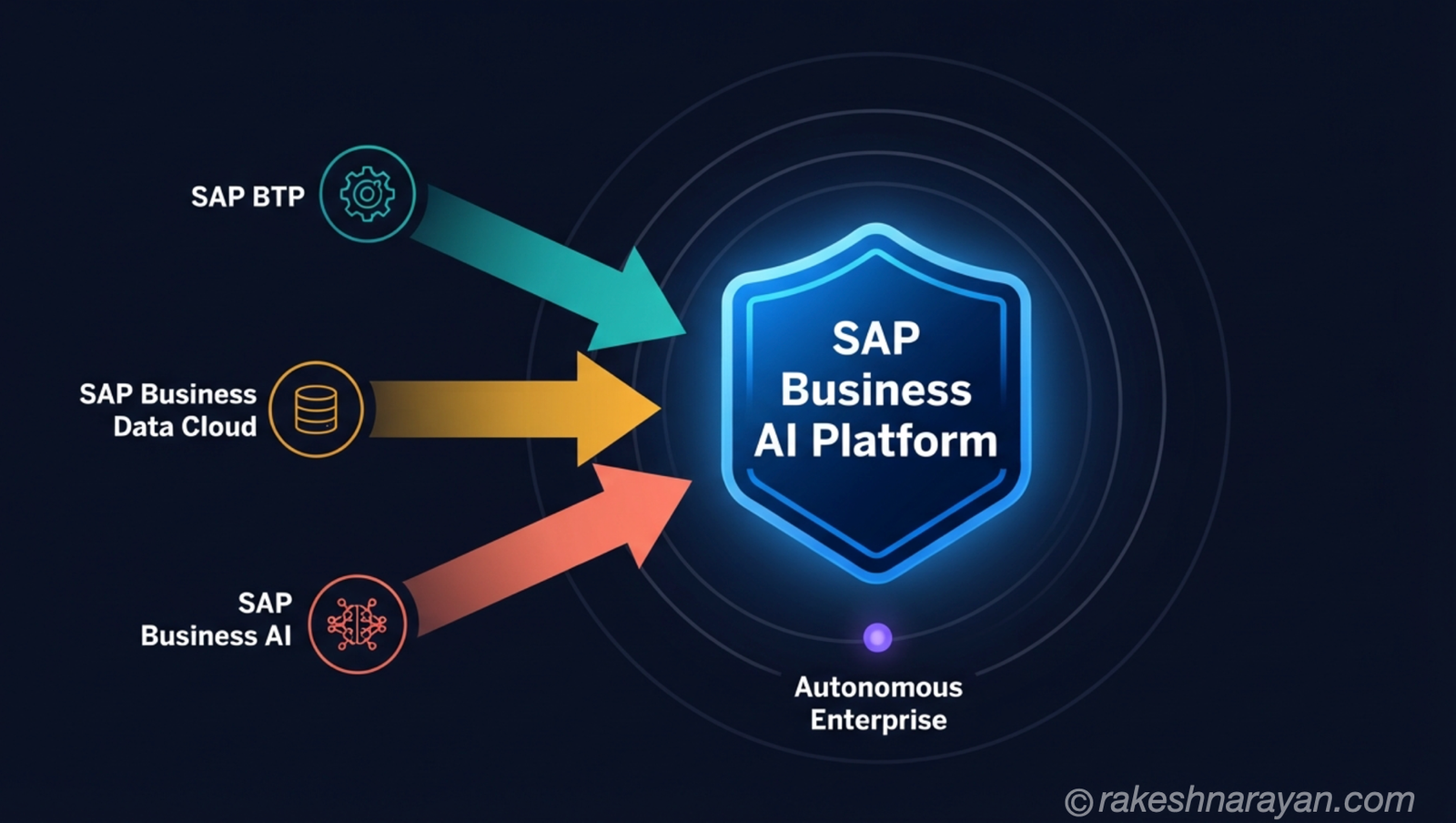
At SAP Sapphire 2026 (May 2026, Orlando), SAP consolidated SAP BTP, SAP Business Data Cloud, and SAP Business AI into a single unified architecture called SAP Business AI Platform. At its core sits the SAP Knowledge Graph — encoding SAP’s ERP data relationships into machine-readable semantic form.
For customers: BDC is no longer positioned as a standalone data product. It is the data layer of SAP’s entire AI platform. That makes BDC readiness a prerequisite for unlocking SAP’s AI roadmap — not an optional add-on.
Microsoft Fabric Connect reached GA in H2 2026, and AWS Athena zero-copy integration was announced — expanding the non-SAP data connections available through BDC.
What BDC is not — the misconceptions worth clearing up
Every project conversation I have had about BDC runs into at least one of these. Better to address them directly.
| Misconception | Reality |
|---|---|
| BDC replaces SAP Analytics Cloud | SAC is embedded inside BDC. It is still the analytics and planning layer. BDC is the data foundation SAC reports on — not a replacement for it. |
| BDC is an instant AI switch | BDC provides the data foundation for AI. If your source application data has quality problems — inconsistent master data, duplicate records, uncleaned classifications — BDC surfaces those problems at scale, not fixes them. Data quality in source systems still matters. |
| BDC replaces SAP Datasphere | Datasphere is a core component of BDC, not a competitor. Existing Datasphere customers are on the migration path to BDC — they are not being asked to abandon their investment. |
| BDC is SAP-data only | BDC is designed to connect the full enterprise data landscape. Non-SAP data — third-party systems, market data, partner feeds — can be integrated through Datasphere’s open data connections. |
| BDC is only for large enterprises | BDC’s managed SaaS model and pre-built Intelligent Applications are specifically designed to reduce the implementation complexity that previously made unified data architecture a large-enterprise project only. |
⚠️ Warning
BDC does not fix data governance problems in source systems — it exposes them. If S/4HANA has multiple conflicting customer master records and SuccessFactors has different employee IDs for the same people, BDC will unify on those inconsistencies, not resolve them. Source data quality work is a prerequisite, not an afterthought.
At a glance — SAP Business Data Cloud
| Concept | One-line summary |
|---|---|
| SAP Business Data Cloud (BDC) | A fully managed SaaS platform that unifies data from SAP and non-SAP applications into a governed semantic layer for analytics and AI |
| Foundation Services | The SAP-managed ingestion and harmonisation layer — automatically replicates data from source applications so customers do not build or maintain pipelines |
| Data product | A ready-to-use, SAP-managed dataset for a business entity (Customer, Order, Employee) — includes data, metadata, and business meaning |
| SAP Datasphere | The semantic layer and data modelling platform at the core of BDC — provides the domain model and data governance |
| SAP Analytics Cloud (SAC) | The analytics and planning layer embedded in BDC — dashboards, reports, and planning models for business users |
| SAP Databricks | The AI and ML development environment embedded in BDC — for data scientists building models on BDC data |
| Intelligent Applications | Ready-to-run analytics installed in clicks — SAP delivers and maintains the full stack from data pipeline to dashboard |
| SAP Knowledge Graph | The semantic core of SAP Business AI Platform — encodes SAP ERP data relationships so AI can reason across business processes |
| BDC vs Datasphere standalone | Datasphere is a component inside BDC. BDC is the superset — adds Foundation Services, Databricks, data products, and the managed SaaS model |
| Joule + BDC | Joule’s cross-application AI intelligence runs on the unified semantic layer BDC provides — without BDC, Joule is limited to single-application boundaries |
What to take away
Most organisations asking why their AI use cases are not delivering are not missing AI tools. They are missing the data foundation that AI needs to work across the full enterprise. That is what BDC is built to solve — not by adding another integration project, but by managing the data layer as a governed service that SAP maintains on your behalf.
The Sapphire 2026 consolidation matters here. SAP is not positioning BDC as a data product you optionally evaluate. It is the data layer of the entire SAP Business AI Platform. If your organisation plans to use Joule at scale — across finance, HR, procurement, and operations simultaneously — BDC is the prerequisite, not the follow-on.
The organisations that will get the most from SAP’s AI roadmap over the next three years are the ones that treat data architecture as the first workstream, not the last. BDC gives SAP customers a managed path to that foundation. The question is not whether you will need it. It is whether you start now or play catch-up later.
🔗 Related posts on this site
SAP BTP — The Platform Explained — BDC is built on BTP. This post explains the platform infrastructure beneath it. SAP Integration Patterns — how integration architecture decisions connect to BDC readiness. SAP S/4HANA vs ECC — The Real Difference — S/4HANA is BDC’s primary data source; this post explains the transition context. SAP Security Roles and Authorisation — how access governance connects to the data layer BDC provides. SAP Analytics Cloud — What It Is and How It Fits — the BI, planning and predictive tool that consumes BDC’s governed semantic layer directly. SAP Business AI Platform (BAIP) — BTP, BDC and AI Explained — how BDC becomes the data layer every agent draws context from once BTP, BDC and AI governance are unified under one architecture.
Published on rakeshnarayan.com — Articles
https://rakeshnarayan.com/articles/sap-business-data-cloud-architecture-behind-sap-ai-push/
Did you enjoy this article?
Let me know — it takes one click.
0 Comments
Leave a Comment
Looks like this one held your attention — I'd really appreciate a quick comment below.
Your comment has been submitted and will appear after review.