Multimodal AI — How Models That See, Hear and Read Actually Work
The first time most people use multimodal AI, they do not realise that is what they are doing. They take a photo of an error message and paste it into ChatGPT. They ask Joule to summarise a scanned PDF. They record a voice note and get back a written summary. It works. But most people do not ask why.
The answer is that the model is not just reading text. It is doing something fundamentally different from what language models did even three years ago. It is perceiving the world across multiple senses simultaneously — the way a person does — not routing your input through a chain of separate specialist tools.
That shift matters. It changes what these models can understand, how they fail, and what you can actually build with them. This post explains how it works.
🔗 Foundation posts
Two posts set up the context for this one. How Generative AI Works explains tokens, embeddings and the transformer — the architecture that multimodal models are built on. What is a Large Language Model (LLM)? covers the text-only baseline that multimodal builds from.
What multimodal actually means
Multimodal means the model can process more than one type of input — text, images, audio, video — and reason across all of them in a single pass. Not route them through separate systems. Not convert everything to text first and then process. Understand them together.
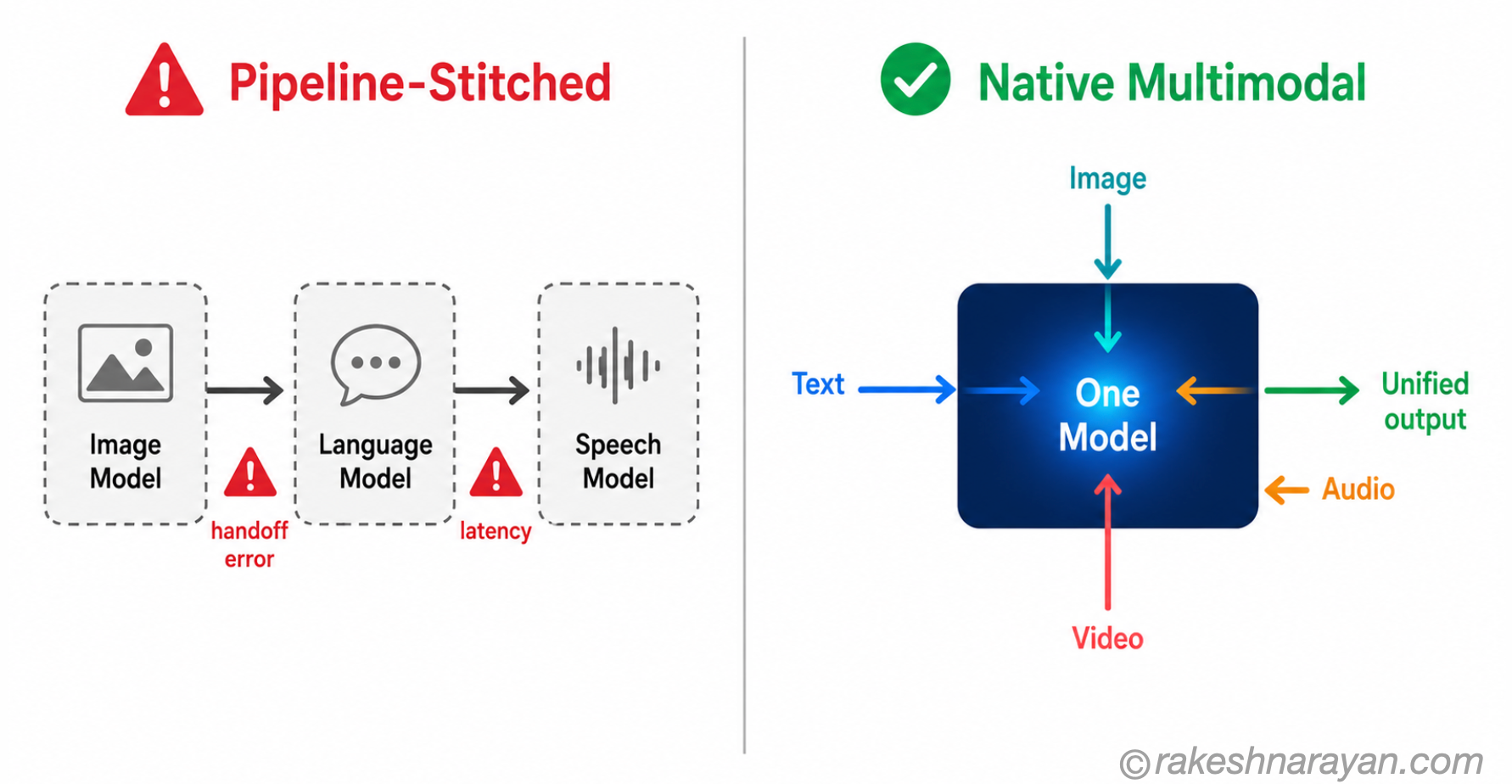
The distinction that matters most here is native multimodal versus pipeline-stitched. Most early ‘multimodal’ systems were stitched: an image recognition model passed its output to a language model, which passed to a speech synthesis model. The inputs never actually met inside one architecture. The models were bolted together.
Native multimodal models are trained across modalities from the start. The model learns that a picture of a fire alarm and the phrase ‘evacuation alert’ and the sound of a klaxon are related — not because a pipeline told it so, but because all three appeared together in its training data. That shared understanding is what makes the difference.
How a multimodal model processes different inputs
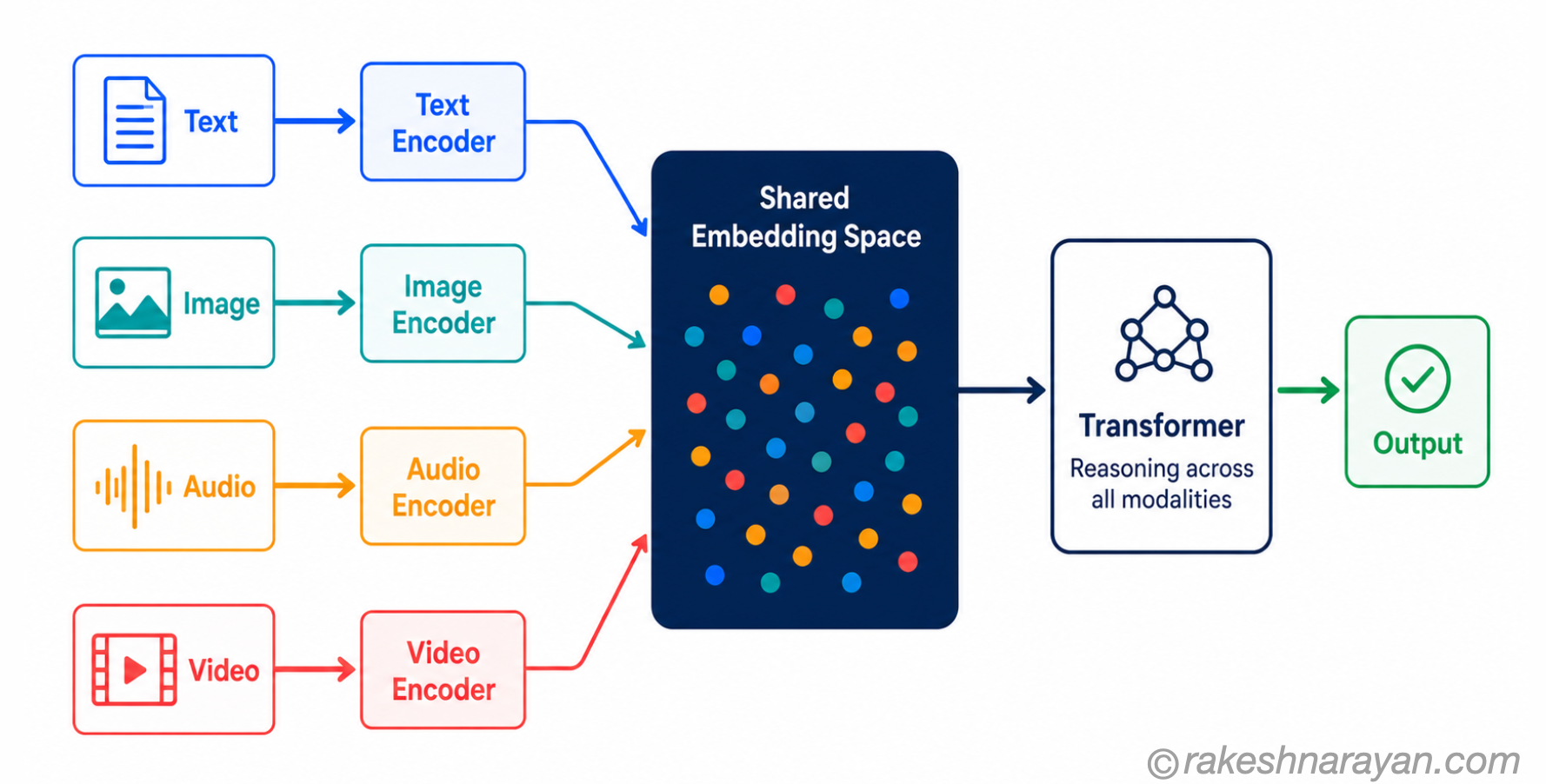
Under the hood, a multimodal model uses separate encoders for each input type. An image encoder converts a photo into a vector representation. An audio encoder does the same for sound. A text tokeniser handles language. Each modality has its own specialist front end.
What happens next is the key step. All of those representations are mapped into the same shared embedding space — the same mathematical coordinate system where meaning lives. Once everything is in the same space, the transformer can attend across all of it simultaneously. A token from the text input can attend to a patch from the image. An audio feature can attend to a word.
The model does not see a photo and a sentence as separate things to reconcile. It sees a unified set of representations in one space, and it reasons across all of them at once. That is what makes the output coherent rather than stitched.
The four modalities — what each one adds
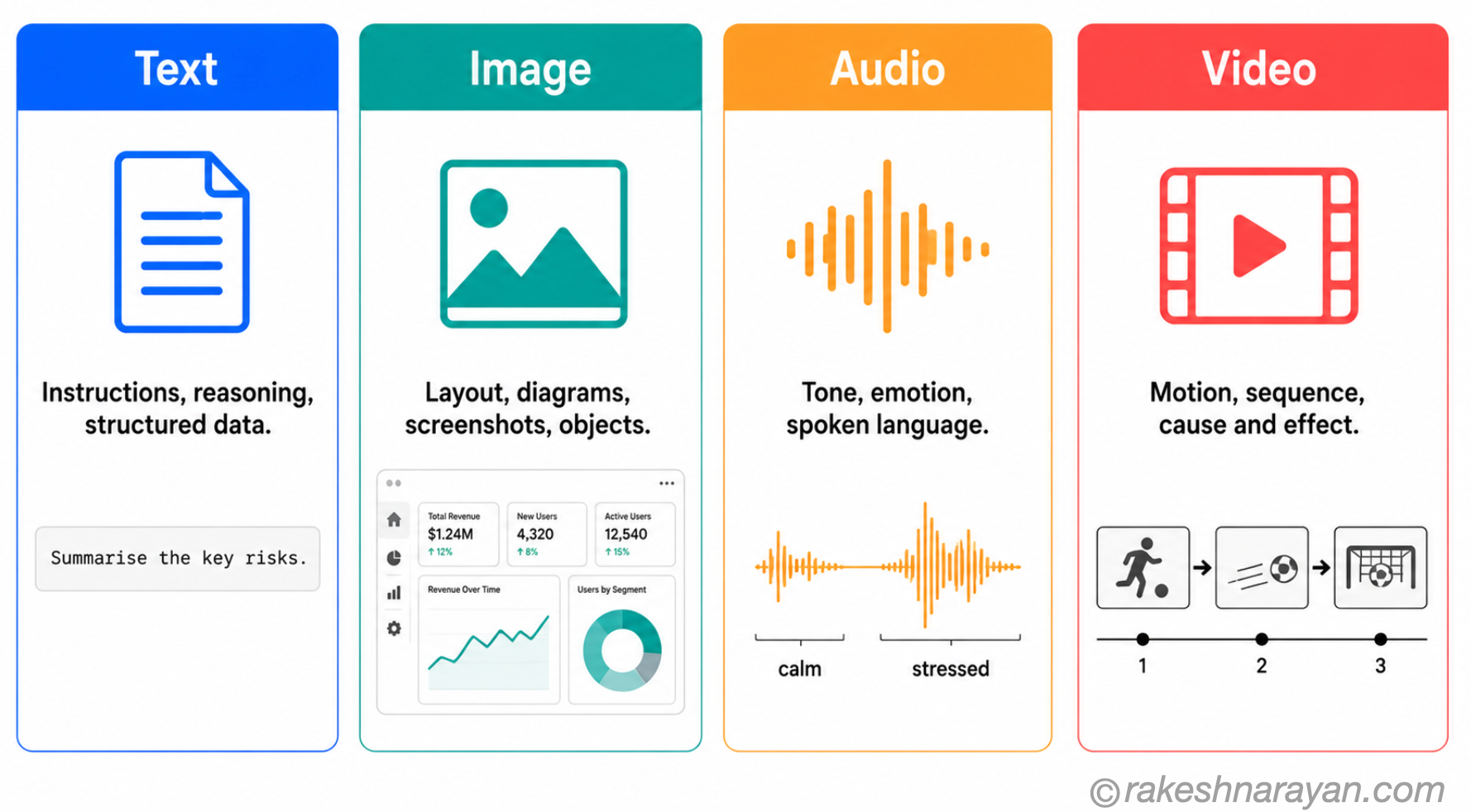
Each modality contributes something the others cannot. That is the point. A model that can only read text misses what the image makes obvious. A model that cannot hear audio misses the hesitation in a voice recording that changes the meaning of the words entirely.
| Modality | What it contributes | What is missed without it | Real example |
|---|---|---|---|
| Text | Language, reasoning, instructions, structured data | The ability to follow complex instructions or return structured output | Reading a contract clause and identifying the risk |
| Image | Visual layout, spatial relationships, diagrams, faces, objects, written content in images | Anything communicated visually — a chart, a screenshot, a damaged component | Reading an SAP error screenshot and diagnosing the authorisation failure |
| Audio | Tone, emotion, spoken language, background context, timing and emphasis | The difference between a confident answer and an uncertain one — same words, different meaning | Transcribing a customer service call and flagging escalation risk from tone |
| Video | Motion, sequence, cause and effect, events unfolding over time | Anything where timing matters — what happened before the error, how a process was performed | Reviewing a warehouse walkthrough video to identify a process deviation |
Native vs stitched — why it matters in practice
Most of the ‘multimodal’ tools built between 2020 and 2023 were stitched. An image-to-text model converted the visual to a description, and a language model processed the description. The chain worked for simple inputs. It fell apart for anything where the relationship between modalities was subtle.
If you asked a stitched system to compare what someone says to what they are pointing at in a video, the intermediate text description often lost the spatial detail. The final model was reasoning about a degraded version of the input. Errors compounded at every handoff.
Native multimodal models bypass this entirely. The transformer attends to image patches directly when forming a response — the visual tokens are in the same sequence as the text tokens. There is no intermediate description to lose detail. This is why GPT-4o could answer questions about a whiteboard photograph with a precision that earlier stitched approaches could not match.
⚠️ Warning
‘Multimodal’ in a product description does not always mean native multimodal. Many enterprise tools still use stitched architectures under the hood. The practical test: does the model handle inputs where the relationship between modalities is implicit and unspoken? If it requires you to describe the image in the prompt to get a good answer, it is probably stitched.
📌 Key Takeaway
Native multimodal models reason across modalities simultaneously in a shared space. Stitched pipelines pass outputs between separate models sequentially. The difference is most visible when subtle cross-modal relationships matter — which is most real-world use cases.
Where multimodal AI is already doing real work
The most compelling applications are not the demos. They are the workflows that used to require a person to bridge between systems, and now do not.
| Domain | What multimodal enables | SAP / enterprise example |
|---|---|---|
| Document processing | Reading scanned invoices, contracts, forms — not just the text but the layout, tables and handwritten annotations | Invoice matching that reads a scanned vendor document and compares it against the SAP PO without manual re-keying |
| Support and troubleshooting | User pastes a screenshot of an error message — model reads the visual, identifies the transaction code and suggests the fix | SAP Joule reading a Fiori error screenshot and returning the relevant SU53 check or missing authorisation object |
| Voice interfaces | End-to-end voice — the model hears the question, understands context and tone, and responds in the same medium | Field technicians dictating maintenance notes that are transcribed, classified and written to the SAP PM notification without manual input |
| Process monitoring | Video analysis of physical processes — detecting deviations, quality issues, safety breaches from footage | Warehouse inspection footage analysed against expected pick-and-pack procedures — exceptions flagged before they reach the goods issue step |
| Training and documentation | Combining recorded walkthroughs, screen recordings and text documentation into structured, searchable outputs | SAP implementation training materials generated from screen recordings and existing process documentation — without manual authoring |
💡 Practical Tip
The highest-value multimodal use cases in enterprise settings are almost always the ones that currently require a human to translate between formats — reading a PDF and entering data, describing a screenshot to a support agent, taking notes from a call. Those handoffs are exactly what multimodal AI eliminates.
The limitations worth knowing
Multimodal AI is genuinely capable. It is also genuinely limited in ways that are easy to miss because the impressive demos do not show them.
Hallucination extends to vision
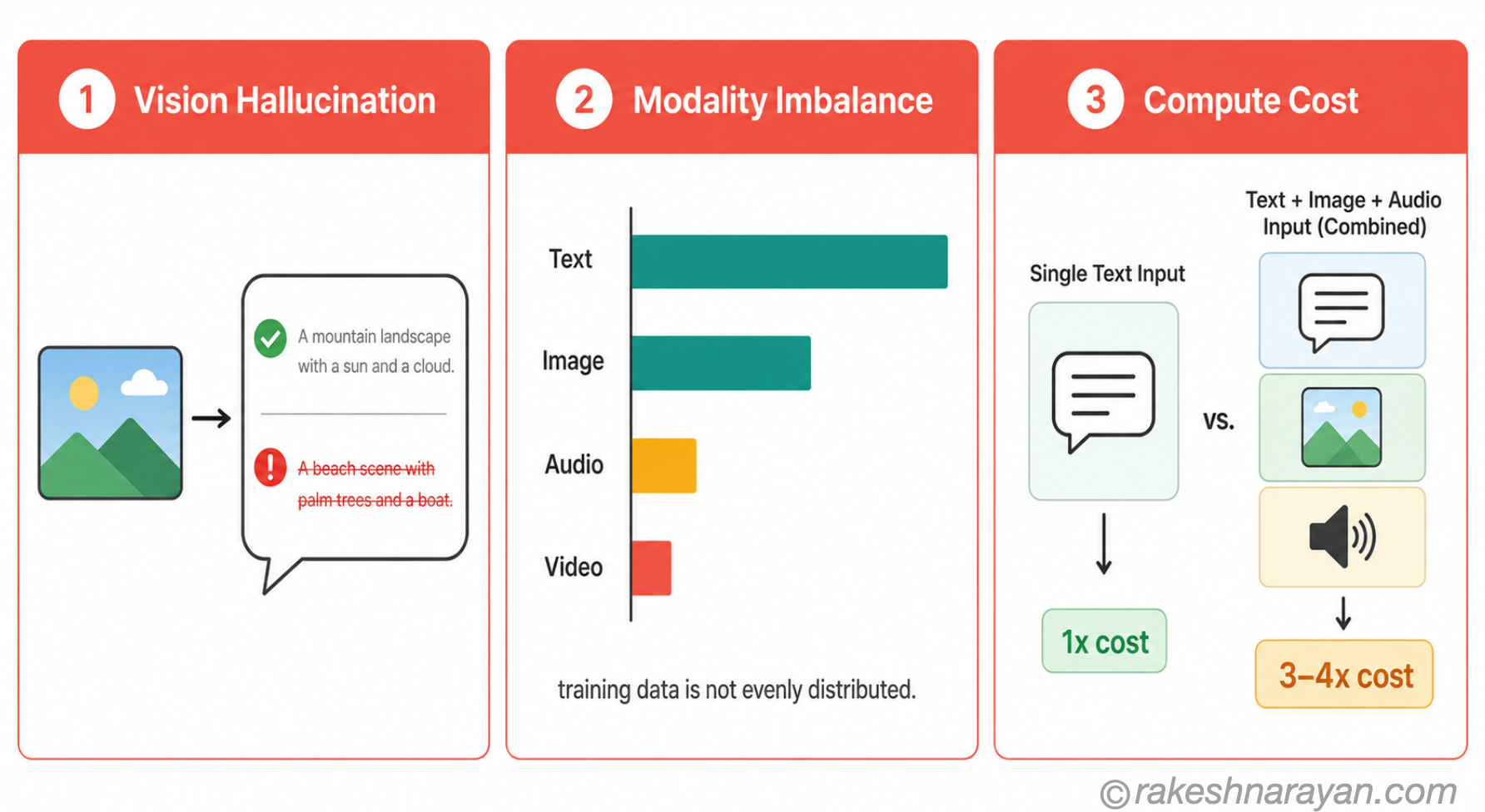
The same statistical generation that causes a language model to confabulate facts also applies to visual reasoning. A model can describe an image confidently and incorrectly. It can misread numbers in a table, misidentify a face, or invent details about a chart that are not there. The mechanism is identical — plausible next token, not verified fact.
Modality imbalance in training
Training data is not balanced across modalities. Text is abundant. High-quality labelled video is comparatively scarce. Models trained on more text than video tend to reason better about text than video — even when both are presented in the same input. The shared embedding space is only as good as the data that shaped it.
Compute and latency cost
Processing four modalities requires significantly more compute than processing one. In practice, this means slower responses for complex multimodal queries and higher API costs per call. For production systems that need to handle high volume, stitched pipelines are sometimes still chosen because they are cheaper and faster — not because they are better.
📝 Note
As of 2026, the leading native multimodal models are GPT-4o (OpenAI), Gemini 2.5 (Google DeepMind) and Claude (Anthropic). All three handle text, image and audio input. Video understanding at production quality is still maturing across the landscape — treat it as capable but verify for your specific use case.
At a glance — multimodal AI
| Concept | One-line summary |
|---|---|
| Multimodal AI | AI that processes text, images, audio and video in a single model and reasons across all of them simultaneously |
| Native multimodal | Trained across modalities from the start — the model learns cross-modal relationships, not just individual formats |
| Pipeline-stitched | Separate specialist models chained together — each passes output to the next; errors compound at every handoff |
| Modality encoder | The specialist front end for each input type — converts images, audio or video into vectors the transformer can process |
| Shared embedding space | The common mathematical space where all modalities are represented — what allows the transformer to reason across them |
| Cross-modal attention | The transformer attending across modalities simultaneously — a text token attending to an image patch in the same reasoning step |
| Modality imbalance | Training data is uneven across modalities — models tend to be stronger in the modalities where training data is most abundant |
| Vision hallucination | The same statistical generation that causes text hallucination applies to visual reasoning — confident wrong descriptions are possible |
What to take away
There is a version of multimodal AI that is just a party trick — impressive demos, a screenshot reader bolted onto a chatbot. And there is a version that is a genuine architectural shift: models that perceive the world across multiple senses simultaneously, the way a person does, and reason about all of it together.
The practical consequence is this. A model that can read the error screenshot, hear the voice note from the person who triggered it, and read the process documentation in the same reasoning step is not just a convenience. It is a different category of capability. It removes the human as the translator between formats — and that is where most of the inefficiency in knowledge work actually lives.
Understanding whether a tool is natively multimodal or stitched is not a technical nicety. It determines which problems it can actually solve and how it fails when it gets something wrong. That is worth knowing before you build something on top of it.
🔗 Related posts on this site
How Generative AI Works — Tokens, Embeddings and the Transformer — the transformer architecture and shared embedding space that make multimodal reasoning possible.
What is a Large Language Model (LLM)? — the text-only foundation that multimodal models build from.
AI Agents — What They Are and How They Work — multimodal perception is what allows AI agents to operate in environments where inputs are not text-only.
AI in the Enterprise — A Practical Map — where multimodal AI fits in the broader picture of enterprise AI adoption in 2026.
Published on rakeshnarayan.com — Articles
URL: https://rakeshnarayan.com/articles/multimodal-ai-how-models-that-see-hear-and-read-actually-work/

Did you enjoy this article?
Let me know — it takes one click.
0 Comments
Leave a Comment
Looks like this one held your attention — I'd really appreciate a quick comment below.
Your comment has been submitted and will appear after review.