AI Evaluation — Why Benchmarks Lie and What to Measure Instead
The AI vendor slides always lead with the benchmark. ‘Our model scores 92% on MMLU.’ ‘Best-in-class on SWE-bench.’ The numbers look impressive. The problem is that neither of those benchmarks can tell you whether the model will actually work on your problem — and in 2026, they barely even differentiate models from each other.
Benchmark scores have become the nutrition labels of AI: technically present, widely cited, and almost entirely useless for the decision you are trying to make. The gap between what a model scores in a lab and what it does in production has never been wider.
This post explains why — and what to measure instead.
🔗 Foundation posts
If you are new to how LLMs work, start with What is a Large Language Model (LLM)? — it explains the architecture that benchmarks are trying to measure. How Generative AI Works explains why token-by-token prediction makes evaluation harder than it sounds.
Why benchmark scores feel reliable — and aren’t
Benchmarks exist because evaluation is hard. Comparing two AI models directly on every possible task would take years. A standardised test with a fixed dataset and a clear scoring method gives the research community a shared reference point. That is a legitimate use.
The problem starts when that reference point gets detached from the question anyone actually needs answered. And in 2026, the most-cited benchmarks have three compounding problems that make them actively misleading at the frontier.
The three ways benchmarks break down
1. Saturation — the scores have hit the ceiling
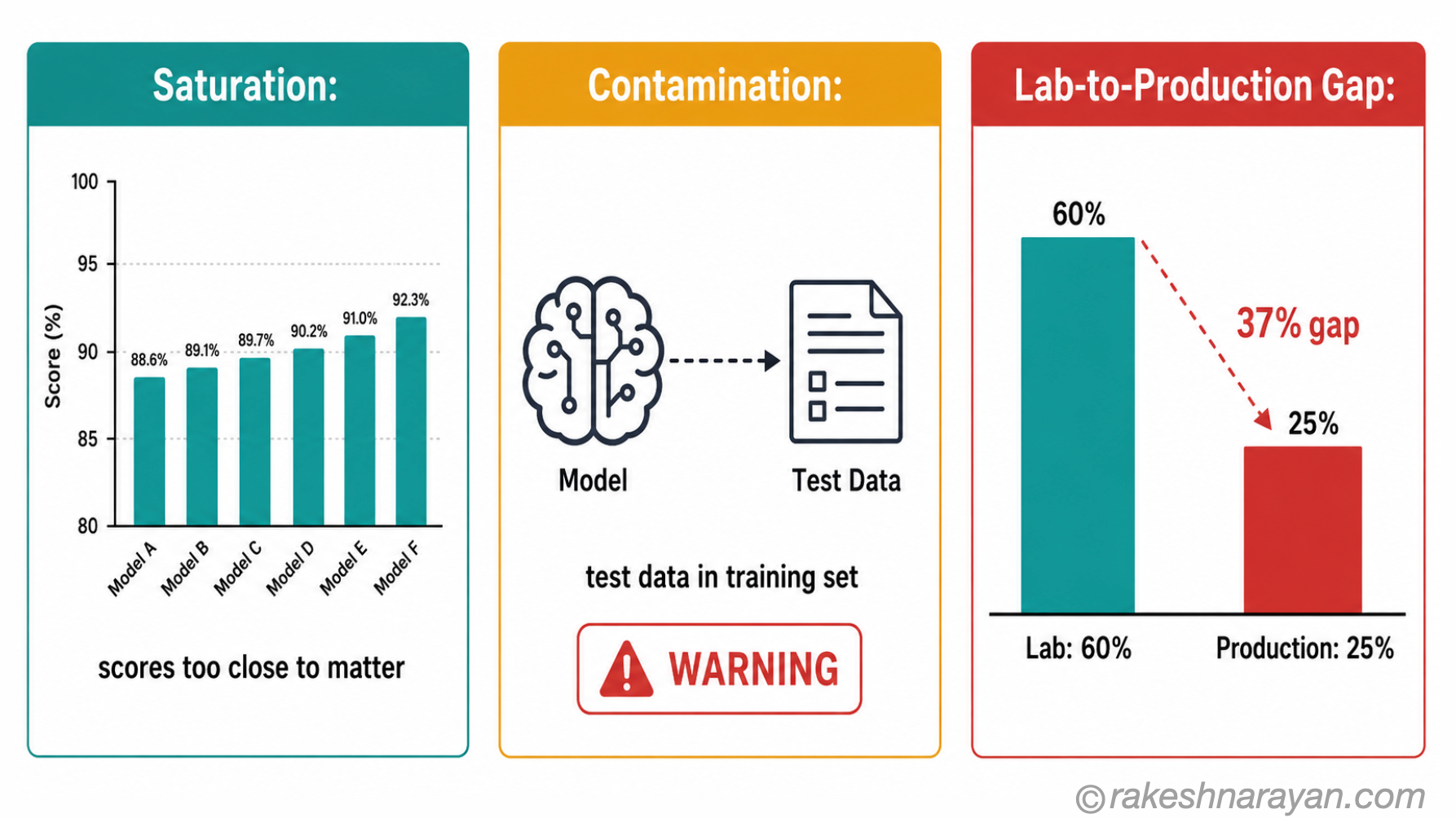
MMLU (Massive Multitask Language Understanding) was the benchmark that defined AI progress for years. It covers 57 academic subjects across 16,000 multiple-choice questions. When GPT-3 first sat the test, it scored around 35%. The problem: every frontier model now exceeds 88%, and a 2% score difference falls within measurement noise. The benchmark can no longer tell them apart.
MMLU-Pro was built to fix this — harder questions, ten answer choices instead of four. It bought about a year. As of mid-2026, top models cluster between 83% and 90% on MMLU-Pro, and the same saturation dynamic is already repeating.
GPQA Diamond, a graduate-level science benchmark designed to be unsolvable by web search, is approaching saturation at the top of the frontier after just two years of useful life.
📌 What saturation actually means
A 2-point MMLU score difference between two frontier models is statistical noise — it could reflect question ambiguity, prompt formatting, or sampling variation. It does not reflect a meaningful capability gap. Choosing a model based on an MMLU delta is like choosing a car because one has 0.3% better fuel economy on a standardised test nobody drives.
2. Contamination — models trained on the test
In February 2026, OpenAI publicly abandoned SWE-bench Verified — the coding benchmark that had been the gold standard for comparing AI software engineering ability. Their audit found that every frontier model tested could reproduce exact solutions verbatim. The models had seen the test during training.
OpenAI’s audit also found that 59.4% of the benchmark’s problems had flawed test cases — tests that rejected correct solutions. A model scoring 80% on SWE-bench Verified was getting credit for passing broken tests it had memorised.
The replacement benchmark, SWE-bench Pro, uses contamination-resistant tasks. The same models that scored 80%+ on Verified score around 23–46% on Pro. Same model. Half the score — and that difference is what honest measurement looks like.
This is not a problem unique to one benchmark. Data contamination is systemic. Any benchmark built from publicly available material carries the risk that its test questions ended up in a model’s training corpus.
⚠️ Self-reported scores need scrutiny
Most leaderboard scores are self-reported by model developers. The incentive to report the highest defensible number is obvious. Independent evaluations using standardised harnesses — like Scale AI’s SEAL leaderboard for coding — consistently produce lower scores than self-reported figures. When a vendor leads with a benchmark number, the first question is: who ran the test?
3. The lab-to-production gap
Even a clean, uncontaminated benchmark measures performance on a fixed dataset under controlled conditions. Production is not controlled. Research on enterprise AI agents has found a 37% gap between lab benchmark scores and real-world deployment performance. Consistent task success dropped from around 60% on a single lab run to around 25% when measured across multiple consecutive runs on the same task.
The gap exists because real use involves variation in input phrasing, edge cases the benchmark never included, partial information, and the compound error effects of multi-step tasks. A benchmark score is a best-case number. Production is the average case.
What the harder benchmarks actually tell you
The research community’s response to saturation has been to build harder tests. Humanity’s Last Exam (HLE), published in Nature in 2026, is the current ceiling. Its 2,500 questions were written by domain experts at the frontier of academic knowledge. Human domain experts average around 90% accuracy. As of June 2026, the top models reach the mid-40s — Gemini 3.1 Pro Preview at 44.7%, GPT-5.4 at 41.6%. The AI-human gap is large and real.
HLE is more honest than MMLU. But it does not solve the fundamental problem: scoring well on expert-level academic questions still does not predict whether a model will work reliably on your specific task, with your data, in your system.
A model that correctly answers obscure PhD-level chemistry questions may still fail consistently when summarising procurement documents or generating structured output from unstructured inputs.
📝 Benchmarks as a shortlist tool, not a decision
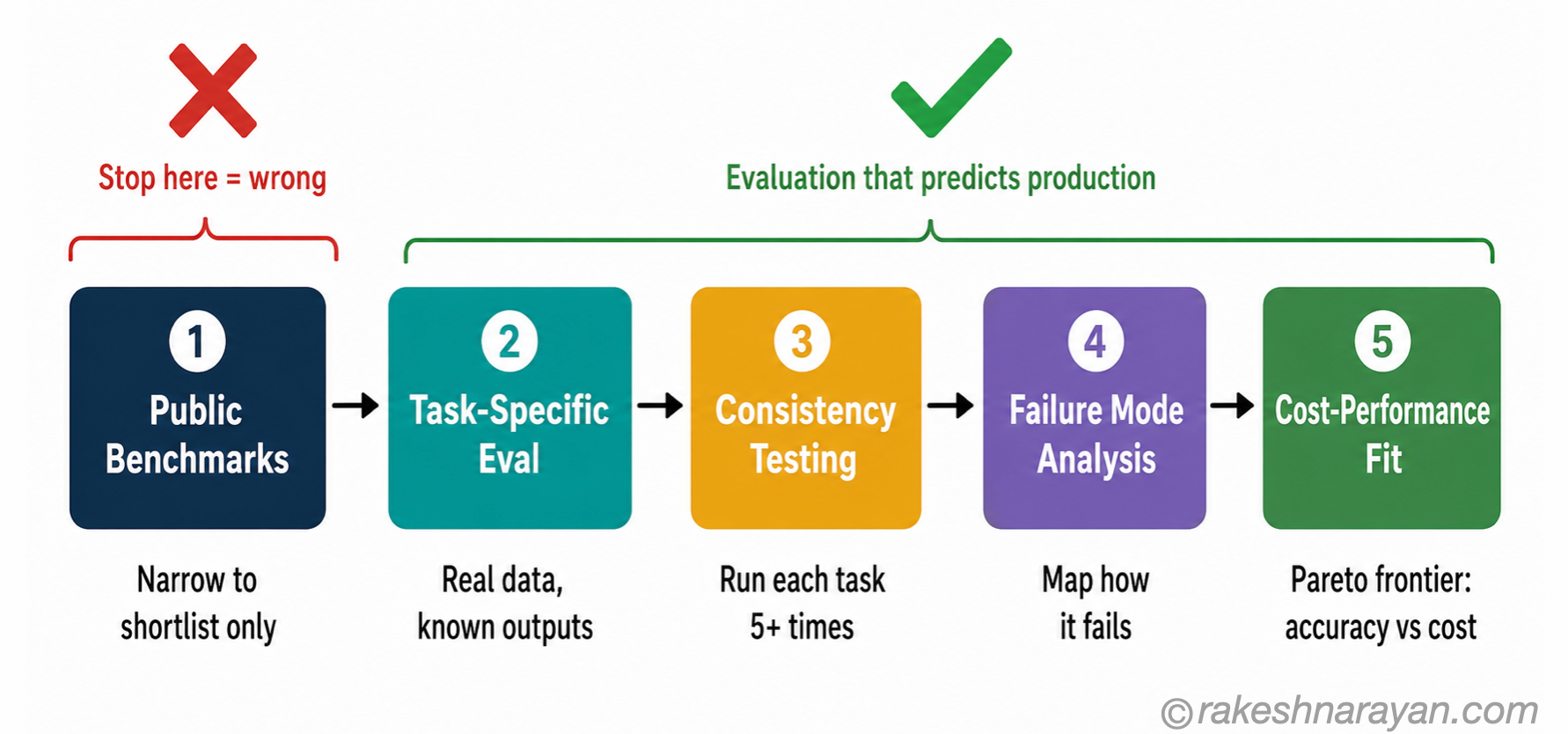
Public benchmarks are useful for one thing: narrowing a field of dozens of models down to three or four candidates worth evaluating properly. Think of them as a resume screen — necessary, but not sufficient. The actual decision requires task-specific testing on your own data.
What to measure instead — a practical framework
Once you have a shortlist of candidate models, four things actually predict whether one will work for your use case.
1. Task-specific evaluation on your own data
Take 50 to 100 real examples from your actual task — real inputs with known correct outputs. Run each candidate model on them. Score the results against your definition of good. This sounds obvious. Most teams skip it entirely and choose based on the leaderboard instead.
Your evaluation does not need to be large to be useful. A carefully selected set of 50 representative examples, covering the normal cases and the hard edge cases, will tell you more than any public benchmark score. The examples must come from your real data — synthetic test sets reproduce the same contamination problem as public benchmarks.
2. Consistency — run it multiple times
Run each task at least five times with the same input. A model that produces the right answer 60% of the time on a single run may succeed only 25% of the time across a session. For any production use case, consistency matters more than peak performance. One spectacular answer buried in four wrong ones is worse than reliably adequate answers every time.
Temperature settings matter here. For tasks requiring consistent structured output — classification, extraction, code generation — run evaluations at low temperature (0 to 0.2). For generative or creative tasks, test at the temperature you plan to deploy with.
💡 Consistency is where most evaluations fail
Single-run evaluations measure best-case performance. Production measures average-case. The same model that looks impressive in a demo can be unreliable in a workflow that runs the same prompt hundreds of times per day. Build multi-run consistency into your evaluation from the start.
3. Failure modes — what does it do wrong?
A benchmark score tells you the percentage of questions a model answered correctly. It tells you almost nothing about how the model fails. For production AI, understanding failure modes is more useful than knowing the average score.
Run your evaluation set and look at every wrong answer. Is the model hallucinating confidently? Refusing tasks it should handle? Producing correct-looking output in the wrong format? Failing on a specific category of input? The pattern of failures determines whether this model is usable for your context — and whether failures are recoverable or catastrophic.
🔗 Why models fail in specific ways
AI Hallucinations — Why They Happen explains the generation mechanism that produces confident wrong answers — essential context for interpreting failure modes.
4. Cost-performance fit
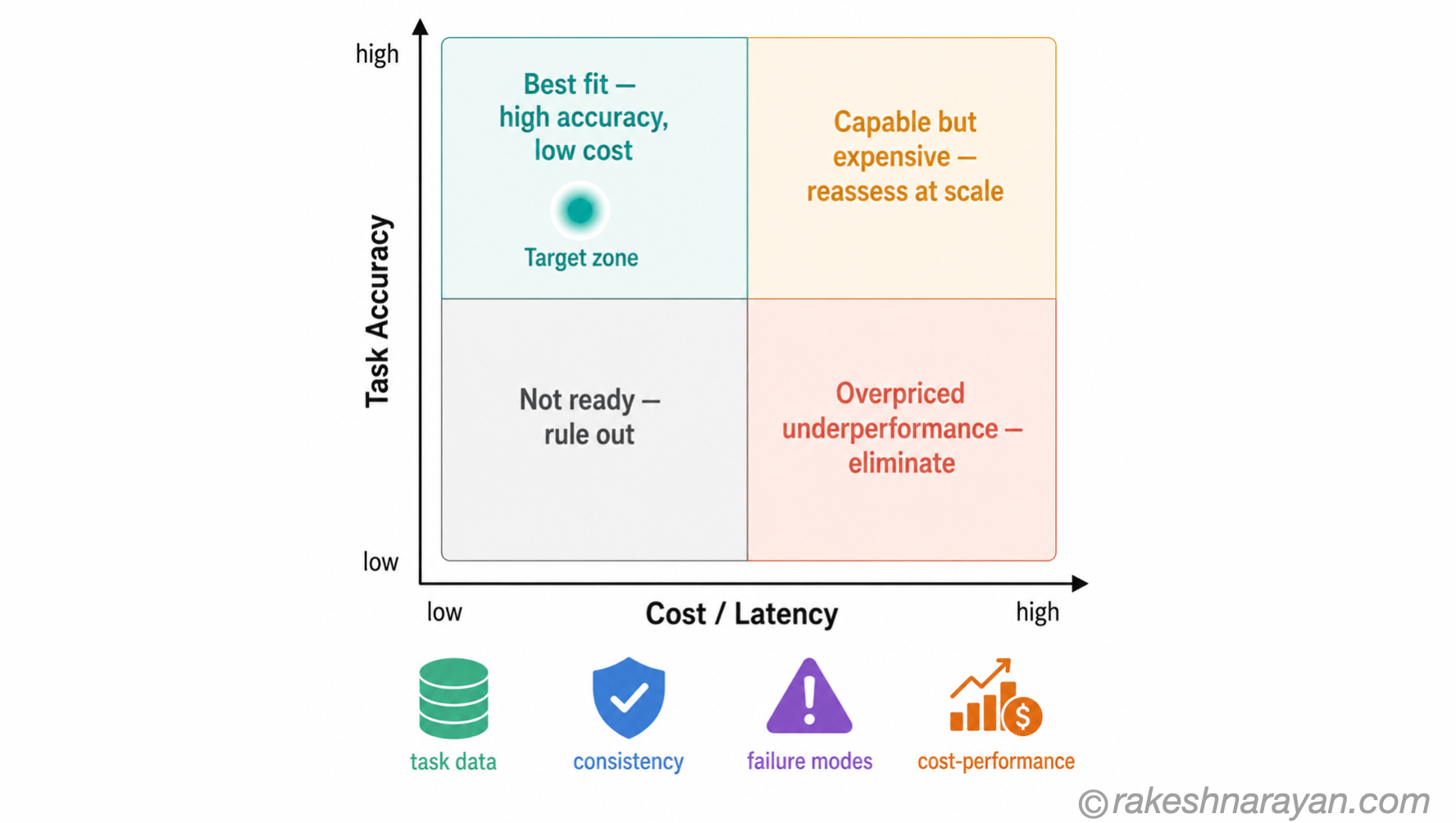
A model that scores 15% higher on your task evaluation but costs six times more per token may not be the right choice at production volume. Evaluation should include a cost-performance plot: accuracy on your task versus cost per thousand tokens at your expected volume. The optimal choice is rarely the top-performing model — it is the model on the Pareto frontier of accuracy and cost for your specific workload.
Latency belongs here too. A highly capable model with a 30-second response time is not useful in a customer-facing application. Test under realistic load conditions, not just in isolation. Once a model clears evaluation, How to Cut LLM Cost and Latency in Production covers the levers for controlling what that model actually costs you to run.
Evaluation in the enterprise context
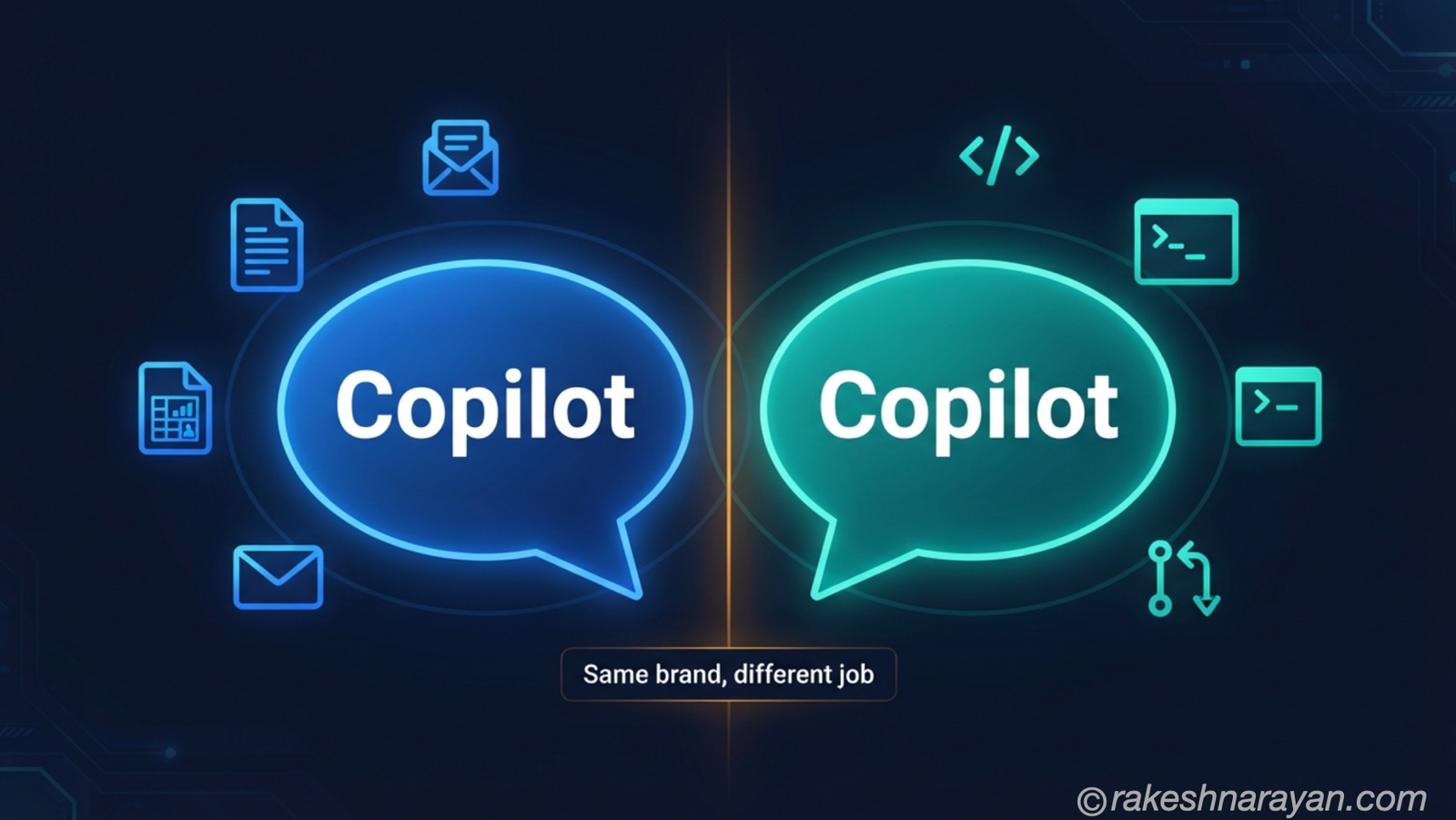
Most enterprise AI decisions are not about choosing between frontier models. They are about evaluating a vendor’s AI-powered product — SAP Joule, Microsoft Copilot, a customer service AI, a document summarisation tool. The benchmark question rarely applies. The practical evaluation framework does.
When a vendor says ‘AI-powered’, the evaluation question is: what does it actually do on our data, in our workflows, and with our edge cases? Build a test set from real transactions, real documents, real queries. Run it before the contract, not after.
Pay particular attention to the failure modes — a tool that fails silently is more dangerous than one that fails obviously.
✅ The four questions to ask any AI vendor
- Can we test it on our own data before committing?
2. What does it do when it gets the answer wrong — silent failure or visible error?
3. What benchmarks are these scores from — and who ran them?
4. What is the accuracy on our specific task type — not the general leaderboard?
At a glance — AI evaluation essentials
| Concept | One-line summary |
|---|---|
| AI benchmark | A standardised test that scores model capability — useful for shortlisting, unreliable for final decisions |
| MMLU saturation | Every frontier model now exceeds 88% on MMLU — score differences at the top are statistical noise |
| Benchmark contamination | Models trained on test data produce inflated scores that reflect memorisation, not capability |
| SWE-bench Verified (retired) | Abandoned by OpenAI in February 2026 after finding 59.4% of tasks were flawed and all frontier models were contaminated |
| Lab-to-production gap | A 37% gap exists between benchmark scores and real deployment performance for enterprise AI agents |
| Humanity’s Last Exam | The current hardest closed-ended benchmark — top models reach the mid-40s; human experts average ~90% |
| Task-specific evaluation | Test on your own real data with known correct outputs — the only evaluation that predicts production performance |
| Consistency testing | Run each task multiple times — single-run scores overestimate real-world reliability significantly |
| Failure mode analysis | Understanding how a model fails is more useful than knowing its average score |
| Cost-performance fit | The right model is on the Pareto frontier of accuracy and cost for your workload — not always the top scorer |
| Chatbot Arena / LMSYS | Human preference ranking via blind pairwise comparisons — harder to game, more predictive of conversational quality |
What to take away
The benchmark number on a vendor slide is not an evaluation. It is marketing. It tells you how a model performed on a test, under controlled conditions, with data it may have seen before. It does not tell you whether the model will work on your problem, in your context, consistently enough to be useful.
The teams making good AI decisions in 2026 are not ignoring benchmarks entirely — they are using them to build a shortlist. Then they stop. From the shortlist they run task-specific evaluations on real data, test consistency across multiple runs, map out the failure modes, and plot cost against accuracy at production volume. That process takes a few days. It is worth every hour.
The hardest shift is moving from ‘which model scores highest’ to ‘which model works best on my task at a cost I can sustain’. Those are different questions. The benchmark answers neither of them.
🔗 Related posts on this site
AI Hallucinations — Why They Happen — the generation mechanism that produces confident wrong answers, and why evaluation must account for it.
Fine-Tuning vs Prompt Engineering vs RAG — Which to Use — once you’ve evaluated which model fits, this post covers how to customise it for your use case.
AI in the Enterprise — A Practical Map — how organisations are deploying AI in 2026 and the decisions that determine whether it works.
Prompt Engineering — How to Get Reliable Output from Any LLM — structured prompts reduce errors by up to 76%, which changes what your evaluation is actually measuring.
How to Cut LLM Cost and Latency in Production — what the cost-performance trade-off costs you once a model has cleared evaluation.
Published on rakeshnarayan.com — Articles
URL: https://rakeshnarayan.com/articles/ai-evaluation-why-benchmarks-lie-and-what-to-measure-instead/

Did you enjoy this article?
Let me know — it takes one click.
0 Comments
Leave a Comment
Looks like this one held your attention — I'd really appreciate a quick comment below.
Your comment has been submitted and will appear after review.