LLMOps — The Operating Model for AI in Production
The demo works. It always works. You show the stakeholders, they are impressed, somebody says “let’s roll this out”, and then everything gets harder.
The chatbot that answered questions perfectly in a controlled pilot starts returning inconsistent responses in production. The document assistant that worked in testing starts surfacing the wrong content. Costs come in three times higher than projected. The compliance team asks questions nobody can answer. The AI project that looked like a success story at proof-of-concept quietly stalls.
This is not a model problem. It is an operations problem. And it is the reason LLMOps exists.
🔗 Foundation posts
This post assumes you know what an LLM is and how it generates output. If not, start with What is a Large Language Model? If you want the broader picture of how organisations use AI before going deep on operations, see the AI in the Enterprise post.
What LLMOps actually is
LLMOps — Large Language Model Operations — is the discipline of deploying, monitoring, and managing LLM-based applications in production. It covers the people, processes, tools, and governance needed to move an LLM system from a working prototype into something that is reliable, cost-controlled, auditable, and safe at scale.
The analogy to DevOps is intentional and accurate. DevOps brought the same cultural and technical discipline to software delivery — automation, continuous feedback, shared ownership of reliability — that developers had been applying informally and inconsistently. LLMOps does the same thing for AI systems.
The term came into common use in 2023 as organisations started hitting the operational wall at scale. The problems it addresses are not new — they are the standard problems of running complex systems in production, made harder by properties specific to LLMs.
📌 Key Takeaway
LLMOps is not a product or a tool. It is a discipline — the operational framework that turns an LLM experiment into a production system. You can have LLMOps without buying a single dedicated LLMOps platform. You cannot have reliable AI in production without the practices it defines.
LLMOps vs MLOps — what actually changes
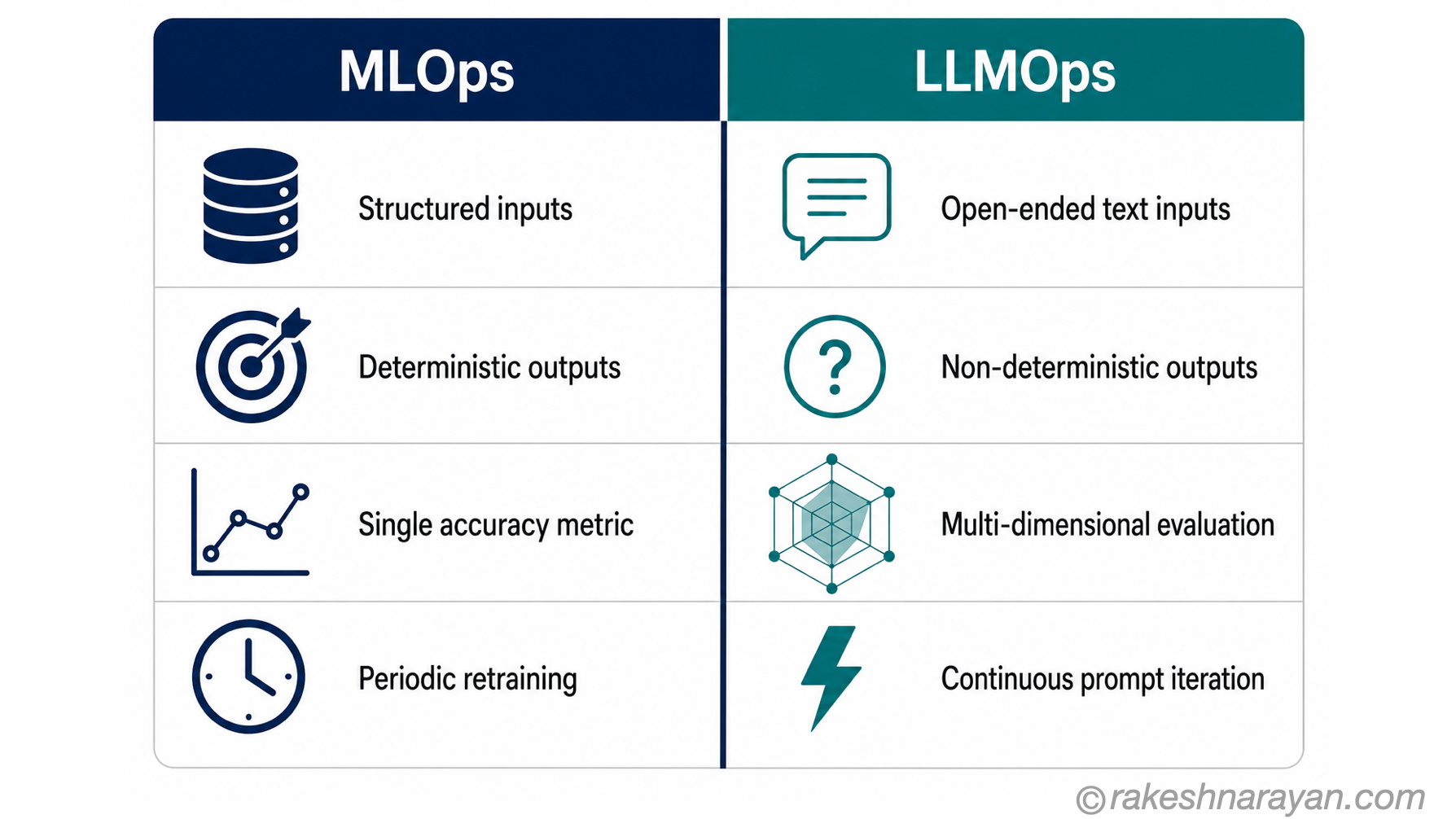
MLOps is a mature discipline. It works well for traditional machine learning: structured inputs, deterministic outputs, clear evaluation metrics, periodic retraining cycles. If you train a fraud detection model and monitor it for prediction drift, MLOps handles that cleanly.
LLMs break nearly every assumption MLOps was built on. The differences are not superficial — they require a fundamentally different operational approach.
| Dimension | MLOps | LLMOps |
|---|---|---|
| What you version | Model weights — change infrequently, managed in training pipelines | Prompts — change constantly, every change is effectively a deployment |
| Output type | Deterministic — same input always produces the same output | Non-deterministic — the same prompt can produce different outputs across calls |
| Evaluation | Accuracy, F1, RMSE against a labelled test set — a number, a threshold, a decision | Relevance, coherence, safety, tone — no single metric; requires LLM-as-judge or human review |
| Monitoring signal | Prediction drift — statistical change in model output distribution | Semantic drift, prompt drift, hallucination rate, output policy violations |
| Failure mode | Model degrades gradually; statistical monitoring catches it | Model can degrade overnight after a silent upstream model update — invisible to standard monitoring |
| Cost structure | Inference is cheap — millisecond predictions at fractions of a cent | A single LLM inference can cost 100x a traditional ML prediction; token budgets matter |
⚠️ Warning
The most dangerous assumption in LLM deployment is that your existing MLOps stack gives you coverage. It does not. Prompt drift — where output quality degrades because upstream model behaviour has changed, not because your code changed — is completely invisible to standard monitoring approaches. You can be flying blind for weeks without knowing it.
The four operational layers
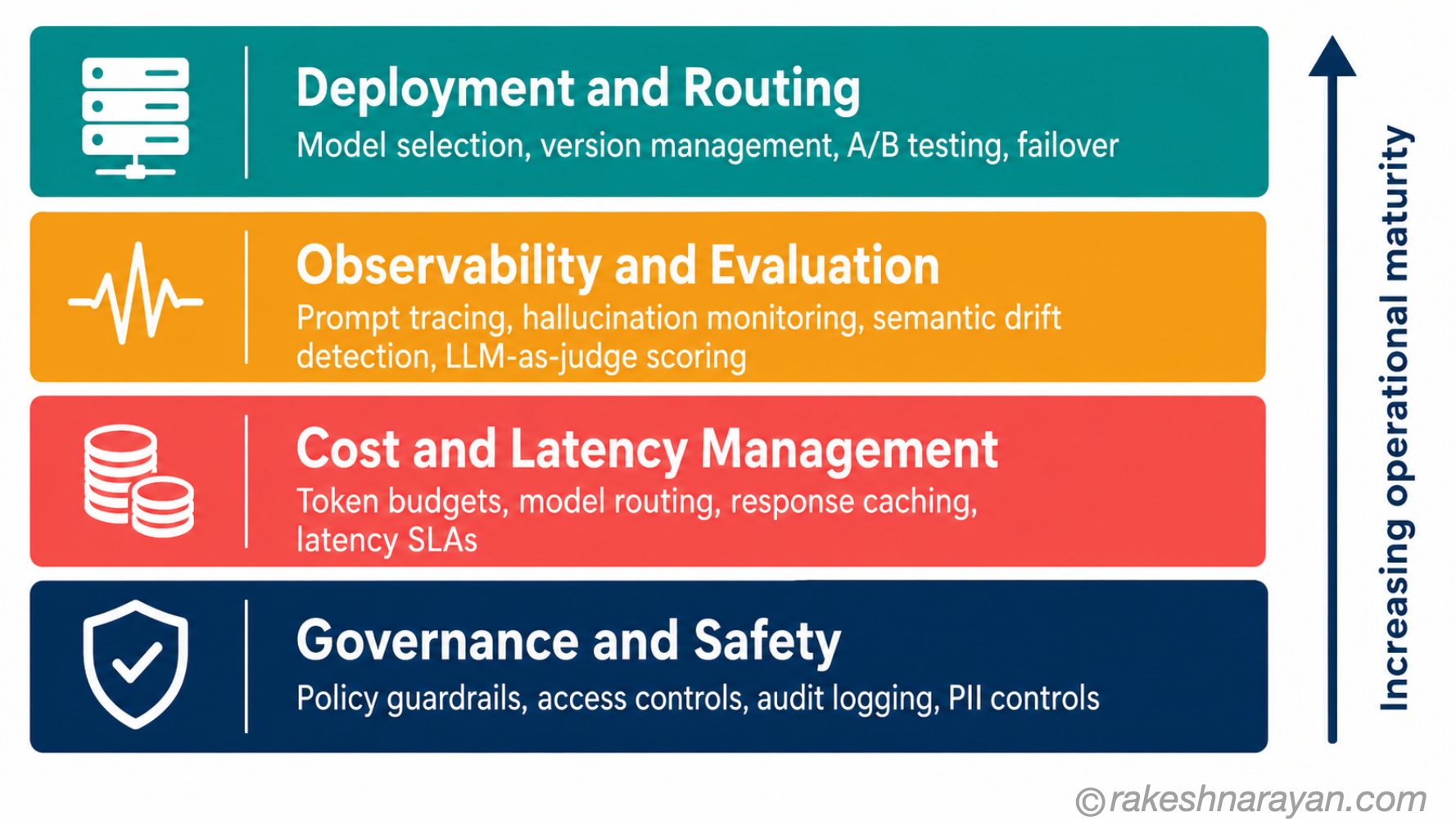
LLMOps is not a single thing — it is a set of overlapping concerns that all need to be addressed in a production deployment. The clearest way to think about it is four layers, each with distinct responsibilities and failure modes.
Layer 1 — Deployment and routing
This is where the LLM system enters production. Deployment in LLMOps means far more than pushing a model to an endpoint. It means managing which model version is serving traffic, how prompts are versioned alongside code, how you run A/B tests on prompt changes, and how you route different request types to different models based on capability and cost requirements.
Model routing — sending simple queries to a smaller, cheaper model and complex ones to a frontier model — is one of the highest-leverage cost levers available. It requires a routing layer that can classify request complexity before selecting a model. This is architecture, not just configuration.
✅ Best Practice
Treat every prompt change as a deployment. Version your prompts in source control, test them against a representative set of inputs before pushing to production, and maintain rollback capability. A prompt change that looks like an improvement in testing can degrade performance on edge cases you have not seen yet.
Layer 2 — Observability and evaluation
This is the hardest layer to get right, and the one most teams underinvest in until something breaks. Traditional observability — did the service return a 200? what was the p95 latency? — tells you nothing about whether the LLM is producing good output.
LLM observability requires tracing every request end-to-end: the prompt sent, the model version used, the response returned, the latency, the token count, and — critically — some measure of output quality. That quality measure is the hard part. Because there is no ground truth in most conversational tasks, evaluation typically uses either LLM-as-judge (a separate model scores the output) or human review on a sampled subset.
RAG systems add complexity here. When retrieval is part of the pipeline — as it is in most enterprise deployments — you need to monitor retrieval quality separately from generation quality. A well-formed response built on the wrong retrieved documents is a failure that generation metrics alone will not catch.
💡 Practical Tip
Start with logging everything. Every production request — prompt, completion, model version, token count, latency — should be written to a durable store from day one. This costs almost nothing in storage terms and gives you the raw material for evaluation, debugging, and audit. Teams that skip this regret it at the worst possible moment.
Layer 3 — Cost and latency management
Token costs compound faster than most engineering teams anticipate. A system that costs a few hundred dollars a month in internal testing can scale to tens of thousands of dollars a month in production — not because the model got more expensive, but because usage scaled and nobody was watching the per-token costs.
The levers are: token budget controls per request, response caching for repeated or near-identical queries, model routing to cheaper models for simpler tasks, and prompt compression where possible. None of these require special infrastructure — they require deliberate design. For a detailed breakdown of each lever and where it falls apart in practice, see How to Cut LLM Cost and Latency in Production.
| Cost lever | How it works |
|---|---|
| Token budget controls | Set hard limits on input + output tokens per request. Prevents runaway costs from unexpectedly long inputs or verbose outputs. |
| Response caching | Cache responses for repeated or near-identical prompts. Particularly effective for structured queries, FAQs, and RAG pipelines with stable context. |
| Model routing | Route simple queries to smaller, cheaper models — reserve frontier models for tasks that genuinely require them. |
| Prompt compression | Reduce input token count by summarising long context before injection. Directly cuts cost on every request. |
| Usage dashboards | Monitor token spend by endpoint, user segment, and model version in near real time. Anomaly detection on token usage catches cost spikes before they appear on the invoice. |
Layer 4 — Governance and safety
Governance is not optional in enterprise deployments — it is the condition on which the rest of the system is allowed to exist. It covers: what data is the LLM allowed to see, what outputs is it allowed to produce, who can access the system, how are requests logged for audit, and what happens when the system produces something it should not have.
Agentic AI systems — LLMs that take actions, not just answer questions — significantly raise the governance stakes. An agent that can write to a database or send emails on behalf of a user needs far more rigorous policy controls than a chatbot that only reads.
⚠️ Warning
PII handling is the compliance risk most teams discover too late. If users can paste sensitive data into your LLM application — and they will — you need input scanning, data retention policies, and anonymisation controls in place before go-live. Not as a post-launch retrofit. The regulatory exposure from uncontrolled PII flowing through an LLM system is significant in most jurisdictions.
Where LLMOps breaks down in practice
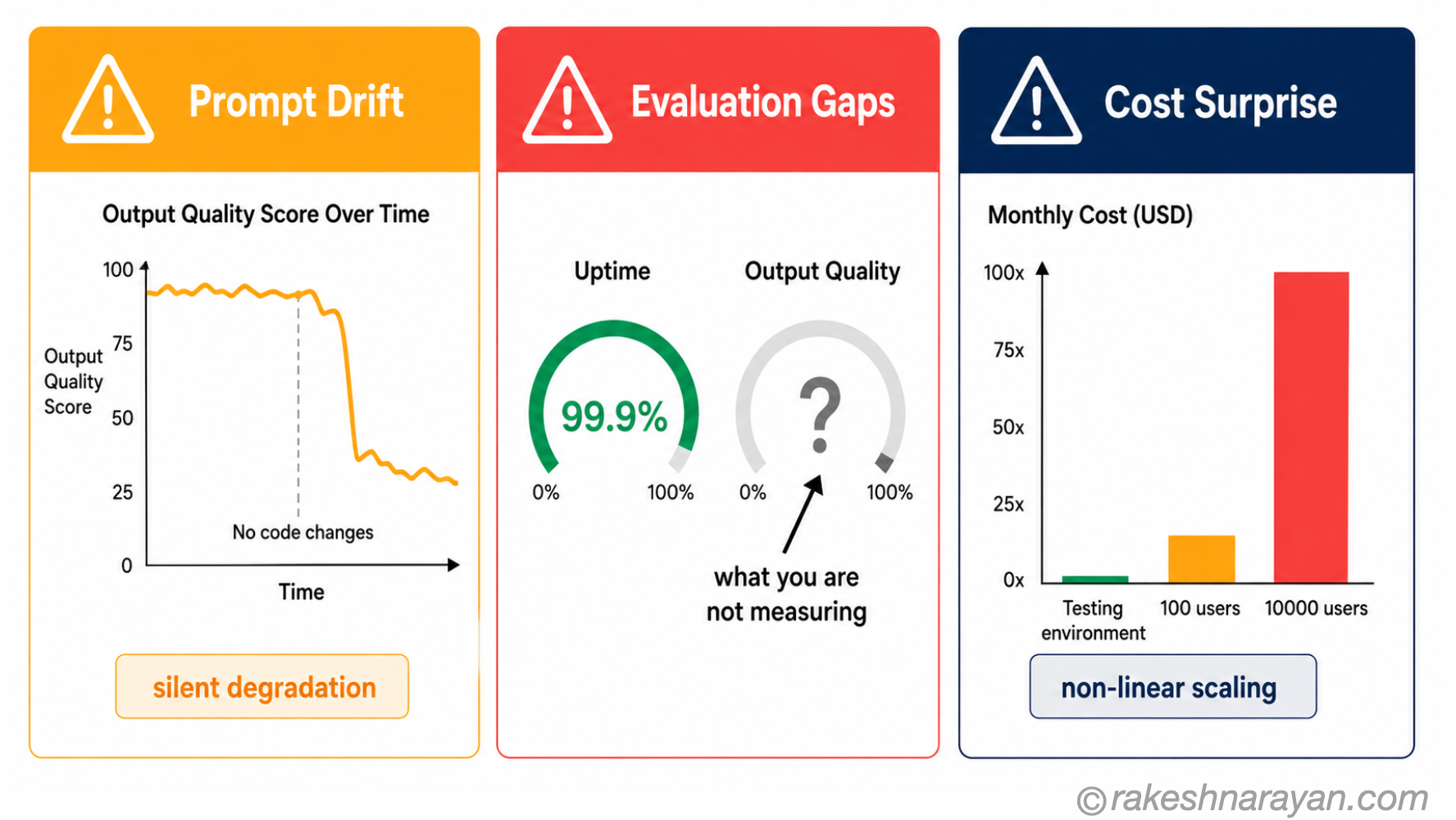
Most LLM production failures I have seen fall into three patterns. They are not exotic edge cases — they are the default outcome when teams move fast without the operational model in place.
Prompt drift goes undetected
Your LLM application is not just your code. It depends on a foundation model maintained by a third party — OpenAI, Anthropic, Google, or your chosen provider. That model can be silently updated, fine-tuned, or replaced with a newer version at any point.
When that happens, a prompt that was producing excellent output can start producing mediocre output overnight, with no code change on your side and no alert in your monitoring stack. The fix is continuous evaluation: a representative set of test inputs with expected output characteristics, run automatically on a schedule, producing a quality score you track over time.
Evaluation gaps hide quality degradation
Teams that monitor latency and error rates — but not output quality — are watching the wrong metrics. An LLM system can have perfect uptime, sub-second response times, and zero server errors, while producing outputs that are increasingly inaccurate, unhelpful, or off-policy. Infrastructure metrics tell you the system is running. They tell you nothing about what it is producing.
This is not a theoretical concern — it is the most common silent failure mode in production LLM systems. Hallucinations do not throw exceptions. They just appear in the output, indistinguishable from correct responses unless you are looking for them.
🔗 Related Reading
AI Hallucinations — Why They Happen and What You Can Do About Them explains the generation mechanism behind hallucinations and the practical controls that reduce them.
Cost surprises at scale
Token costs in testing environments are negligible. That makes it easy to build a system that is architecturally expensive without noticing. When the same system handles ten thousand users instead of ten, costs can scale non-linearly — particularly if prompts are verbose, context windows are large, or every query is hitting a frontier model regardless of complexity.
The teams that avoid this run cost modelling before production launch, not after. They set token budgets, instrument cost-per-request from day one, and have alerts on cost anomalies before they appear on the cloud invoice.
At a glance — LLMOps essentials
| Concept | One-line summary |
|---|---|
| LLMOps | The operational discipline for deploying, monitoring, and governing LLM-based applications in production |
| MLOps vs LLMOps | MLOps is model-centric with deterministic outputs; LLMOps is interaction-centric with non-deterministic, open-ended outputs |
| Prompt versioning | Every prompt change is a deployment — version, test, and maintain rollback capability for prompts as you would for code |
| Prompt drift | Silent output quality degradation caused by upstream model updates — invisible to infrastructure monitoring, requires continuous evaluation |
| LLM observability | Tracing requests end-to-end including output quality, not just latency and error rates — infrastructure metrics alone are insufficient |
| LLM-as-judge evaluation | Using a separate model to score output quality at scale — the standard approach when human review cannot cover production volume |
| Token budget controls | Hard limits on input/output tokens per request — the primary mechanism for controlling per-request LLM cost |
| Model routing | Routing simple queries to cheaper models and complex queries to frontier models — high-leverage cost and latency lever |
| Governance layer | Policy controls covering data access, output constraints, PII handling, audit logging, and human oversight for consequential decisions |
| Agentic AI governance | Higher-stakes operational requirements for LLMs that take actions — policy controls must match the risk of what the agent can do |
What to take away
The reason so many AI projects stall between pilot and production is not model capability. The models are good enough. What is missing is the operational layer that keeps them running reliably, safely, and within cost at scale.
LLMOps is that layer. It is not a single tool or platform — it is a set of practices that have to be designed in from the start, not retrofitted after the first production incident. The teams that are scaling AI successfully in 2026 are not using more capable models than everyone else. They have observability from day one, prompt versioning built into their deployment pipeline, token budgets set before launch, and governance controls that satisfy their compliance teams.
The benchmark is not “does the demo work”. It is “can I tell, six months from now, whether it is still working as well as it did on launch day — and act on the answer.” That is what LLMOps gives you.
🔗 Related posts on this site
AI Agents — What They Are and How They Work — agentic systems raise the LLMOps governance stakes significantly; this post covers the architecture and risk dimensions.
RAG — Retrieval Augmented Generation Explained — most enterprise LLM systems include a RAG layer; observability needs to cover retrieval quality as well as generation.
AI Hallucinations — Why They Happen — hallucination is the production failure mode LLMOps evaluation is specifically designed to catch.
How to Cut LLM Cost and Latency in Production — the detailed playbook behind the cost lever in Layer 3.
Published on rakeshnarayan.com — Articles
URL: https://rakeshnarayan.com/articles/llmops-the-operating-model-for-ai-in-production/
Did you enjoy this article?
Let me know — it takes one click.
0 Comments
Leave a Comment
Looks like this one held your attention — I'd really appreciate a quick comment below.
Your comment has been submitted and will appear after review.