GROW with SAP vs RISE with SAP — Which Is Right for You
Every SAP customer faces this question eventually. The 2027 ECC maintenance deadline is concentrating minds across the industry, and SAP’s answer is always a version of the same two words: GROW or RISE. Most people nod along in the meeting and then spend the next hour trying to work out what those names actually mean.
They are not products. That is the first thing to understand. GROW with SAP and RISE with SAP are structured journeys — commercial and delivery frameworks that bundle the product, the methodology, the services and the commercial model into a single named offering. The product underneath both is S/4HANA. The question is which version, which cloud model, and which implementation approach fits where you are starting from.
The distinction matters. Choosing the wrong path is not just an inconvenience — it can mean a contract that does not fit your landscape, implementation expectations that cannot be met, or costs that escalate in ways you did not see coming during the sales conversation.
🔗 Related reading
This post sits alongside the SAP S/4HANA vs ECC post on this site. SAP S/4HANA vs ECC — The Real Difference explains why the migration conversation is happening at all. SAP BTP — The Platform Explained covers the platform included in both GROW and RISE.
The naming problem — and why it confuses everyone
Before GROW and RISE existed, SAP’s cloud ERP products had names. SAP S/4HANA Cloud Public Edition. SAP S/4HANA Cloud Private Edition. These names are still the products. GROW and RISE are the programmes layered on top of them.
GROW with SAP is built on S/4HANA Cloud Public Edition — a SaaS, multi-tenant cloud ERP managed entirely by SAP. You share infrastructure with other SAP customers. SAP pushes quarterly updates whether you are ready or not. The trade-off is simplicity and speed: SAP handles everything, and you configure rather than customise.
RISE with SAP is primarily associated with S/4HANA Cloud Private Edition — dedicated infrastructure, more room for customisation, more control. It also bundles additional services including SAP Signavio for process intelligence, SAP Business Network access, and BTP credits. RISE can technically run on Public Edition too, but for most organisations choosing RISE, the Private Edition is the reason.
📌 The short version: GROW = Public Cloud, fast start, mid-market. RISE = complex migration or Private Cloud, enterprise transformation. If you are confused about which is which, the product underneath will tell you.
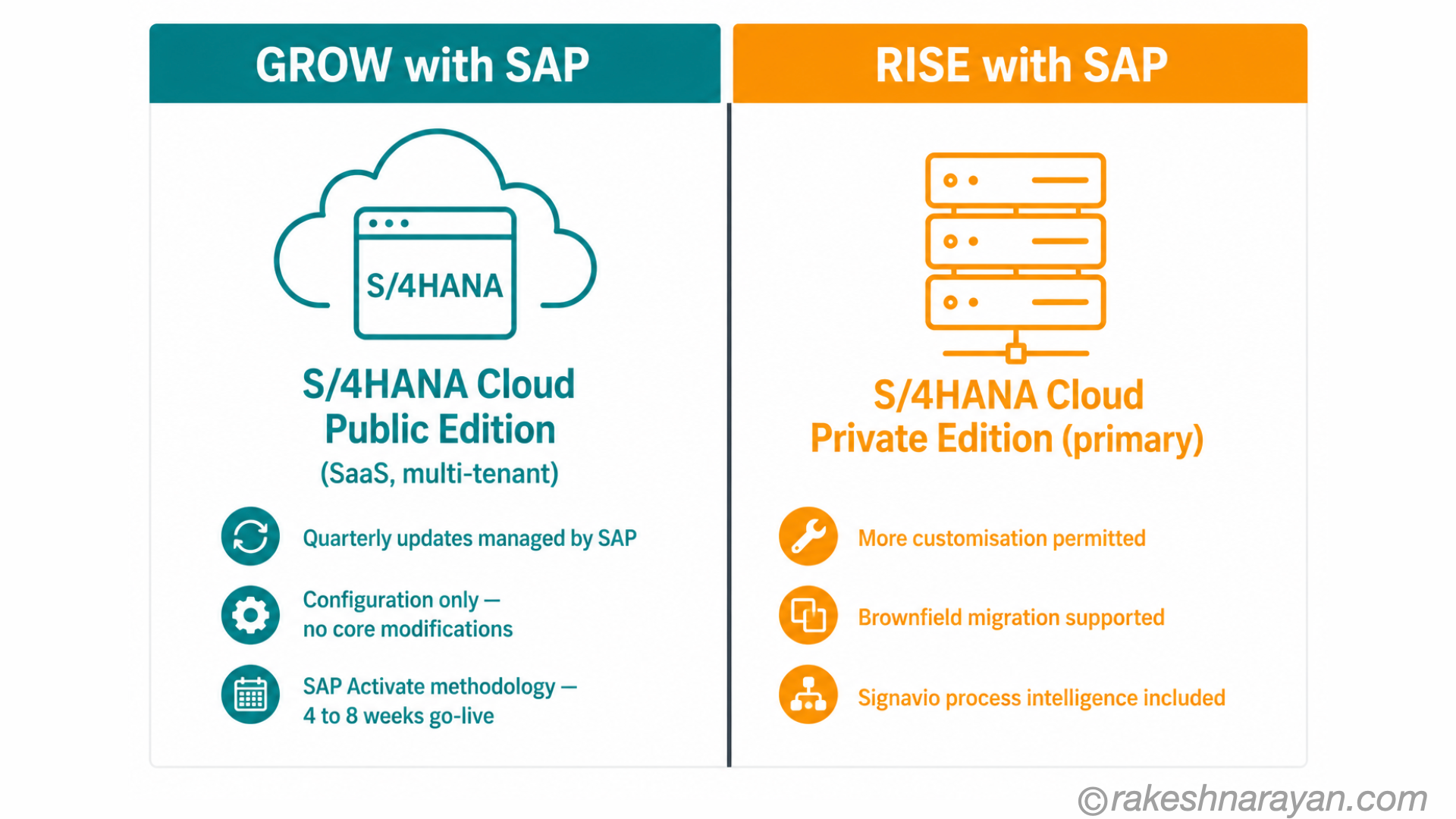
What GROW with SAP actually is
SAP launched GROW with SAP in March 2023. The premise was straightforward: mid-market companies moving to cloud ERP for the first time needed a packaged, predictable path that did not require an army of consultants or a multi-year implementation programme.
GROW bundles three things together. The product — S/4HANA Cloud Public Edition — covering finance, procurement, sales, supply chain, and operations. The methodology — SAP Activate, a six-phase framework (Discover, Prepare, Explore, Realize, Deploy, Run) designed to get organisations to go-live fast using preconfigured best-practice processes.
And the commercial packaging — a subscription model with FUE (Full User Equivalent) licensing, available in two tiers.
Base and premium editions
GROW comes in two bundles. The base edition covers core ERP: finance, procurement, sales, and operations, with starter BTP credits for basic integration. The premium edition adds advanced financial capabilities — cash management, receivables management, advanced financial close — plus SAP Analytics Cloud planning, Sales Cloud CRM, and Concur Expense.
The right edition depends on your finance complexity and whether you have a sales team that needs CRM functionality. Most mid-market greenfield customers start with base and add premium capabilities as they grow.
💡 The FUE model in one sentence: Instead of buying separate licence types for different user roles, you purchase a pool of Full User Equivalents and allocate them across your user population — a professional user counts as 1.0 FUE, a lighter self-service user as 0.2 FUE. This simplifies compliance and lets you adjust the user mix within your contracted total without renegotiating.
What RISE with SAP actually is
SAP launched RISE with SAP in January 2021 — two years before GROW — and the timing tells you something about the audience. The 2027 ECC maintenance deadline was already visible on the horizon, and RISE was SAP’s answer to the question every large ECC customer was starting to ask: how do we get to S/4HANA without starting from scratch?
RISE is a business transformation as a service offering. It bundles S/4HANA Cloud (typically Private Edition for complex customers), SAP Signavio for business process intelligence and modelling, SAP Business Network access, and BTP credits under a single multi-year subscription contract. The contract term is typically three to five years — longer than GROW’s standard three years — reflecting the longer transformation timelines involved.
The defining characteristic of RISE is migration support. Brownfield implementations — where you carry forward existing data, process configurations and some customisations — are the norm. SAP provides tooling to assess your current landscape, identify what needs to change, and manage the technical migration to the cloud. This is not a fast path. Large RISE programmes run for years.
⚠️ A common misread: RISE does not automatically mean Private Cloud. SAP has made RISE available on Public Edition too. But if an organisation is choosing RISE over GROW, it is almost always because they need the customisation depth, migration tooling, or commercial structure of the Private Edition path. If Public Edition meets your needs, GROW is the simpler and typically cheaper commercial vehicle.
The honest comparison
| Dimension | GROW with SAP | RISE with SAP |
|---|---|---|
| Target organisation | New-to-SAP or greenfield mid-market | Existing SAP customers — ECC, Business Suite, or on-premise S/4HANA. Complex landscapes. |
| ERP platform | S/4HANA Cloud Public Edition — SaaS, multi-tenant, fully SAP-managed | S/4HANA Cloud Private or Public Edition — Private Edition most common for complex migrations |
| Deployment approach | Greenfield (clean start). Fit-to-standard — adopt SAP best practices as delivered | Brownfield (migrate existing) or greenfield. More room to carry forward existing customisations |
| Customisation depth | Clean core — configuration only. Extensions via SAP BTP, not core modifications | Significantly more customisation permitted, especially in Private Cloud Edition |
| Implementation speed | 4–8 weeks targeted for initial go-live with SAP Activate methodology | Months to years — migration of complex legacy landscapes takes time |
| Contract term | Typically 3 years. FUE (Full User Equivalent) licensing model | 3–5 years. FUE licensing model. More complex commercial structure |
| Total cost profile | Lower upfront. Predictable subscription. Fewer customisation costs | Higher investment — broader scope, migration services, infrastructure complexity |
| BTP credits included | Starter allocation for basic integration and extension | More generous allocation for enterprise-scale integration |
| 2027 ECC deadline driver? | No — designed for SAP newcomers, not ECC migration | Yes — primary vehicle for ECC customers who must migrate by 2027 (or pay for extended maintenance to 2030) |
| Who should not choose this? | Organisations with deep legacy customisations they need to carry forward | Organisations starting fresh with no legacy SAP to migrate — GROW is simpler and cheaper |
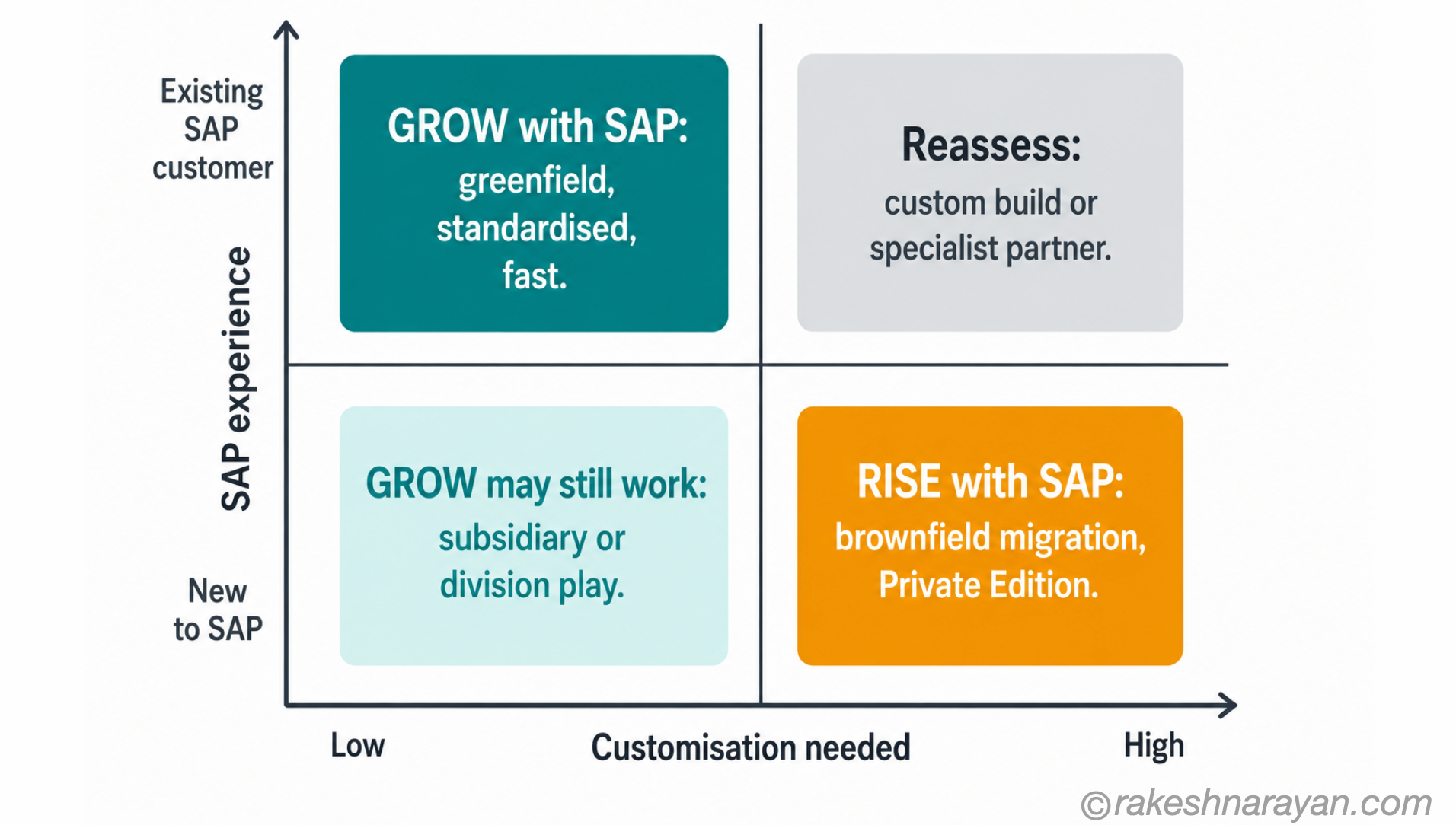
The fit-to-standard trade-off — the conversation most partners skip
GROW’s speed comes from a constraint. You adopt SAP’s best-practice processes as delivered — you do not redesign them to match how you work today. This is called fit-to-standard, and it is the philosophical opposite of the traditional SAP implementation approach where the system was bent to fit the client’s existing processes.
In practice, fit-to-standard means workshops where the question is not ‘how do we configure this to match our current process’ but ‘does our current process need to change to match SAP’s best practice?’ For some organisations, that is liberating — it removes years of accumulated process debt and gives everyone a modern baseline. For others, particularly those with differentiated processes that are genuinely a source of competitive advantage, it creates a real tension.
The clean core principle reinforces this. In GROW, you do not modify the S/4HANA core. Extensions and custom logic go onto SAP BTP — a separate layer that connects to the core through APIs. This keeps your system upgradeable: when SAP releases quarterly updates, your core is clean, so the update applies without breaking customisations.
✅ Best practice: Before signing a GROW contract, run a fit-to-standard assessment workshop. Map your top 10 critical business processes against SAP standard. If more than two or three require significant workarounds or BTP extensions to function, the scope and cost estimates will need revisiting before go-live.
How to decide — the three questions that cut through the noise
After years of sitting in rooms where this decision gets made, the conversation usually comes down to three questions. Not a feature checklist — three diagnostic questions that tell you which path fits before you have looked at a single product demo.
Question 1: Are you an existing SAP customer?
If yes, RISE is probably your path — not because GROW cannot be used by existing SAP customers, but because RISE was built for the migration challenge you are facing. You have data to move, integrations to re-establish, and custom code to assess and decide what to do with. GROW’s fit-to-standard approach was not designed for that complexity.
The exception: subsidiaries or divisions of larger SAP organisations often use GROW for a clean-start deployment on a specific scope, while the parent maintains RISE for the main landscape. This two-tier model is explicitly supported and increasingly common.
Question 2: How much does your process need to differ from standard?
Be honest here. Most organisations believe their processes are more differentiated than they actually are. SAP’s best practices cover the vast majority of what a mid-market finance, procurement, or supply chain function needs to do. If your answer is ‘we have a few non-standard things but nothing fundamental’, GROW can almost certainly handle it via configuration and BTP extensions.
If your answer is ‘we have industry-specific processes, regulatory requirements, or deeply embedded custom logic from 15 years of ECC development that we cannot simply retire’, that is a RISE conversation.
Question 3: What is your timeline and budget posture?
GROW’s promise is 4 to 8 weeks to initial go-live. That requires discipline — fit-to-standard workshops, fast decisions, minimal scope creep. If your organisation has a culture of extended business process review and large steering committee sign-offs before any decision, GROW’s timeline will slip regardless of the technology.
RISE accepts that transformation takes time. The commercial structure — longer contract terms, higher investment, more included services — reflects this. It is not a better or worse option, just a different posture about what the journey looks like.
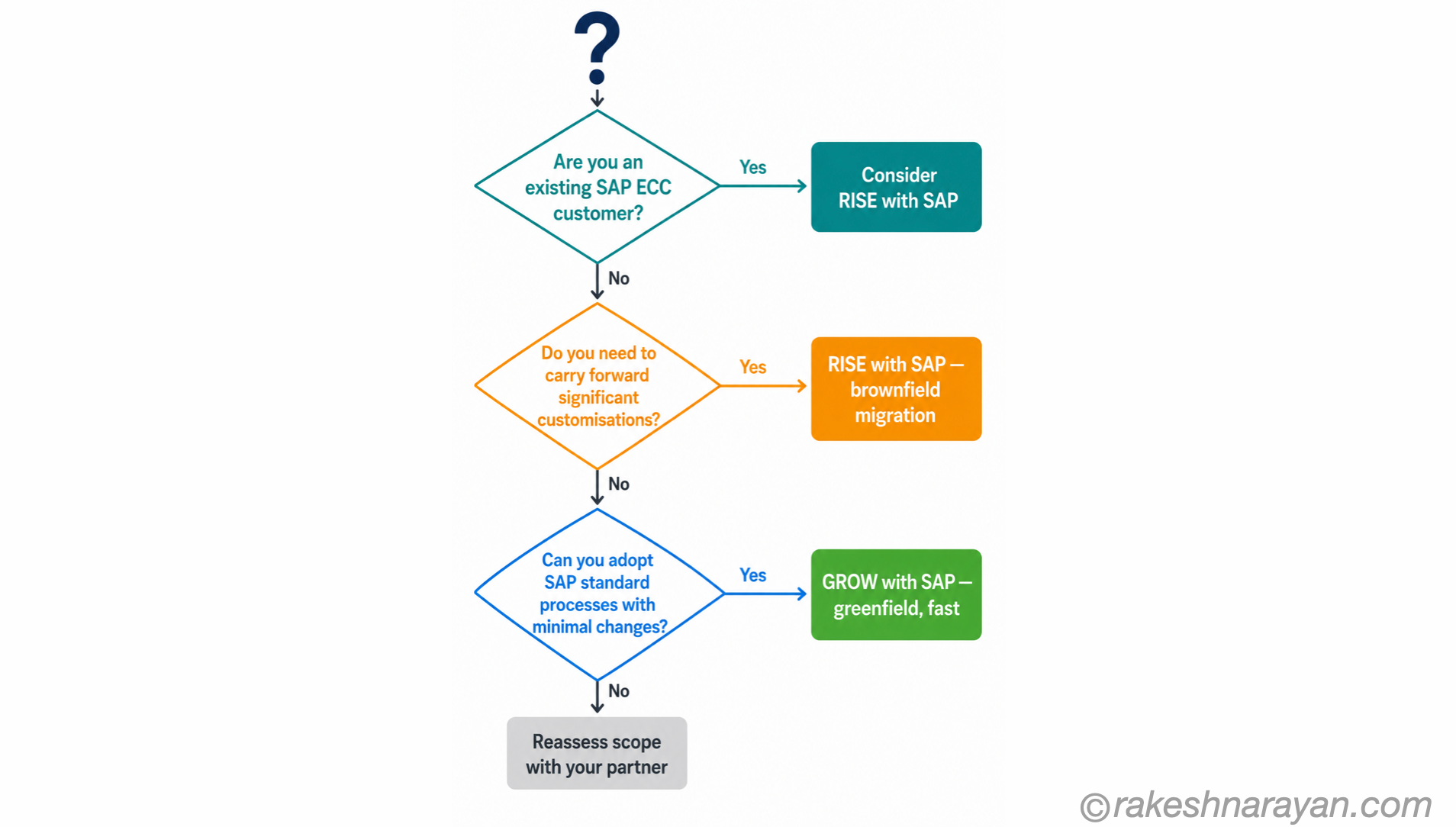
At a glance — GROW and RISE with SAP
| Concept | One-line summary |
|---|---|
| GROW with SAP | SAP’s cloud ERP journey for mid-market and new-to-SAP organisations — fast, standardised, public cloud |
| RISE with SAP | SAP’s cloud transformation journey for existing SAP customers migrating complex on-premise landscapes |
| S/4HANA Cloud Public Edition | The SaaS ERP product that powers GROW — multi-tenant, fully SAP-managed, quarterly updates |
| S/4HANA Cloud Private Edition | The dedicated cloud ERP that powers most RISE deployments — more customisation, private infrastructure |
| SAP Activate | The 6-phase implementation methodology used in GROW — Discover, Prepare, Explore, Realize, Deploy, Run |
| Fit-to-standard | GROW’s approach — configure to SAP best practices rather than building custom processes |
| Clean core | The principle behind GROW — no modifications to the ERP core; extend through SAP BTP instead |
| FUE licensing | Full User Equivalent — the metric both GROW and RISE use to licence users across different role types |
| Greenfield | A fresh ERP implementation with no legacy data or process migration — GROW’s natural terrain |
| Brownfield | A migration that carries existing data, customisations and processes forward — RISE’s primary use case |
| 2027 ECC deadline | SAP ECC mainstream maintenance ends 2027; extended maintenance available to 2030 at additional cost |
| BTP | SAP Business Technology Platform — included in both; GROW includes starter credits, RISE includes more |
What to take away
The 2027 ECC deadline is real, and SAP’s sales organisation knows exactly how to use it. The urgency is legitimate — but urgency should produce a faster decision, not a worse one. GROW and RISE are both solid paths to S/4HANA. The mistake is choosing the wrong one for where you are starting from.
GROW is genuinely excellent at what it does. For a mid-market organisation new to SAP, or a division that wants a clean-start cloud ERP without years of consultancy, it offers something the old SAP implementation world never did: speed, predictability, and a lower cost of entry to enterprise-grade ERP. But it is only excellent if you are willing to let the system set the standard rather than the other way around.
RISE is the right conversation if you have years of SAP investment to protect and a complex landscape to migrate. The fact that it costs more and takes longer is not a failure of the programme — it is an honest reflection of what the work actually involves.
The question to ask in the room is not ‘which one sounds better?’ It is ‘where are we starting from, and what are we willing to change?’ That answer tells you everything.
🔗 Related posts on this site
SAP S/4HANA vs ECC — The Real Difference The context for why the migration conversation is happening at all, and what the difference between S/4HANA and ECC actually means for an organisation.
SAP BTP — The Platform Explained BTP is included in both GROW and RISE; this post explains what it actually does and why it matters for the clean core approach.
AI in SAP — How Joule and Business AI Actually Work Joule is embedded across both GROW and RISE; this post explains what SAP’s AI actually does in practice.
SAP LeanIX — Enterprise Architecture Management Before choosing GROW or RISE, LeanIX is how many organisations map their current landscape and application risk to inform that decision.
SAP Fiori Design Principles GROW with SAP is entirely Fiori-based; understanding the design model behind every screen matters for user adoption.
Published on rakeshnarayan.com — Articles
URL: https://rakeshnarayan.com/articles/grow-with-sap-vs-rise-with-sap-which-is-right-for-you/
Did you enjoy this article?
Let me know — it takes one click.
0 Comments
Leave a Comment
Looks like this one held your attention — I'd really appreciate a quick comment below.
Your comment has been submitted and will appear after review.