SAP S/4HANA Migration: Greenfield, Brownfield, Bluefield
Every SAP customer running ECC knows the deadline. Mainstream maintenance ends 31 December 2027. Extended maintenance is available until 2030, at extra cost.
Either way, the clock is running — and the first question on every migration project is not about budget or resourcing. It is: which path?
Greenfield, brownfield and bluefield — sometimes called Selective Data Transition or SDT — are the three routes from ECC to S/4HANA. They are not interchangeable. Each one makes a fundamentally different set of trade-offs, and choosing the wrong one early is expensive to undo.
The naming does not help: the same approach gets called bluefield by some consultants and SDT by others. This post uses both terms and explains why.
The decision matters more than most teams realise. It is not just a technical choice about how data moves. It is a statement about what kind of SAP organisation you want to be after the migration is done.
🔗 Foundation reading
This post assumes you know why S/4HANA is different from ECC. If you need that context first, read SAP S/4HANA vs ECC — The Real Difference . For the platform decisions that follow migration, see SAP BTP — The Platform Explained .
The three paths — what each one actually means
Before getting into trade-offs, here is the plain-English version of each approach. A lot of confusion in this space comes from consultants and vendors using technical language before the concepts are clear.
| Path | Also called | What it means | The analogy |
|---|---|---|---|
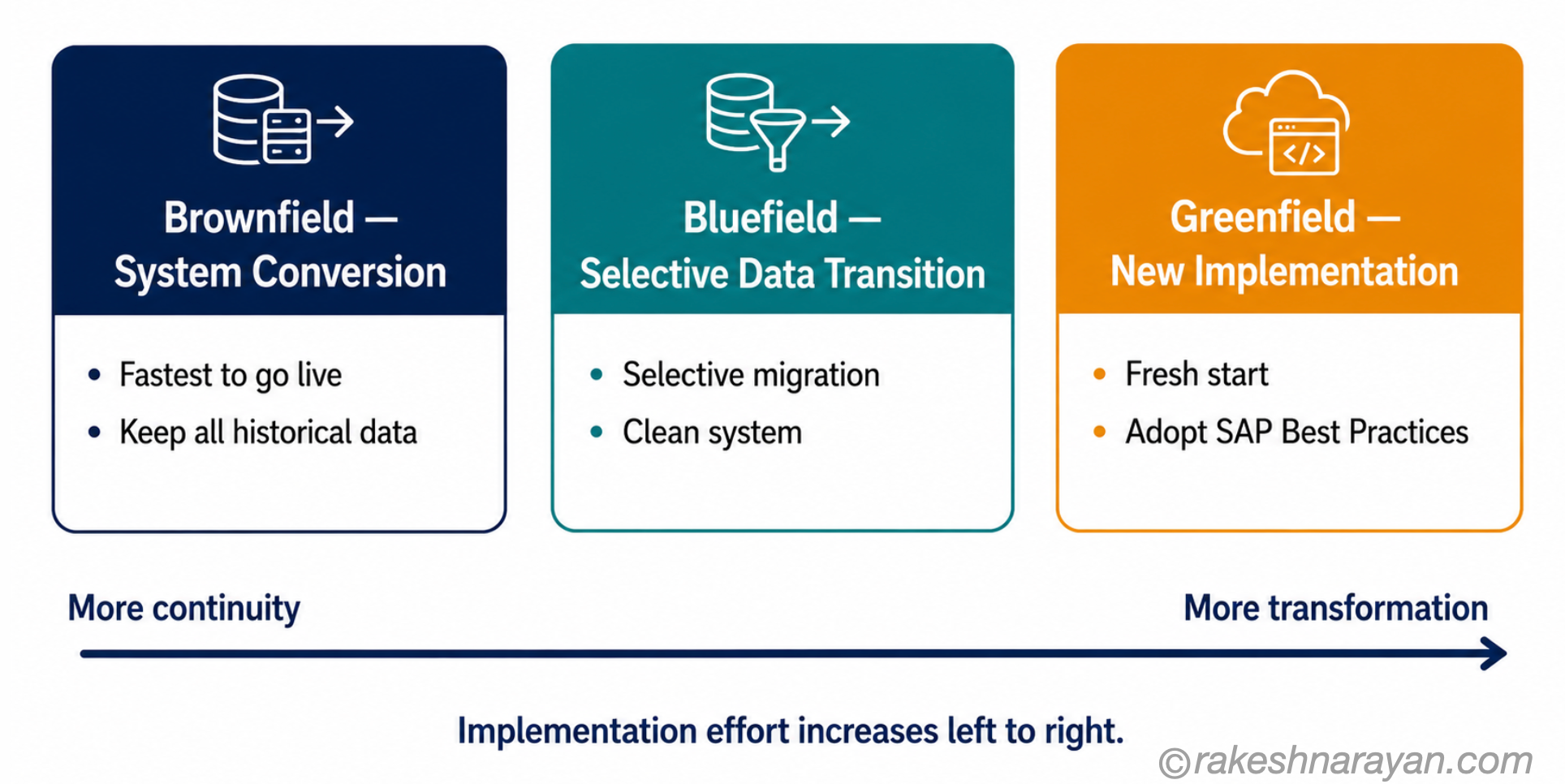
| Brownfield | System conversion | Convert your existing ECC system to S/4HANA in place — software and data migrate together | Renovating the house you are living in |
| Greenfield | New implementation | Build a fresh S/4HANA system from scratch — configure from zero, migrate only the data you choose | Tearing down and building new on the same lot |
| Bluefield | Selective Data Transition (SDT) | Build a new S/4HANA system but selectively carry across configurations, master data and history from ECC | Building a new house and carefully moving the furniture you want to keep |
Bluefield and Selective Data Transition mean the same thing. SAP uses SDT in its official tooling. Partners and consultants often say bluefield. Some call it the hybrid approach. This post uses both terms interchangeably from here on.
Brownfield — the fastest path, not the easiest one
Brownfield is a system conversion. SAP’s Software Update Manager (SUM) with the Database Migration Option (DMO) handles the technical work — converting your database to SAP HANA and upgrading the system to S/4HANA in a single operation. Your data, your configurations, your custom code — all of it moves across.
The appeal is real. You keep your full transaction history. Your users work in a system that largely looks and behaves like the one they know. Go-live risk is lower because you are not retraining an entire organisation on new processes simultaneously.
And the timeline is typically shorter than greenfield — often 12 to 18 months for a mid-sized organisation.
The honest downside: you carry your mess with you. Every inefficient process, every workaround that became standard practice, every piece of custom code that should have been retired years ago — it all comes along.
The custom code remediation exercise is almost always bigger than estimated. S/4HANA has simplified and restructured key data models (the financial accounting tables, the material ledger, the inventory structures) and custom code that reads or writes those tables will break. Every project I have seen has underestimated this.
⚠️ The custom code assumption that derails brownfield projects
Most project plans estimate custom code remediation based on the number of custom objects. The number that actually matters is how many of those objects touch the simplified data model areas — ACDOCA, MATDOC, EBAN/EKPO structures. Run SAP’s Readiness Check and the Custom Code Migration tool (CCMTOOL) before committing to a timeline. The results are often a surprise.
Brownfield makes sense when your processes are well-designed and genuinely worth keeping, your custom code volume is manageable, and speed to S/4HANA is the priority. It is also the natural choice when you are in a heavily regulated industry where process change needs to be minimised.
✅ Best fit for Brownfield
Organisations with stable, mature processes that work well — where the goal is platform modernisation, not process transformation. Also suited to organisations with tight timelines and limited appetite for change management.
Greenfield — the clean start that is never quite clean
Greenfield means building a new S/4HANA system from scratch. You install the software, design your processes using SAP Best Practices and SAP Activate methodology, configure from zero, and migrate only the data you choose to bring across — typically master data and a defined window of transactional history.
The case for greenfield is straightforward. You get a clean system with no legacy technical debt. You can redesign processes to match how the business actually works in 2026, not how it worked when ECC was implemented fifteen years ago.
You can adopt SAP’s Intelligent Enterprise capabilities — embedded analytics, AI features, integration patterns — properly, rather than bolting them onto an older structure.
The honest downside: there is no such thing as a truly clean start. Your historical transactional data does not disappear — it goes into an archive system or a data warehouse and your users will ask for it regularly.
The change management load is significant — people are learning new processes, new screens, new logic simultaneously with a go-live. And the timeline is the longest of the three approaches, typically 15 to 24 months for a complex organisation.
📌 The data history question is the one most teams answer too late
Greenfield teams consistently underestimate how much users rely on transaction history in the live system. Define the data archiving and accessibility strategy before the project design phase, not during testing. Discovering that finance needs seven years of open items in the live system during UAT is a project-stopper.
Greenfield makes sense when your current ECC processes are genuinely outdated or poorly designed, when you are undergoing a significant business transformation at the same time, or when you are a subsidiary or new entity rolling out S/4HANA against a standard template.
✅ Best fit for Greenfield
Organisations where ECC was over-customised and the processes need redesigning regardless. Also subsidiaries or regional rollouts where a parent organisation has already defined a clean template to follow.
Bluefield (SDT) — the flexible middle that requires the most thinking
Bluefield splits the difference. You start with a new, clean S/4HANA system — which gives you the same technical foundation as greenfield. But instead of migrating only a narrow data set, you selectively carry across configurations, master data, and historical transactional data from ECC. You choose what comes over and what gets left behind.
In practice this takes two forms. The first is a shell conversion — the existing ECC system is used as the basis, configurations are carried selectively, and you strip out what you do not want. The second is a mix-and-match approach — you start fresh with a new system and inject the elements you need from ECC.
Both arrive at the same destination: a new S/4HANA system with a curated set of your legacy content.
💡 Why Bluefield is growing in popularity
The ECC deadline pressure is pushing organisations toward brownfield for speed — but brownfield’s technical debt problem is making bluefield more attractive. You get a clean system architecture and the ability to leave legacy mess behind, without the data migration complexity of a full greenfield. The trade-off is more upfront analysis work to decide what moves and what does not.
The honest downside: bluefield requires more upfront analysis than either of the other two paths. You need to make deliberate decisions about every element that moves — and that takes time and rigour.
The tooling required is more complex than a standard conversion. And the project needs a partner with genuine experience in selective transition work, not just standard implementation methodology.
✅ Best fit for Bluefield (SDT)
Organisations that want a clean technical foundation but cannot afford to lose historical data or start configuration from zero. Also organisations with specific processes they want to keep and specific ones they want to redesign — bluefield lets you make that distinction at a granular level.
The decision factors — what actually determines the right path
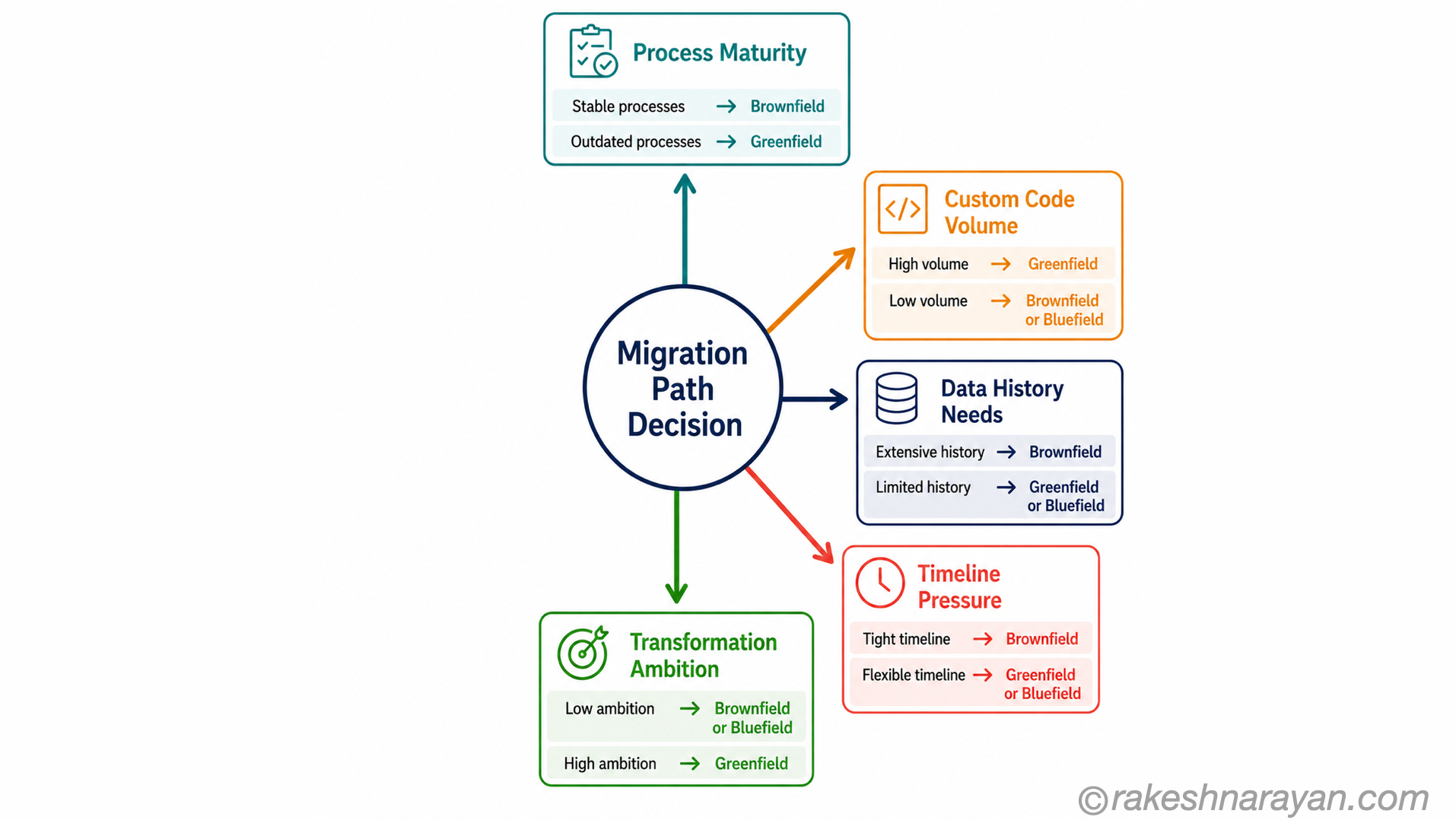
Every consultant will tell you the right approach depends on your situation. That is true — but it is not helpful without a framework for reading your situation. These are the five questions that actually drive the decision.
| Decision factor | Points toward Brownfield | Points toward Bluefield | Points toward Greenfield |
|---|---|---|---|
| Process maturity | Processes are stable and well-designed | Mix — some worth keeping, some need redesign | Processes are outdated or were over-customised |
| Custom code volume | Low to medium — remediation is manageable | High — want to leave legacy code behind | High — want a clean system with minimal Z-code |
| Data history requirements | Full history needed in live system | Selective history — define what moves | Limited history needed — archive acceptable |
| Timeline pressure | Tight — need to go live fastest | Medium — worth the upfront analysis time | Flexible — willing to invest in full redesign |
| Transformation ambition | Platform upgrade only — no process change | Selective transformation — specific areas only | Full transformation — redesign everything |
No single factor decides it alone. A tight timeline that points toward brownfield combined with a massive custom code footprint and outdated processes — that is a project that needs a serious conversation about whether brownfield is actually faster when the remediation work is factored in.
Clean Core — why it changes the calculus in 2026
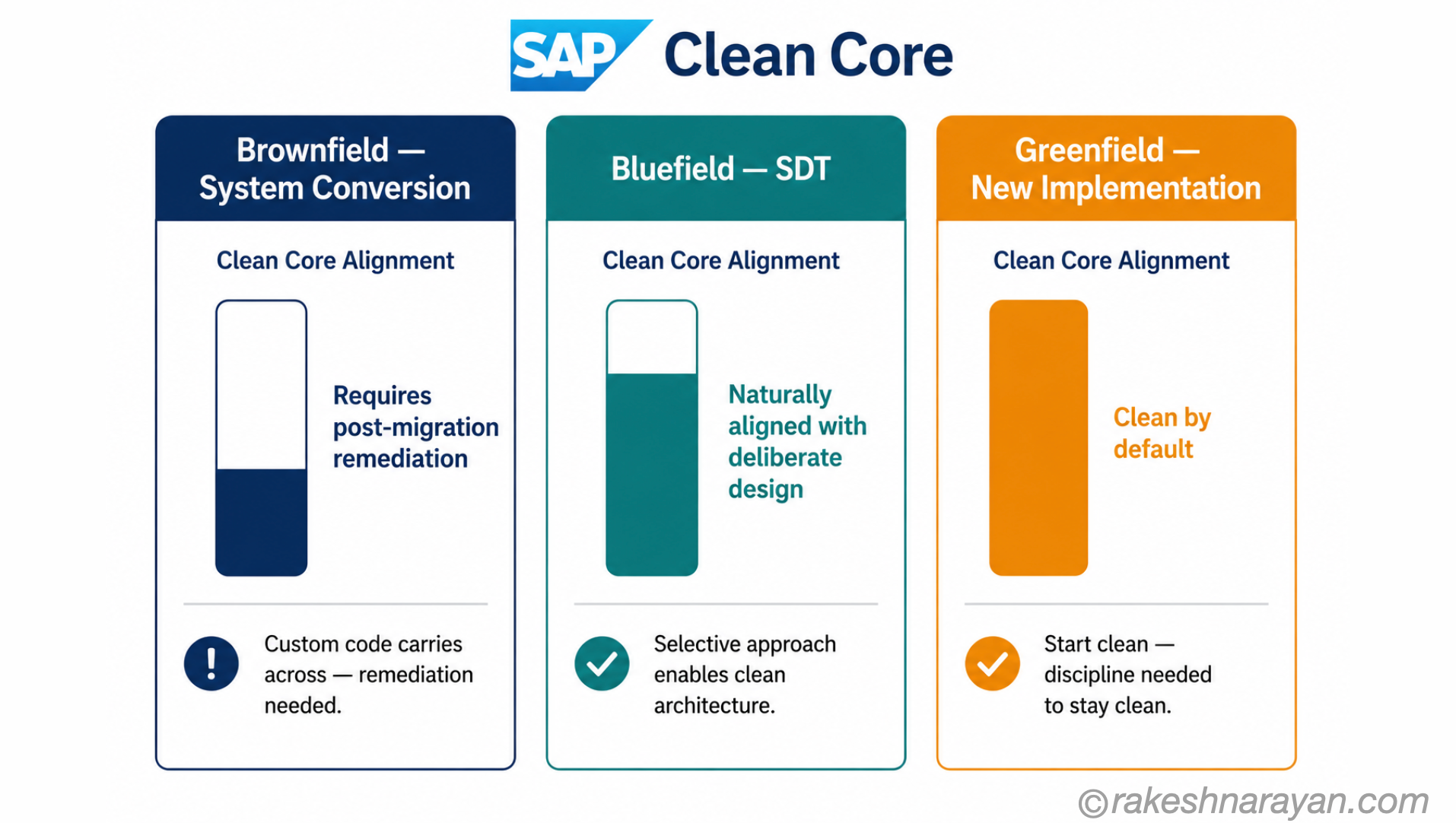
SAP’s Clean Core principle is not a product feature. It is a design philosophy — keep the core S/4HANA system as standard as possible, push extensions and customisations to the side using approved extension patterns (BAdIs, SAP BTP extensions, the ABAP Cloud development model).
This matters for migration path selection because the three approaches have very different natural relationships with Clean Core. Brownfield carries custom code across by default — you then have to remediate it post-migration to move toward Clean Core compliance. That is not impossible, but it is a second project layered on top of the migration itself.
Greenfield gives you a clean starting point by definition, but you have to be disciplined about not recreating the same customisation patterns in the new system. Bluefield gives you the architectural clean start while letting you be deliberate about what comes across — which makes it the most naturally aligned with Clean Core principles if the upfront analysis work is done properly.
📝 Clean Core and CDS Views
Clean Core compliance in S/4HANA increasingly means using CDS views for data access rather than direct table reads — particularly for reporting and integrations. If your custom code uses direct SELECT on ECC tables, that code will need rethinking regardless of which migration path you choose.
The practical consequence: if Clean Core compliance is a goal — and for most organisations it should be, given the long-term maintenance and upgrade implications — brownfield requires the most additional work post-migration to get there. This changes the true cost comparison between the paths significantly.
At a glance — the three paths compared
| Concept | One-line summary |
|---|---|
| Brownfield (System Conversion) | Convert existing ECC to S/4HANA in place — fastest path, but carries technical debt and custom code across |
| Greenfield (New Implementation) | Build a fresh S/4HANA system from scratch — cleanest result, but longest timeline and highest change management load |
| Bluefield / SDT | Start with a new clean S/4HANA system but selectively migrate what you need from ECC — most flexible, most upfront analysis |
| Custom code remediation | The work needed to fix Z-code that breaks on S/4HANA’s simplified data model — always larger than estimated in brownfield projects |
| SUM / DMO | SAP’s Software Update Manager with Database Migration Option — the technical toolchain for brownfield conversion |
| SAP Activate | SAP’s implementation methodology — the standard approach for greenfield and bluefield projects |
| Clean Core | SAP’s design principle to keep the S/4HANA core standard — bluefield and greenfield align more naturally than brownfield |
| ECC maintenance deadline | Mainstream maintenance ends 31 December 2027, extended maintenance available until 2030 at additional cost |
| Data archiving strategy | Where historical ECC data lives after migration — critical to define early, especially in greenfield and bluefield projects |
What to take away
The deadline makes the migration feel like a technical project. It is not. Not really. The path you choose determines what your SAP system looks like for the next decade.
Brownfield gets you to S/4HANA on the shortest timeline, but if your current system is a tangle of custom code and workarounds, you are moving that tangle into a newer box. Greenfield gives you the clean start, but a clean start only stays clean if the discipline to maintain it follows.
Bluefield is the option that has gained the most ground in the last two years — not because it is the easiest, but because it forces the conversation that both other paths avoid. What in your current system is worth keeping? What should be redesigned? What should simply be left behind?
That conversation is uncomfortable. It is also the most valuable thing a migration project can produce.
The path choice is not a technical decision. It is a question about what kind of SAP organisation you want to be on the other side of 2027. The answer to that question should drive the methodology — not the other way around.
🔗 Related posts on this site
SAP S/4HANA vs ECC — The Real Difference — what actually changed between ECC and S/4HANA: the data model, the database, the user experience.
SAP Clean Core — Strategy Behind Every S/4HANA Build Decision — the architectural discipline that determines where custom logic lives after migration.
SAP Security Roles and Authorisation — the security model you need to redesign or carry across in any migration project.
SAP BTP — The Platform Explained — where extensions, integrations and AI capabilities live in the S/4HANA world after migration.
SAP Integration Patterns — how your existing integrations need to change when moving from ECC to S/4HANA.
SAP Activate — The Methodology Behind Every S/4HANA Project — whichever migration path you pick, Activate is the methodology the project itself runs on.
SAP Blueprinting — Fit-Gap to Design Freeze — turning the path you choose here into a blueprint and a design freeze that actually holds.
Published on rakeshnarayan.com — Articles
https://rakeshnarayan.com/articles/sap-s4hana-migration-greenfield-brownfield-bluefield/
Did you enjoy this article?
Let me know — it takes one click.
0 Comments
Leave a Comment
Looks like this one held your attention — I'd really appreciate a quick comment below.
Your comment has been submitted and will appear after review.