RISE with SAP — What's Actually in the Bundle
Ask ten people in an SAP project what RISE with SAP is and you will get ten different answers. A cloud platform. A migration programme. A subscription model. A rebranding of S/4HANA. None of these are wrong. None of them are complete.
The confusion is not accidental. SAP’s marketing for RISE is deliberately vague — “business transformation as a service” is a phrase designed to sound significant without committing to anything specific. Behind the marketing language is something much more concrete: a bundled commercial offering with a defined set of components, a methodology, and a single contract. Once you understand the bundle, everything else makes sense.
This post explains what RISE actually is, what is inside it, how it compares to GROW with SAP, what the clean core principle means in practice, what changed in 2025, and why the ECC deadline makes all of this urgent right now.
🔗 Foundation context
What is SAP? — Start here if you are new to the SAP landscape.
SAP S/4HANA vs ECC — The Real Difference — The platform differences that RISE is designed to bridge.
What RISE with SAP actually is
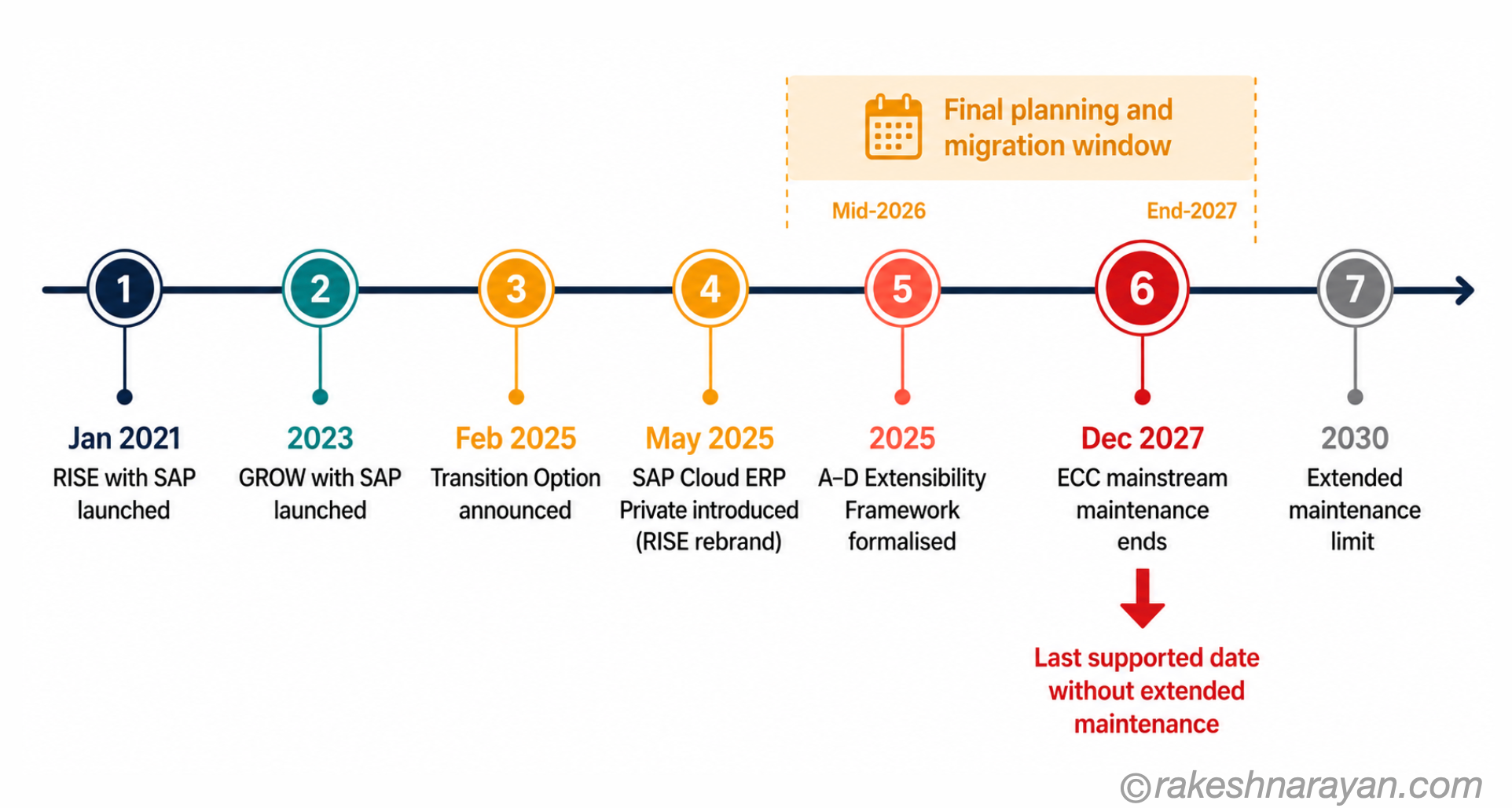
RISE with SAP is not a product. It is a bundled commercial offering — a single subscription contract that packages everything an existing SAP customer needs to move from on-premise ECC to S/4HANA in the cloud. SAP launched it in January 2021 specifically to accelerate ECC migrations.
The core idea is simple: instead of negotiating separate contracts for software licences, cloud infrastructure, managed services, and implementation tools, you get one contract with SAP. One invoice. One point of accountability. One migration path.
That simplicity is the genuine value proposition. The complexity is in understanding exactly what that contract includes — and what it does not.
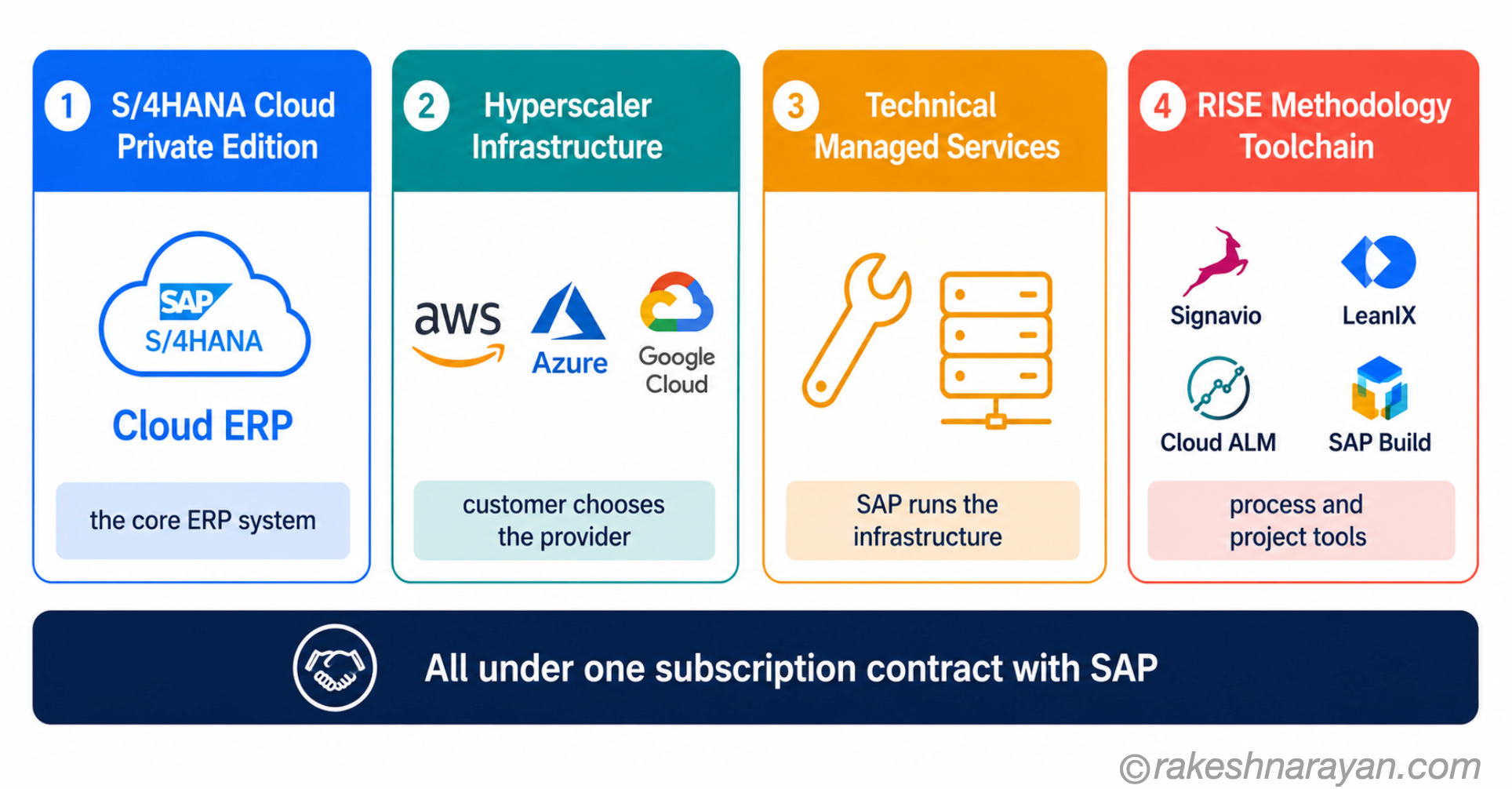
What is inside the bundle
The RISE bundle has four components. Understanding each one separately is the fastest way to cut through the marketing language.
| Component | What it is | What it means in practice |
|---|---|---|
| S/4HANA Cloud Private Edition | The core ERP system. A dedicated, single-tenant cloud instance of SAP S/4HANA. Not shared with other customers. | More flexibility and customisation than the Public Cloud edition. The environment your business runs on. |
| Hyperscaler Infrastructure | The physical cloud hosting. SAP runs your S/4HANA system on AWS, Azure or Google Cloud — you choose the provider and region. | SAP manages the infrastructure SLA. You no longer own servers or manage hardware. |
| Technical Managed Services (TMS) | SAP takes responsibility for infrastructure operations — patching, backups, system monitoring, availability management. | Reduces the Basis workload significantly. Your team focuses on the business layer, not the technical platform. |
| RISE Methodology Toolchain | A bundled set of tools: SAP Signavio (process analysis), SAP LeanIX (enterprise architecture), SAP Cloud ALM (project management), SAP Build (extensions), WalkMe (user adoption). | Replaces tools you would otherwise procure separately. The methodology follows the SAP Activate framework — Discover, Prepare, Explore, Realize, Deploy, Run. |
💡 Practical Tip
BTP credits are bundled within RISE — the amount depends on your contract tier. BTP is where custom extensions and integrations live under the clean core model. Know what BTP services are included before you start scoping extensions, or you will hit consumption costs you did not budget for.
RISE vs GROW — the two paths SAP offers
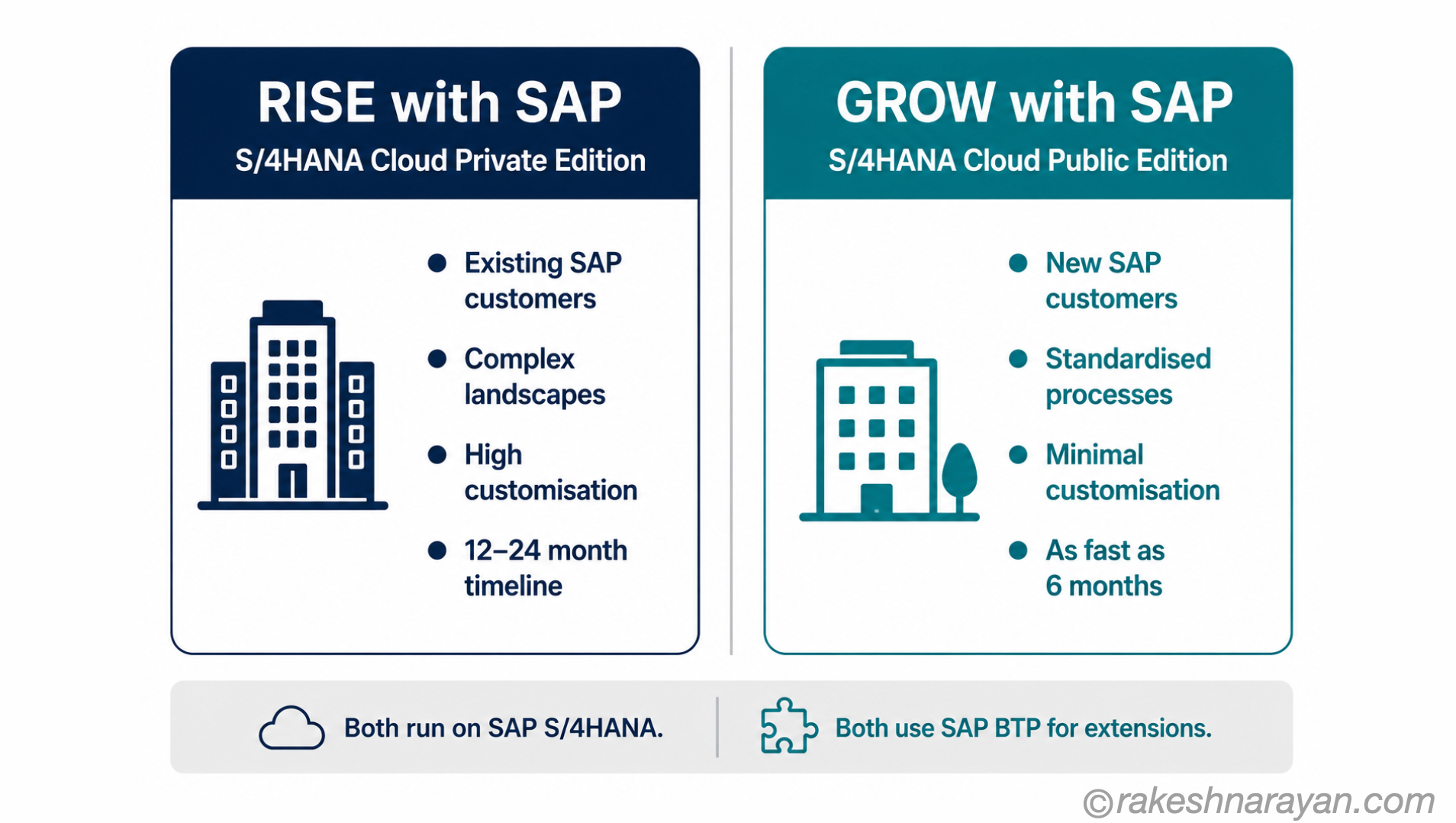
Every client conversation about RISE eventually hits the same question: “What about GROW with SAP?” The two are SAP’s parallel cloud ERP offerings and they serve fundamentally different audiences.
GROW with SAP was launched in 2023. It targets net-new SAP customers or organisations with simpler, more standardised needs. It runs on S/4HANA Cloud Public Edition — a multi-tenant SaaS model where SAP manages everything, updates happen automatically twice a year, and customisation is deliberately limited.
RISE targets existing SAP customers migrating from ECC. It runs on S/4HANA Cloud Private Edition — a dedicated environment with far more room for complexity, custom code management, and industry-specific configurations.
| RISE with SAP | GROW with SAP | |
|---|---|---|
| Target customer | Existing SAP customers migrating from ECC or on-premise S/4HANA | New SAP customers or companies with simpler, standardised needs |
| Cloud model | S/4HANA Cloud Private Edition — dedicated environment | S/4HANA Cloud Public Edition — multi-tenant SaaS |
| Customisation | High — custom code, complex configurations, industry-specific | Low — SAP standard processes, limited modification |
| Deployment timeline | Typically 12–24+ months for large enterprises | As fast as 6 months for standard deployments |
| Implementation approach | Greenfield (new) or Brownfield (convert from ECC) | Greenfield only — designed for clean starts |
| Right for | Large enterprises, regulated industries, complex landscapes, existing SAP investment | Mid-market, simpler scope, first-time SAP adopters |
📌 Key Takeaway
If a client is running ECC and has years of customisations, integrations and industry-specific configurations, the answer is almost always RISE — Private Edition. GROW is not designed to absorb that complexity. The distinction matters because the implementation scope, timeline and cost profile are completely different.
Clean core — the principle that runs through all of it
Clean core is not a product or a feature. It is a design principle: keep your S/4HANA system as close to SAP standard as possible, and build any custom logic or extensions on BTP instead of inside the core.
In the ECC world, customisation meant modifying SAP source code directly — Z-programs, user exits, modifications to standard tables. It worked. It also created a maintenance nightmare. Every upgrade required retesting and often rewriting those modifications. Some systems accumulated decades of custom code that nobody fully understood anymore.
RISE requires you to break that pattern. Extensions go on BTP using released APIs and SAP Build. The S/4HANA core stays standard and upgrade-stable. SAP formalised this with an A–D extensibility level framework in 2025 — Level A is fully upgrade-safe, Level D (direct modifications) is what you are eliminating.
The practical consequence: your existing custom code is the biggest risk in any RISE migration. The first thing any serious implementation partner will do is a custom code assessment. The volume and complexity of your Z-code will drive a significant part of your project timeline and cost.
⚠️ Warning
Clean core does not mean zero customisation. It means customisation in the right place — on BTP, using SAP’s extensibility framework. Organisations that interpret clean core as “go completely standard” end up with a system that does not fit their business. Organisations that ignore it end up with the same upgrade problem they had in ECC, just in the cloud.
🔗 Related reading
SAP BTP — The Platform Explained — SAP BTP is the platform where all clean core extensions live. This post explains what BTP actually is and how it sits alongside S/4HANA.
What changed in 2025
At SAP Sapphire in May 2025, SAP introduced SAP Cloud ERP Private as the new commercial package name. This is the current evolution of RISE — same foundation, restructured bundle, new name.
The old RISE offering had three tiers — Base, Premium and Premium Plus. These have been consolidated into a single package. More importantly, what is now included in the standard bundle has changed materially.
📝 Note — the naming is genuinely confusing
“RISE with SAP” has not been retired. SAP’s own documentation, partner communications and customer contracts still use it widely as of 2026. “SAP Cloud ERP Private” is the new commercial package name introduced at Sapphire 2025, but RISE remains the umbrella brand and methodology name. If someone says RISE with SAP in 2026, they mean the same thing as SAP Cloud ERP Private — just using the older, more familiar name.
💡 Practical Tip — the Transition Option for complex customers
In February 2025, SAP announced the SAP ERP, Private Edition, Transition Option — a path for the largest and most complex customers who genuinely cannot complete their full migration by 2027. It allows operation until 2033 under a cloud subscription. This is not the standard RISE path. It is a niche provision for specific scenarios. Customers who signed up by end of 2025 with a start date no later than 2026 secured the most favourable commercial terms.
The ECC deadline — why this is all urgent
SAP mainstream maintenance for ECC ends on 31 December 2027. This has been confirmed. There will be no further extensions. After that date, organisations running ECC without a migration plan will be on unsupported, unpatched ERP — a security and compliance risk, not just an operational inconvenience.
Extended maintenance is available to 2030 at extra cost. RISE and SAP Cloud ERP Private customers also retain compatibility pack usage rights until 2030. But these are not migration strategies — they are extensions that buy time, not a destination.
The arithmetic is the problem. A mid-to-large enterprise RISE migration takes 18 to 24 months from contract signature to go-live — sometimes longer for complex, multi-country landscapes. Add 6 to 9 months for scoping, budget approval, vendor selection and internal alignment before technical work starts. Organisations starting planning conversations in mid-2026 are running a tight schedule.
The majority of SAP’s ECC installed base has not yet started their S/4HANA migration. The result is a tightening resource market — experienced S/4HANA consultants and implementation partners are already seeing increased demand, and that will compound through 2026 and into 2027.
✅ Best Practice
Start the custom code assessment now, regardless of when you plan to sign a RISE contract. It is the single input that most often surprises organisations — and it has the longest lead time to remediate. Knowing your Z-code volume and complexity early gives you an accurate migration scope and a realistic timeline.
At a glance — RISE with SAP
| Concept | One-line summary |
|---|---|
| RISE with SAP | A bundled commercial offering — S/4HANA Cloud Private Edition, infrastructure, managed services and methodology tools in one subscription contract |
| SAP Cloud ERP Private | The 2025 commercial package name for RISE — same foundation, consolidated tiers, expanded bundle including Joule AI and BTP services |
| S/4HANA Cloud Private Edition | The dedicated, single-tenant cloud ERP at the centre of RISE — more flexibility than Public Edition, less than on-premise |
| Technical Managed Services | SAP manages your infrastructure — patching, backups, availability. Reduces internal Basis workload significantly |
| RISE Methodology Toolchain | Bundled transformation tools: Signavio (processes), LeanIX (architecture), Cloud ALM (project management), SAP Build (extensions) |
| GROW with SAP | SAP’s Public Cloud path — for net-new or simpler customers on S/4HANA Cloud Public Edition. Faster, more standardised, less customisable than RISE |
| Clean core | The design principle: keep S/4HANA standard, build extensions on BTP using released APIs — not by modifying SAP source code |
| ECC 2027 deadline | Mainstream SAP ECC maintenance ends 31 December 2027. Extended maintenance available to 2030 at extra cost. No further extensions confirmed. |
| Transition Option | SAP ERP, Private Edition, Transition Option — announced Feb 2025 for complex customers who need time beyond 2027. Allows operation to 2033. |
| Custom code risk | Your Z-code volume is the biggest driver of migration complexity and timeline. Start the assessment before anything else. |
What to take away
RISE with SAP is not a product you buy — it is a commercial vehicle SAP built to move its ECC installed base to the cloud before 2027. When a client asks whether they should “do RISE”, they are really asking whether they should move to S/4HANA Cloud Private Edition under a managed subscription model, using SAP’s bundled tools and methodology to get there. The answer to that question depends on their landscape complexity, their 2027 timeline, and how much of their ECC customisation debt they are prepared to address.
The 2025 rebranding to SAP Cloud ERP Private changes the packaging, not the fundamentals. What matters more is what is now inside the bundle — Joule AI included, BTP expanded, clean core tooling built in. Organisations signing RISE contracts today are getting materially more platform value than those who signed in 2022 or 2023.
The real risk is not choosing the wrong path between RISE and GROW. The real risk is starting too late. The timeline arithmetic for a large enterprise does not leave room for another year of evaluation. The organisations moving confidently through RISE in 2026 are the ones who started their custom code assessment in 2024.
🔗 Related posts on this site
SAP S/4HANA vs ECC — The Real Difference — the platform differences that RISE is designed to bridge. If your client is still deciding whether to move at all, start here.
SAP BTP — The Platform Explained — RISE bundles BTP credits and SAP Build for extensions. This post explains what BTP actually is and how it sits alongside S/4HANA.
AI in SAP: How Joule and Business AI Actually Work — Joule is now included in RISE at no extra licence cost. This post explains what that means in practice.
SAP Security Roles and Authorisation — the authorisation model in S/4HANA Cloud Private Edition follows the same PFCG principles — with a Fiori and BTP layer on top.
SAP Activate — The Methodology Behind Every S/4HANA Project — the implementation methodology every RISE project runs on, regardless of how the licensing bundle is structured.
Published on rakeshnarayan.com — Articles
URL: https://rakeshnarayan.com/articles/rise-with-sap-what-s-actually-in-the-bundle/
Did you enjoy this article?
Let me know — it takes one click.
0 Comments
Leave a Comment
Your comment has been submitted and will appear after review.