SAP Business AI Platform (BAIP) — BTP, BDC and AI Explained
Log into the SAP Partner Portal and check your BTP competency. It doesn’t say BTP anymore. It says SAP Business AI Platform — BAIP for short — and nobody sent a memo explaining what actually changed underneath that label.
I get asked about this on almost every call now. Is BAIP a new product? Did BTP quietly disappear?
Do I need to redo work I already did on Business Data Cloud? The honest answer sits somewhere between rebrand and genuine architectural shift — and most of what’s been written about it doesn’t commit to one side or the other.
This post commits. What BAIP actually is, what it consolidates, what stays exactly as it was, and what genuinely changes for anyone building or governing AI on SAP’s platform in 2026.
🔗 Related Reading
This post builds on SAP BTP — The Platform Explained and SAP Business Data Cloud — The Architecture Behind SAP’s AI Push . If those two names are unfamiliar, start there first — BAIP is what happens when SAP brings them together under one roof.
What SAP Business AI Platform Actually Is
SAP unveiled the SAP Business AI Platform at SAPPHIRE 2026, positioning it as the technology foundation for what SAP calls the ‘Autonomous Enterprise’ — a vision where AI agents don’t just answer questions about your business, they act inside your business processes directly.
Strip away the marketing language and the definition is simple. SAP Business AI Platform is SAP’s unified, SAP-managed foundation for building, running and governing agentic AI. It combines SAP Business Technology Platform (BTP), SAP Business Data Cloud (BDC) and select capabilities from SAP Business Transformation Management (BTM) — mainly SAP LeanIX and SAP Signavio — under one architecture and one governance model.
If that’s a lot of acronyms in one sentence, that’s normal. Every one of them existed before BAIP. What’s new is that they are now presented, licensed and architected as one platform instead of three separate stories.
📌 Key Takeaway
BAIP is not a new product built from scratch. It’s three existing portfolios — one mature, one fairly new, one borrowed in part — pulled under a single strategic and architectural umbrella.
| Component | Role before BAIP | Role inside BAIP |
|---|---|---|
| SAP BTP | A stand-alone build, integration and extension platform | The build and execution layer |
| SAP Business Data Cloud | A stand-alone governed data platform | The data layer every agent draws context from |
| SAP Business AI + select SAP BTM capabilities | Separate AI services and separate enterprise-architecture tooling | The intelligence and governance layer |
The Three Layers — Build, Data and AI Foundation
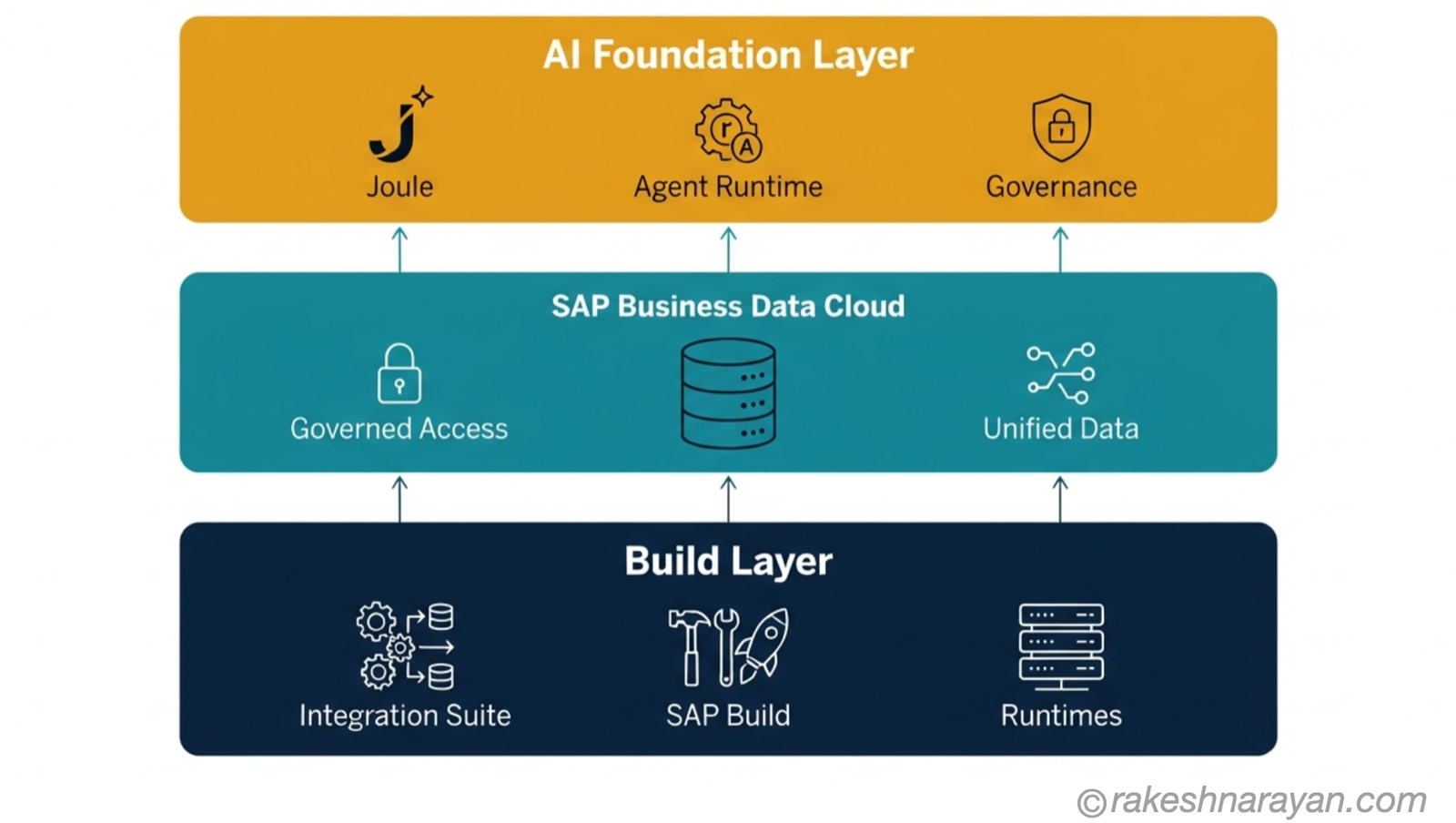
Once you see BAIP as three layers instead of one product, the whole thing gets easier to reason about. Each layer answers a different question, and each one already had a name before SAP put BAIP on the box.
The build layer is SAP BTP. This is where you develop applications, integrate systems and extend S/4HANA — SAP Integration Suite, SAP Build, and the Cloud Foundry, Kyma and ABAP runtimes all live here. Nothing about how you use these services has changed.
The data layer is SAP Business Data Cloud. It unifies SAP and non-SAP data behind a governed access model, so the AI models and agents sitting above it are working from clean, current business data instead of whatever each team happens to have exported into a spreadsheet.
The AI Foundation layer is the newest part of the story. It covers the models, the knowledge graph, Joule as the engagement layer, and — critically — the governance tooling that decides which agent can touch which data. This is where SAP LeanIX and SAP Signavio, previously filed under Business Transformation Management, now do real work.
| Layer | What it does | Key SAP components |
|---|---|---|
| Build layer | Develop, integrate and extend | SAP BTP — Integration Suite, SAP Build, Cloud Foundry, Kyma, ABAP runtime |
| Data layer | Unify and govern business data | SAP Business Data Cloud |
| AI Foundation layer | Models, orchestration and governance | Joule, SAP AI Core, SAP AI Agent Hub (via SAP LeanIX), SAP Signavio process context |
💡 Practical Tip
If you already know SAP BTP well, don’t relearn it. Treat ‘build layer’ as a synonym for the BTP services you already use — the architecture around it changed, not the services themselves.
Rebrand or Real Architectural Shift?
I’ve seen both extremes written about this. Partner blogs waving it off as ‘just a label change on a competency certificate.’
Vendor pitch decks calling it the most important platform announcement in a decade. Neither view survives contact with the actual details.
There are genuinely two separate things happening here, and conflating them is where most of the confusion comes from.
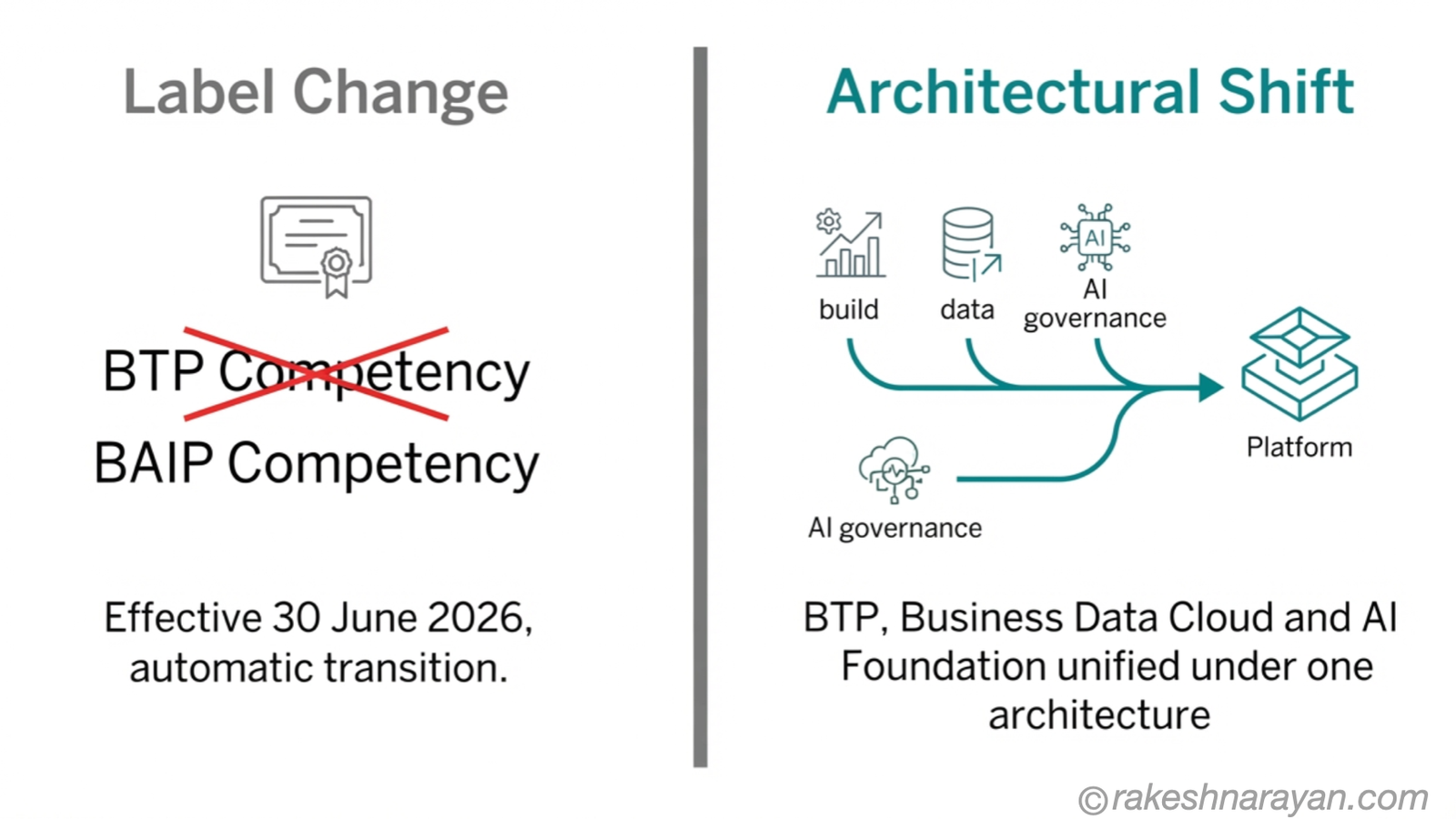
The first is a partner competency rename, effective 30 June 2026. The SAP BTP competency became the SAP Business AI Platform competency. Existing holders were transitioned automatically.
No new requirements. No re-certification. This part really is just a label.
The second is a platform-level consolidation — BTP, Business Data Cloud and AI governance brought under one architecture, with the new SAP AI Agent Hub and Joule Studio sitting on top. This part is real. It changes how you scope an AI project, what you sell a client, and what a governance conversation looks like six months into a rollout.
| Aspect | What changed | What stayed the same |
|---|---|---|
| Partner competency | Renamed from BTP to BAIP, effective 30 June 2026 | Certification levels and specialisations carried over automatically |
| Underlying services | Presented as one consolidated architecture story | SAP Integration Suite, SAP Build and the BTP runtimes work exactly as before |
| Governance | New — the SAP AI Agent Hub is a genuinely new capability | — |
| Your existing landscape | Now described using BAIP’s three-layer language | No forced migration or re-architecture required |
⚠️ Warning
Don’t assume the word ‘BAIP’ means you need to re-architect anything you already built on BTP. Nothing in SAP’s announcement forces a migration, and I haven’t seen a single credible source claim otherwise.
My take, after going through SAP’s own materials and the partner guidance directly: it’s both, depending on where you’re standing. If your day job is defending a certificate on a company profile, it’s a rename. If your day job is designing how AI agents get built, governed and trusted inside a client’s landscape, it’s the biggest architectural signal SAP has sent in years — because governance finally has a real home instead of being bolted on by whichever third-party tool a project team happened to pick.
What Happens to Your Existing BTP and Business Data Cloud Investment
This is the question that actually matters to most people reading this, so let me be direct about it.
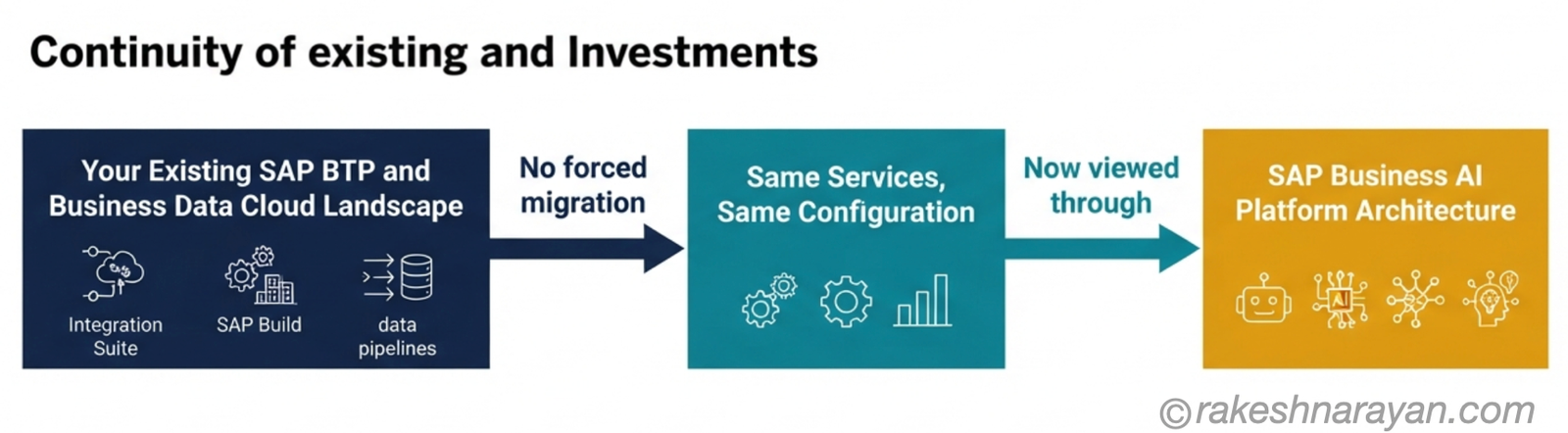
If you’re already running SAP BTP, nothing breaks. Your Integration Suite flows, your SAP Build apps, your Cloud Foundry and Kyma deployments, your CAP services — all of it continues to run exactly as it did before the announcement.
BAIP doesn’t replace BTP. BTP is BAIP’s build layer.
If you’re already running SAP Business Data Cloud, the same logic applies. Your data products, your governed access model, your existing pipelines carry forward unchanged. What’s different is that this data is now explicitly positioned as the context every BAIP agent draws from.
✅ Best Practice
Don’t wait for a migration wave that isn’t coming. Treat BAIP as a new lens for your architecture diagrams and your client conversations, not a new deployment project on your backlog.
The one thing worth tracking is the rollout pace of the governance layer itself. As of mid-2026, SAP had only part of the SAP AI Agent Hub’s planned governance capabilities generally available, with the rest — including agent identity management and session-level observability — following through the second half of the year. That’s a roadmap detail to watch, not a reason to delay anything you’re already doing.
Where Joule and the SAP AI Agent Hub Fit
Two names come up constantly in every BAIP conversation, and they answer completely different questions.
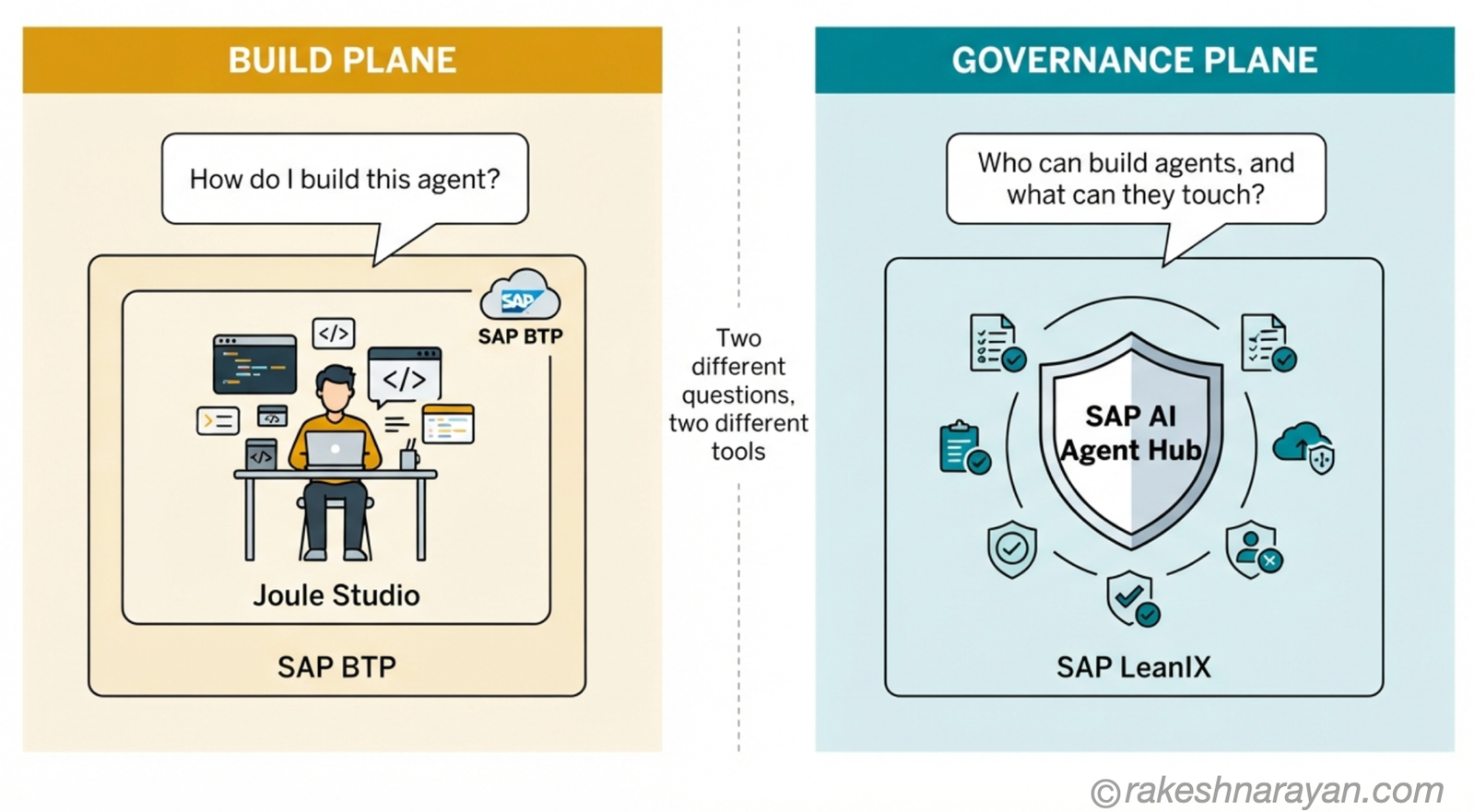
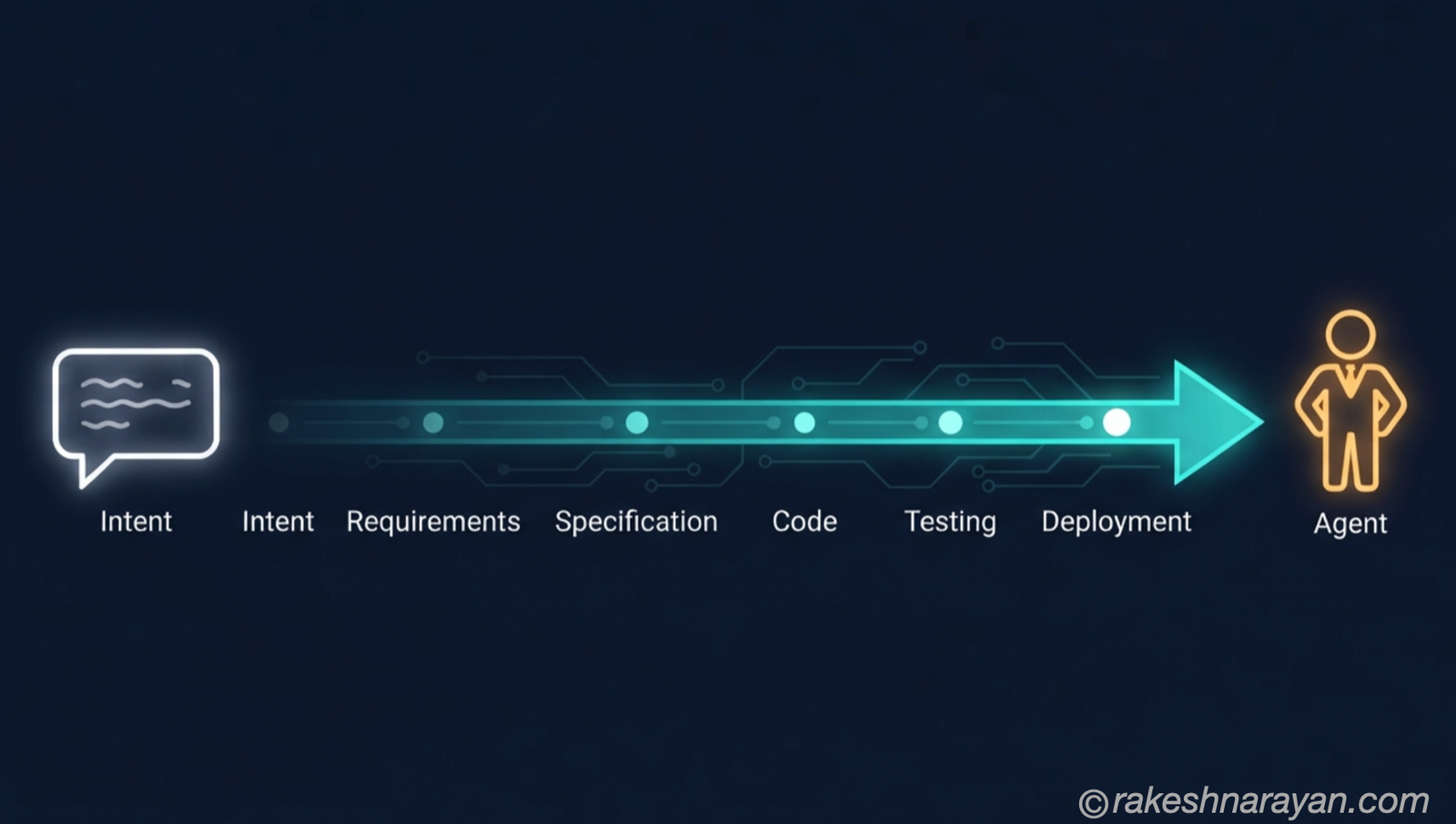
Joule — specifically Joule Studio — is where agents get built. It’s SAP’s shift from clicks to intent: instead of navigating a transaction, you describe what you want and Joule orchestrates the underlying processes, data and applications to get there.
This sits inside the build layer, working directly with SAP BTP. For the mechanics of how Joule itself works, see AI in SAP: How Joule and Business AI Actually Work.
The SAP AI Agent Hub is a different animal entirely. It lives inside SAP LeanIX — SAP’s enterprise architecture tool — and it doesn’t build or run agents at all. It discovers and governs them.
That includes agents built with Joule, but also agents built on Microsoft Copilot Studio, Google Vertex AI, or anywhere else in the landscape. It’s vendor-agnostic by design, and that scope covers large language models and MCP servers as well as agents themselves — the same building blocks covered in AI Agents — What They Are and How They Work.
Separating these two mentally solves most of the remaining confusion. One tool answers ‘how do I build this agent?’
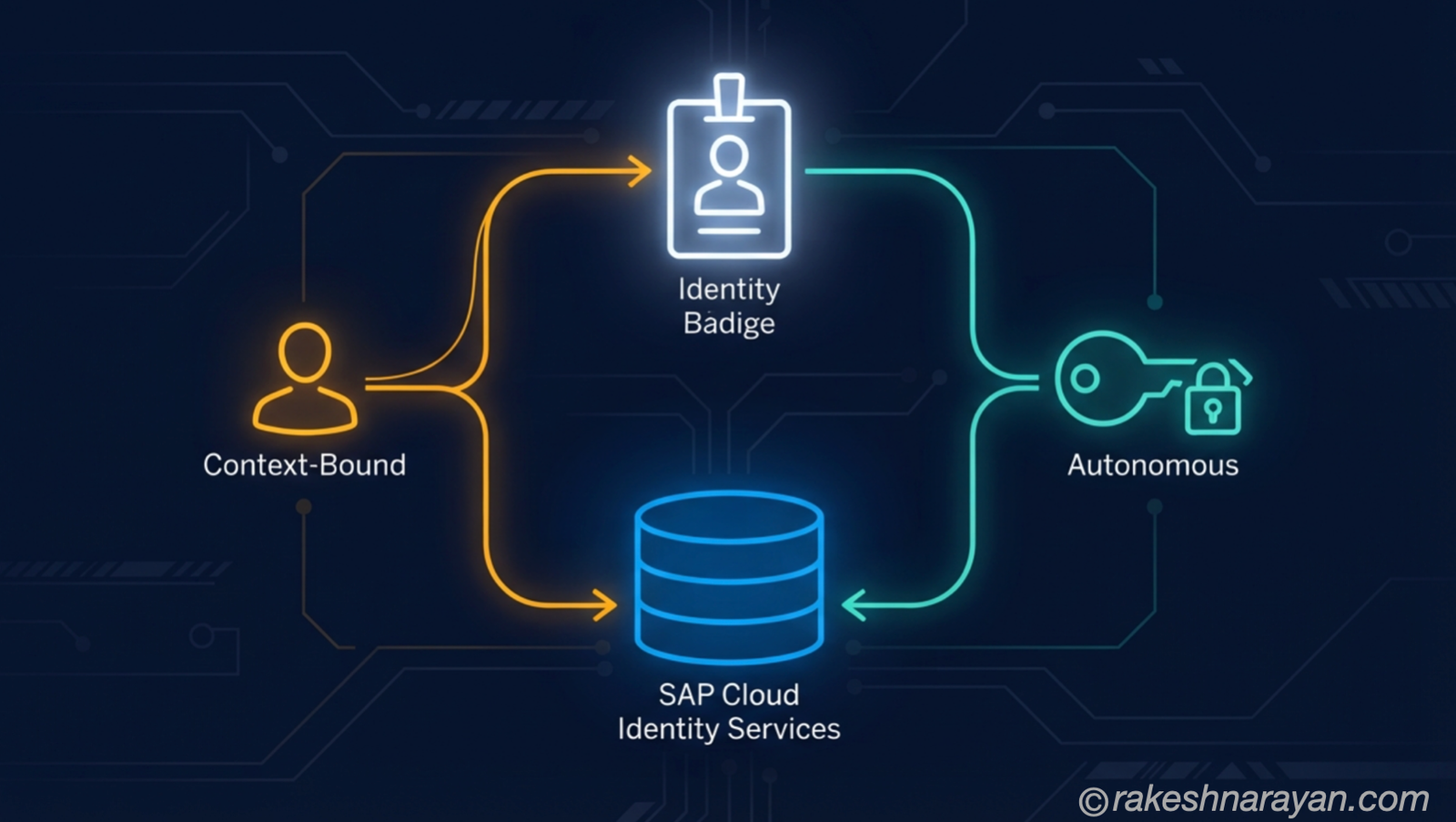
The other answers ‘who is allowed to build agents, what can they touch, and can I prove that during an audit?’ Enterprise AI has needed a real answer to that second question for a while — this is SAP’s.
| Plane | Tool | Question it answers |
|---|---|---|
| Build plane | Joule Studio + SAP BTP | How do I build this agent? |
| Governance plane | SAP AI Agent Hub (via SAP LeanIX) | Who can build agents, what can they touch, and are they trustworthy? |
📝 Note
The AI Agent Hub governing agents built outside SAP entirely — Microsoft, Google, custom-built — is one of the more underrated details in the whole BAIP story. It’s a genuine admission that most enterprise landscapes are not SAP-only, and governance has to cover all of it or it isn’t governance.
At a Glance — SAP Business AI Platform
| Concept | One-line summary |
|---|---|
| SAP Business AI Platform (BAIP) | SAP’s unified foundation for building, running and governing agentic AI, unveiled at SAPPHIRE 2026 |
| SAP BTP | The build and execution layer inside BAIP — integration, extension and application development, unchanged |
| SAP Business Data Cloud | The governed data layer inside BAIP — unifies SAP and non-SAP data for AI context |
| SAP Business Transformation Management (BTM) | SAP’s process and enterprise-architecture portfolio — BAIP borrows SAP LeanIX and SAP Signavio from it |
| AI Foundation layer | Models, knowledge graph, Joule and governance tooling — the newest part of BAIP |
| Joule Studio | Where agents get built — the intent-based build tool inside BAIP’s build plane |
| SAP AI Agent Hub | The governance plane, built inside SAP LeanIX — discovers and governs agents from any vendor |
| Partner Competency Rename | Effective 30 June 2026 — a label change only, automatic transition, no re-certification |
| Autonomous Enterprise | SAP’s stated vision behind BAIP — AI agents acting inside processes, not just answering questions about them |
What to Take Away
BAIP is not really a new platform. It’s SAP admitting, architecturally, that AI can’t be bolted onto a platform after the fact — it has to be the reason the platform is shaped the way it is.
The rename on your competency certificate matters far less than the fact that governance — knowing exactly which agent can touch which data, and proving it during an audit — is now a first-class part of the platform story, not an afterthought handled by whichever third-party tool a project team picked up.
So stop asking whether BAIP is ‘real.’ Start asking whether your BTP and Business Data Cloud landscape is actually ready to be governed the way BAIP assumes it will be. That’s the project hiding behind the rebrand, and it’s the one worth starting now.
🔗 Related Reading
SAP BTP — The Platform Explained — the build layer BAIP is built directly on top of.
SAP Business Data Cloud — The Architecture Behind SAP’s AI Push — the data layer underneath every BAIP agent.
AI in SAP: How Joule and Business AI Actually Work — how Joule itself works, one level below this post.
SAP LeanIX — Enterprise Architecture Management — where the SAP AI Agent Hub actually lives.
Published on rakeshnarayan.com — Articles
URL: https://rakeshnarayan.com/articles/sap-business-ai-platform-baip-btp-bdc-ai-explained/
Did you enjoy this article?
Let me know — it takes one click.
0 Comments
Leave a Comment
Looks like this one held your attention — I'd really appreciate a quick comment below.
Your comment has been submitted and will appear after review.